
Intuitive Machines (LUNR) Stock Analysis 2026: The $1B Inflection Point | Race to Own the Lunar Economy
Introduction: The Shift from Exploration to Infrastructure
The global space economy is undergoing a structural transformation. What was once dominated by government-led exploration is now evolving into a commercially driven ecosystem where infrastructure, not launches, will determine long-term value creation. At the center of this transition is Intuitive Machines (NASDAQ: LUNR), a company that has rapidly repositioned itself from a lunar delivery contractor into a vertically integrated space infrastructure provider.
This evolution is not merely strategic but it is existential. Companies that control infrastructure layers in emerging markets historically capture the highest margins and the most durable competitive advantages.
Following a series of transformative developments, including a $4.82 billion NASA Near Space Network contract, a major satellite manufacturing acquisition, and guidance pointing toward nearly $1 billion in 2026 revenue, LUNR is entering what can only be described as a critical inflection phase.
For investors who are already tracking industry leaders such as SpaceX, Rocket Lab, and even adjacent innovators like Tesla, Intuitive Machines presents a differentiated opportunity. Rather than competing in launch or terrestrial AI, LUNR is targeting ownership of the cislunar economic layer: a market that could define the next era of global infrastructure.
The Macro Thesis: The Birth of the Lunar Economy
The investment case for Intuitive Machines cannot be understood in isolation. It must be contextualized within the broader emergence of the lunar economy, a concept that is increasingly gaining traction among institutional investors and government agencies alike.
The driving force behind this shift is NASA’s Artemis program, which aims to establish a sustained human presence on the Moon. Unlike the Apollo era, Artemis is designed as a public-private partnership model, meaning commercial entities will build and operate large portions of the infrastructure required.
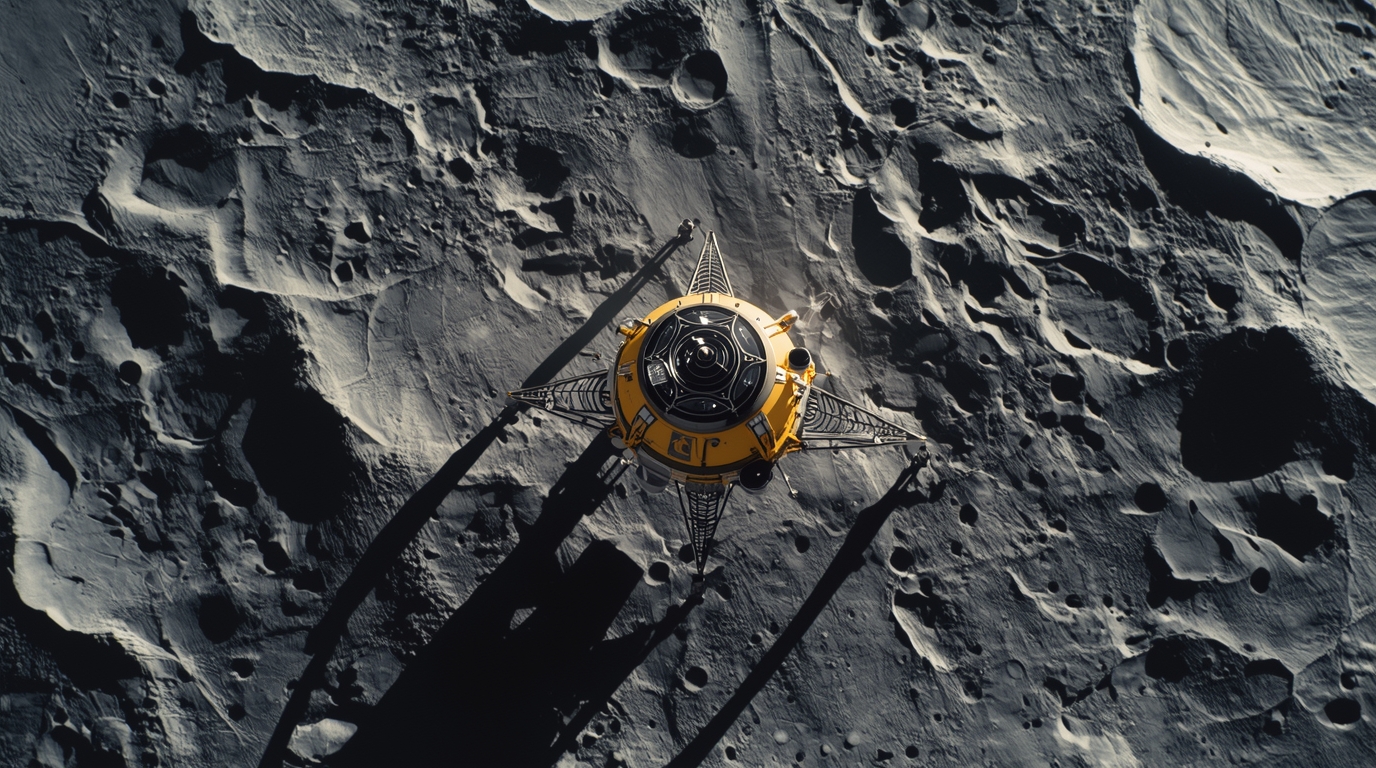
This creates entirely new economic layers:
- Persistent lunar logistics networks
- Data relay and communications infrastructure
- Orbital energy and computing systems
- Defense-oriented space surveillance and tracking
In many ways, this resembles the early buildout of the internet. The companies that laid fiber cables and built cloud infrastructure ultimately captured far more value than those providing end-user applications.
Intuitive Machines is attempting to replicate this playbook in space.
Company Evolution: From Lander Developer to Space Prime Contractor
Founded in 2013, Intuitive Machines initially focused on solving a very specific problem: delivering payloads to the lunar surface under NASA’s Commercial Lunar Payload Services (CLPS) program. While this niche provided early validation, it was never sufficient to support long-term valuation expansion.
The company’s strategic pivot toward a “Build–Connect–Operate” model marks a fundamental transformation:
- Build: Design and manufacture spacecraft, satellites, and lunar landers
- Connect: Establish communication and navigation networks in cislunar space
- Operate: Monetize infrastructure through recurring service-based revenue
This shift effectively transitions LUNR from a mission-based contractor to an infrastructure platform company, which is a far more scalable and defensible model.
The acquisition of satellite manufacturing capabilities and deep-space navigation assets further reinforces this transformation, enabling vertical integration across the entire value chain.
Technology Stack: Building the Backbone of Space Infrastructure
Intuitive Machines’ technological moat is not based on a single breakthrough, but rather on the integration of multiple complex systems into a unified architecture.
At the foundational level is the company’s lunar landing capability. Its Nova-C lander demonstrated that commercial entities can successfully execute soft landings on the Moon, an achievement that historically belonged only to nation-states. While the initial mission encountered landing anomalies, it nonetheless validated the company’s core engineering capabilities.
However, the real strategic value lies beyond the lander itself.
The Near Space Network (NSNS), backed by NASA, represents a multi-layered communications architecture that will facilitate data transmission between Earth, lunar orbit, and the Moon’s surface. This effectively positions Intuitive Machines as a future provider of bandwidth and connectivity in space, a role analogous to terrestrial telecom giants or cloud service providers.
The acquisition of satellite bus technology through Lanteris adds another critical dimension. By owning the underlying hardware platform, LUNR can:
- Reduce dependency on third-party suppliers
- Improve margin control
- Accelerate deployment timelines
Furthermore, integration with deep-space navigation capabilities enables the company to manage increasingly complex orbital systems, particularly as missions expand beyond the Moon toward Mars and other deep-space destinations.
Financial Analysis: From Pre-Revenue Volatility to Hypergrowth Trajectory
The most critical shift in the LUNR investment thesis lies in its financial trajectory. Historically, space companies have struggled with unpredictable revenue streams due to mission-based payments and long development cycles. Intuitive Machines is now beginning to break out of this pattern.
In 2025, the company reported revenue of approximately $210 million. While this represented a modest contraction year-over-year due to launch timing, it masks a more important trend: improving revenue quality and visibility.
The company’s backlog, approaching $1 billion, provides a forward-looking indicator of contracted revenue that is expected to be recognized over the coming years. This backlog is particularly significant because it is largely tied to government contracts, which tend to have lower counterparty risk and higher reliability compared to commercial customers.
More importantly, management has guided for 2026 revenue between $900 million and $1 billion, implying nearly 5x growth within a single year. Such an acceleration is rare and signals a transition from early-stage volatility to scaled execution.
Margin dynamics are also improving. The company reported gross margins approaching 19% in recent quarters, a notable achievement in an industry known for cost overruns and thin margins. As higher-margin service revenue from data transmission and infrastructure operations begins to scale, there is potential for further margin expansion.
From a cash flow perspective, the company remains in an investment phase, with continued capital expenditures required to build out its satellite network. However, improving free cash flow trends suggest that capital efficiency is gradually increasing.
The recent strategic capital injection of approximately $175 million further strengthens the balance sheet, providing the liquidity necessary to execute on its ambitious roadmap.
Competitive Landscape: Infrastructure vs Transportation
To fully appreciate LUNR’s positioning, it is essential to differentiate between transportation-layer companies and infrastructure-layer companies.
Companies like SpaceX and Rocket Lab dominate the launch segment, which focuses on reducing the cost of getting payloads into orbit. While this is a critical function, it is inherently competitive and capital-intensive.
Intuitive Machines, by contrast, is targeting the post-launch value chain, specifically, the infrastructure required to support sustained operations in space.
This distinction is crucial because infrastructure businesses tend to exhibit:
- Higher switching costs
- Recurring revenue streams
- Stronger pricing power over time
If successful, LUNR could evolve into a platform company rather than a project-based contractor, which would justify significantly higher valuation multiples.
Risk Analysis: Understanding the True Downside Profile
Investing in Intuitive Machines requires a clear understanding of its unique risk profile. Unlike traditional technology or industrial companies, space infrastructure investments carry a combination of technical, financial, and geopolitical risks that can be highly asymmetric.
1. Execution and Mission Risk
The most immediate and visible risk is mission execution. Space operations operate in an environment where failure is not incremental, it is binary. A single failed launch, malfunctioning payload deployment, or unsuccessful landing can result in the complete loss of capital associated with that mission.
Beyond the financial impact, such failures can also damage the company’s reputation and erode trust with key customers like NASA and the Department of Defense. While redundancy and engineering rigor can mitigate these risks, they cannot eliminate them.
2. Customer Concentration and Government Dependency
A significant portion of LUNR’s revenue is derived from U.S. government contracts. While this provides stability, it also introduces dependency on federal budgets and political priorities.
Changes in administration, shifts in defense spending, or delays in the Artemis program could materially impact contract flow. Unlike diversified commercial businesses, LUNR does not yet have a broad base of private-sector customers to offset this risk.
3. Integration Risk from Strategic Acquisitions
The acquisition of Lanteris represents a transformational step, but it also introduces complexity. Integrating a large manufacturing operation into a previously more focused organization requires operational discipline and management expertise.
Failure to achieve synergies could result in cost overruns, inefficiencies, and margin compression, outcomes that would undermine the investment thesis.
4. Capital Intensity and Dilution Risk
Building space infrastructure is inherently capital-intensive. Even with improving cash flow, the company may require additional funding to scale its satellite network and operational capabilities.
This raises the possibility of future equity issuances, which could dilute existing shareholders. For investors, this is a critical consideration, particularly in a high-growth but still unprofitable company.
5. Competitive Pressure from Well-Capitalized Players
While LUNR has an early-mover advantage, it operates in an industry where competitors such as Lockheed Martin, FireFly and Blue Origin possess significantly greater financial resources.
If these players decide to aggressively enter the cislunar infrastructure market, they could exert pricing pressure or outspend smaller competitors.
Investment Thesis: Evaluating the Asymmetric Opportunity
The investment case for Intuitive Machines is best understood through a probabilistic framework, where outcomes are driven by execution quality and market adoption.
Bull Case: Infrastructure Dominance
In the most optimistic scenario, LUNR successfully executes its backlog, integrates its acquisitions, and deploys the Near Space Network as planned. This would enable the company to establish a recurring, high-margin revenue stream from data transmission and infrastructure services.
Under this scenario, the market would likely re-rate LUNR from a speculative aerospace company to a strategic infrastructure provider, similar to how cloud companies were revalued during the early stages of the internet boom. The resulting multiple expansion could be substantial.
Base Case: Steady Execution and Gradual Scaling
A more moderate outcome involves consistent execution without major disruptions. Revenue growth would track management guidance, margins would improve gradually, and the company would continue to secure government contracts.
In this scenario, LUNR becomes a reliable, albeit still volatile, growth stock with strong long-term potential.
Bear Case: Execution Failures and Capital Constraints
The downside scenario involves a combination of mission failures, integration challenges, and funding constraints. In such a case, the company could face delays, increased costs, and potential dilution.
Given the binary nature of space missions, this scenario cannot be dismissed and must be factored into any valuation model.
Final Verdict: A High-Risk Gateway to the Next Economic Frontier
Intuitive Machines represents one of the most compelling yet challenging investment opportunities in the public markets today.
On one hand, the company is uniquely positioned at the intersection of multiple high-growth themes:
- The commercialization of space
- The militarization of orbital infrastructure
- The expansion of data networks beyond Earth
On the other hand, it operates in an environment where risks are amplified, timelines are uncertain, and execution must be flawless.
For investors, the key question is not whether the lunar economy will emerge, it almost certainly will. The question is whether Intuitive Machines can establish itself as a core infrastructure provider within that ecosystem.
If it succeeds, the upside could be transformative. If it fails, the downside could be severe.
Bottom Line
Intuitive Machines is not a stock for conservative investors seeking stable returns. It is a high-conviction, high-volatility play on one of the most ambitious technological expansions in human history.
For those willing to accept the risks, LUNR offers something rare:
A front-row seat and potentially a stake in the construction of humanity’s first off-world economy.
Frequently Asked Questions About Intuitive Machines (LUNR)
1. What does Intuitive Machines (LUNR) do?
Intuitive Machines is a space infrastructure company focused on building and operating systems that support lunar and deep-space missions. Its core business includes lunar landers, satellite platforms, data relay networks, and orbital services for government and commercial customers.
2. Why is LUNR stock gaining attention in 2026?
LUNR is gaining significant investor attention due to its projected $900 million to $1 billion revenue guidance for 2026, representing a major inflection point. Additionally, its $4.82 billion NASA contract positions the company as a key player in the emerging lunar economy.
3. How does Intuitive Machines make money?
The company generates revenue through:
- Government contracts (primarily NASA and U.S. Department of Defense)
- Lunar payload delivery missions
- Satellite and infrastructure development
- Future recurring revenue from space-based communication networks
Its long-term strategy focuses on transitioning toward recurring infrastructure-based income rather than one-time mission revenue.
4. What is the Near Space Network (NSNS)?
The Near Space Network is a NASA-backed communications infrastructure project designed to enable data transmission between Earth, lunar orbit, and the Moon’s surface. It is a cornerstone of LUNR’s business model and could evolve into a space-based internet backbone.
5. Is Intuitive Machines profitable?
As of 2025, Intuitive Machines is not yet profitable, reporting a net loss while investing heavily in growth. However, the company is targeting positive Adjusted EBITDA in 2026, signaling a potential transition toward profitability.
6. What are the biggest risks of investing in LUNR stock?
Key risks include:
- Mission failure (binary event risk)
- Heavy reliance on government contracts
- High capital expenditure requirements
- Potential shareholder dilution
- Competition from larger aerospace companies
7. How does LUNR compare to SpaceX and Rocket Lab?
Unlike SpaceX and Rocket Lab, which focus primarily on launch services, Intuitive Machines is building space infrastructure, including communication networks and orbital systems. This positions it for potentially higher-margin recurring revenue.
8. Is LUNR a good long-term investment?
LUNR may be attractive for high-risk, long-term investors seeking exposure to the space economy. Its success depends on execution, government funding stability, and the successful commercialization of lunar infrastructure.
9. What is the long-term potential of the lunar economy?
The lunar economy could become a multi-billion to trillion-dollar market, driven by space exploration, resource utilization, defense systems, and communication infrastructure. Companies like Intuitive Machines aim to build the foundational systems supporting this growth.
10. What should investors watch in 2026?
Key catalysts include:
- Revenue growth toward $1 billion
- Execution of NASA contracts
- Progress of the Near Space Network
- Margin expansion and profitability trends
- New contract wins in defense and commercial sectors
Disclaimer: This article is for educational purposes only and does not constitute investment advice. Investors should conduct their own due diligence before making any financial decisions. We are not responsible for any investment losses incurred based on the information provided in this article.