
Rocket Lab (RKLB) Stock Analysis 2026: The “Space Prime” Era Begins
1. Rocket Lab’s 2026 Strategy
If you still think of Rocket Lab (RKLB) as just “the small rocket company,” you are looking at a 2021 snapshot of a business that has fundamentally transformed by late 2025. While headlines often fixate on the Electron rocket’s launch cadence, the real story emerging as we head into 2026 is Rocket Lab’s successful evolution into a vertically integrated “Space Prime”, a one-stop shop for everything from launch to satellite manufacturing and on-orbit operations.
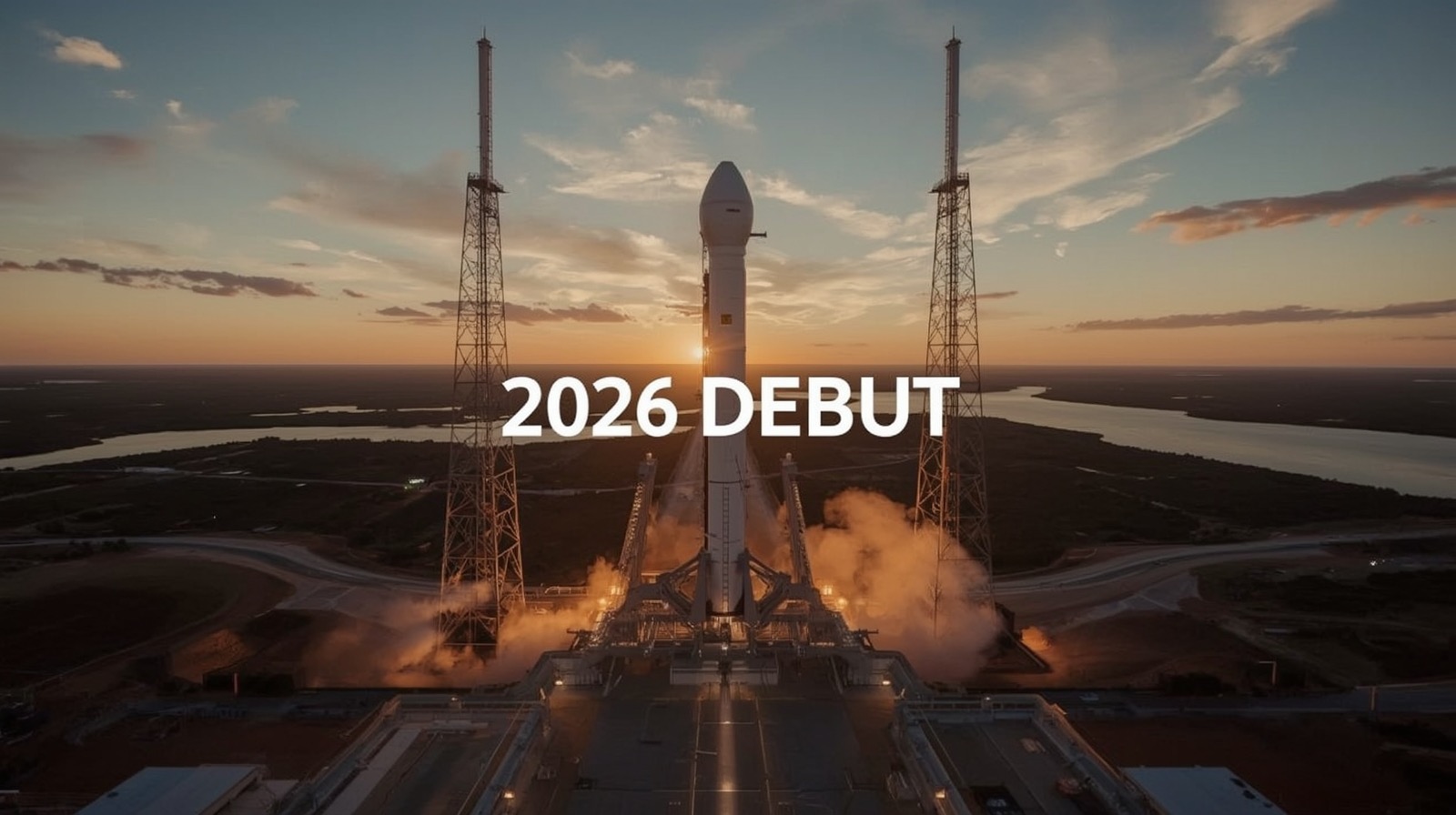
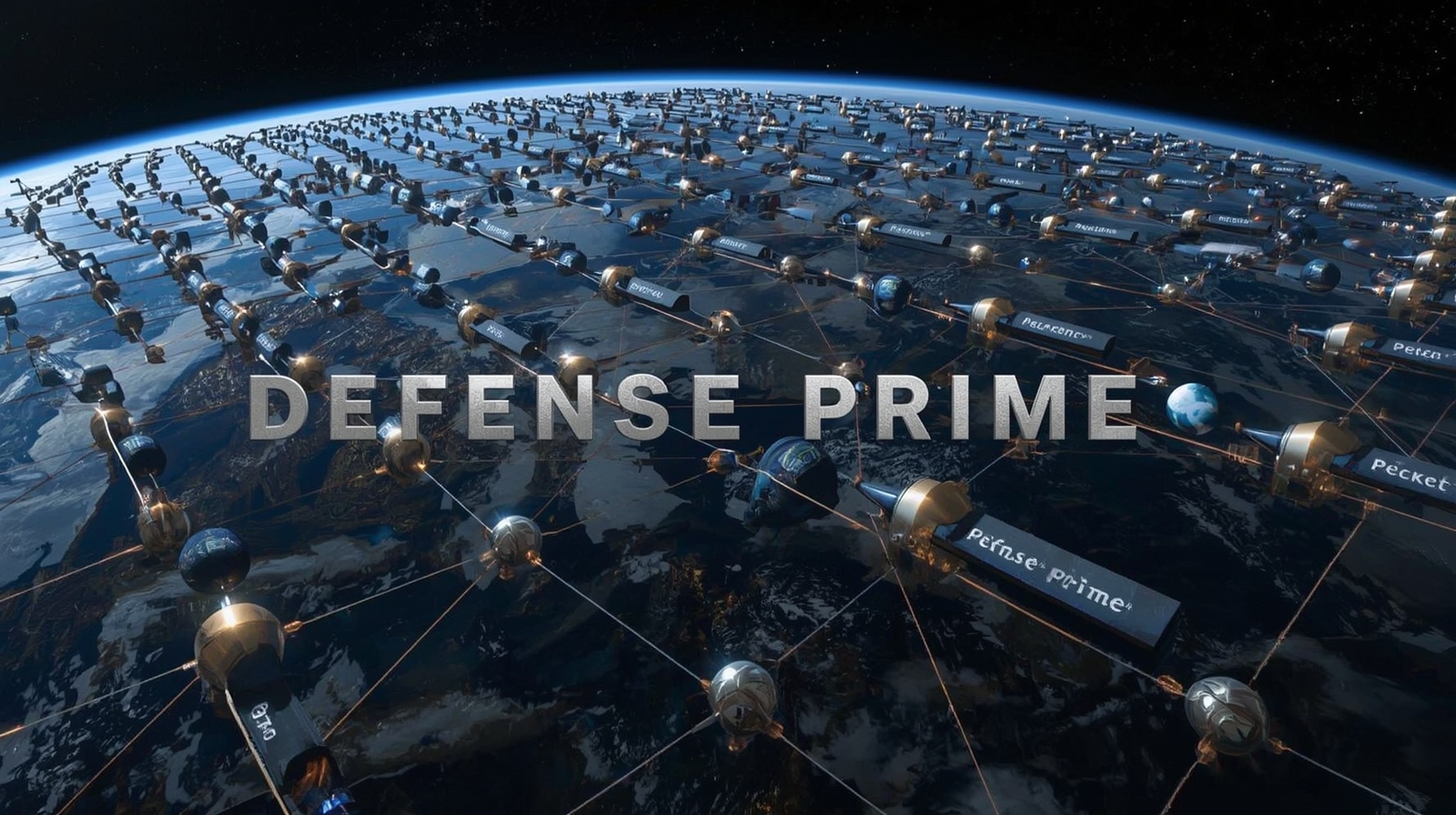
With the recent announcement of a massive $816 million contract from the U.S. Space Development Agency (SDA) in December 2025, Rocket Lab has cemented its status not just as a competitor, but as a critical pillar of U.S. national defense infrastructure. The company is no longer fighting for survival; it is fighting for dominance in a market starved for a reliable alternative to SpaceX.
2026 promises to be the most pivotal year in the company’s history. It marks the expected debut of the medium-lift Neutron rocket, a vehicle designed specifically to break the monopoly on constellation deployment. For investors, the question is no longer “will they survive?” but rather “how big can they get?” as they bridge the gap between a niche launch provider and a multi-billion dollar space infrastructure giant.
2. Company Overview
Founding & Mission Founded in 2006 by Peter Beck in New Zealand, Rocket Lab’s mission was to democratize access to space. Unlike competitors who chased massive rockets immediately, Beck focused on frequency and reliability with the small-lift Electron rocket. Today, the company is headquartered in Long Beach, California, and operates as a true end-to-end space company.
Core Products
- Launch Services: Electron (small-lift) and Neutron (medium-lift, upcoming).
- Space Systems: Satellite manufacturing (Photon bus), components (solar panels, reaction wheels, radios), and software.
Market Position As of late 2025, Rocket Lab is the second most frequent launcher in the U.S., trailing only SpaceX. They closed 2025 with 21 successful Electron launches, achieving a 100% mission success rate for the year.
Industry Context The space economy is shifting from “access” (getting there) to “utility” (what we do there). Rocket Lab’s acquisition strategy, buying up critical component manufacturers like SolAero (solar) and Sinclair Interplanetary (reaction wheels), has positioned them to capture value at every layer of this stack.
3. Technology & Core Innovation
Rocket Lab’s technology stack is defined by extreme vertical integration and pragmatic innovation.
Neutron: The 2026 Catalyst The medium-lift Neutron rocket is the centerpiece of the 2026 thesis. Designed to carry ~13,000 kg to Low Earth Orbit (LEO), it directly targets the mega-constellation market currently dominated by the Falcon 9.
- “Hungry Hippo” Fairing: Unlike traditional rockets that jettison fairings (the nose cone) into the ocean, Neutron’s fairing opens like a mouth to release the payload and stays attached to the first stage. This allows for rapid reusability without the complex logistics of ocean recovery.
- Carbon Composite Structure: Neutron is the world’s largest carbon composite rocket. This material choice makes the vehicle lighter and more durable than stainless steel, crucial for the aggressive reflight margins Beck demands.
- Archimedes Engine: The heart of Neutron is the Archimedes engine, which runs on an oxidizer-rich staged combustion cycle. Crucially, it is designed for reliability over raw performance, described as the “Toyota Corolla” of rocket engines rather than a Ferrari, operating at lower stress levels to ensure rapid turnaround. The engine successfully completed critical hot-fire tests in August 2024, validating the design.
Electron & HASTE The Electron rocket remains the workhorse, but its modified version, HASTE (Hypersonic Accelerator Suborbital Test Electron), has opened a lucrative niche in hypersonic testing for the DoD. This allows Rocket Lab to charge premium pricing for suborbital missions that require precision and confidentiality.
Space Systems Integration Rocket Lab doesn’t just bolt parts together; they manufacture the “guts” of the satellite. By owning the production of reaction wheels, star trackers, and solar panels, they control their own supply chain. This was a decisive factor in winning the $816M SDA contract, as they aren’t reliant on third-party suppliers who might cause delays.
Competitor Comparison: The Launch Market Battleground (2026)
While SpaceX remains the Goliath, Rocket Lab’s Neutron is positioned as the agile “David” – targeting the specific niche of constellation deployment where frequency matters more than raw tonnage.
| Feature | Rocket Lab (Neutron) | SpaceX (Falcon 9) | Relativity Space (Terran R) |
| Status | Debuting Q1 2026 | Operational (Dominant) | In Development (Late 2026) |
| Payload to LEO (Reusable) | ~13,000 kg | ~17,500 kg (Drone Ship) | ~23,500 kg |
| Target Price / Launch | ~$50–55 Million | ~$67 Million (Commercial) | ~$55 Million |
| Cost per kg (Approx) | ~$3,800/kg | ~$3,800/kg | ~$2,300/kg (Paper Target) |
| Reusability Strategy | RTLS + Captive Fairing | Drone Ship + Ocean Fairing | Downrange Landing |
| Turnaround Goal | 24 Hours (“Hungry Hippo”) | <21 Days (Current Record) | Rapid (3D Printed Updates) |
| Key Advantage | Vertical Integration: They build the satellite and the rocket. | Reliability: 300+ successful flights. | Manufacturing: 3D printing allows rapid design iteration. |
| Primary Risk | Execution: Maiden flight delay. | Starship: If Starship works, F9 is obsolete. | Unproven: Zero orbital track record. |
Analyst Note: While Relativity’s Terran R promises higher payload on paper, Rocket Lab holds the decisive advantage of a proven orbital track record (via Electron) and a diversified revenue stream from Space Systems. Relativity is a pure-play launch bet; Rocket Lab is a space infrastructure ecosystem.
4. Business Model & Revenue Engine
Rocket Lab operates a dual-engine business model that is unique among public space companies.
1. Launch Services (The Gateway) Launch is the flashy “billboard” of the company. It brings customers in the door. While Electron generates steady cash flow, its primary strategic value is building relationships and proving reliability. The real revenue scaling in launch will come from Neutron, with a target price point of ~$50 million per launch, significantly undercutting legacy providers while offering high margins due to reusability.
2. Space Systems (The Profit Engine) This segment is the true growth driver, often accounting for more revenue than launch itself.
- Revenue Quality: Contracts here are larger and longer-term. The SDA Tracking Layer contract ($816M) and the Globalstar constellation work are prime examples.
- Recurring Revenue: By building the satellites and operating them (Mission Operations), Rocket Lab is moving toward a “Space-as-a-Service” model where they generate recurring revenue long after the launch is complete.
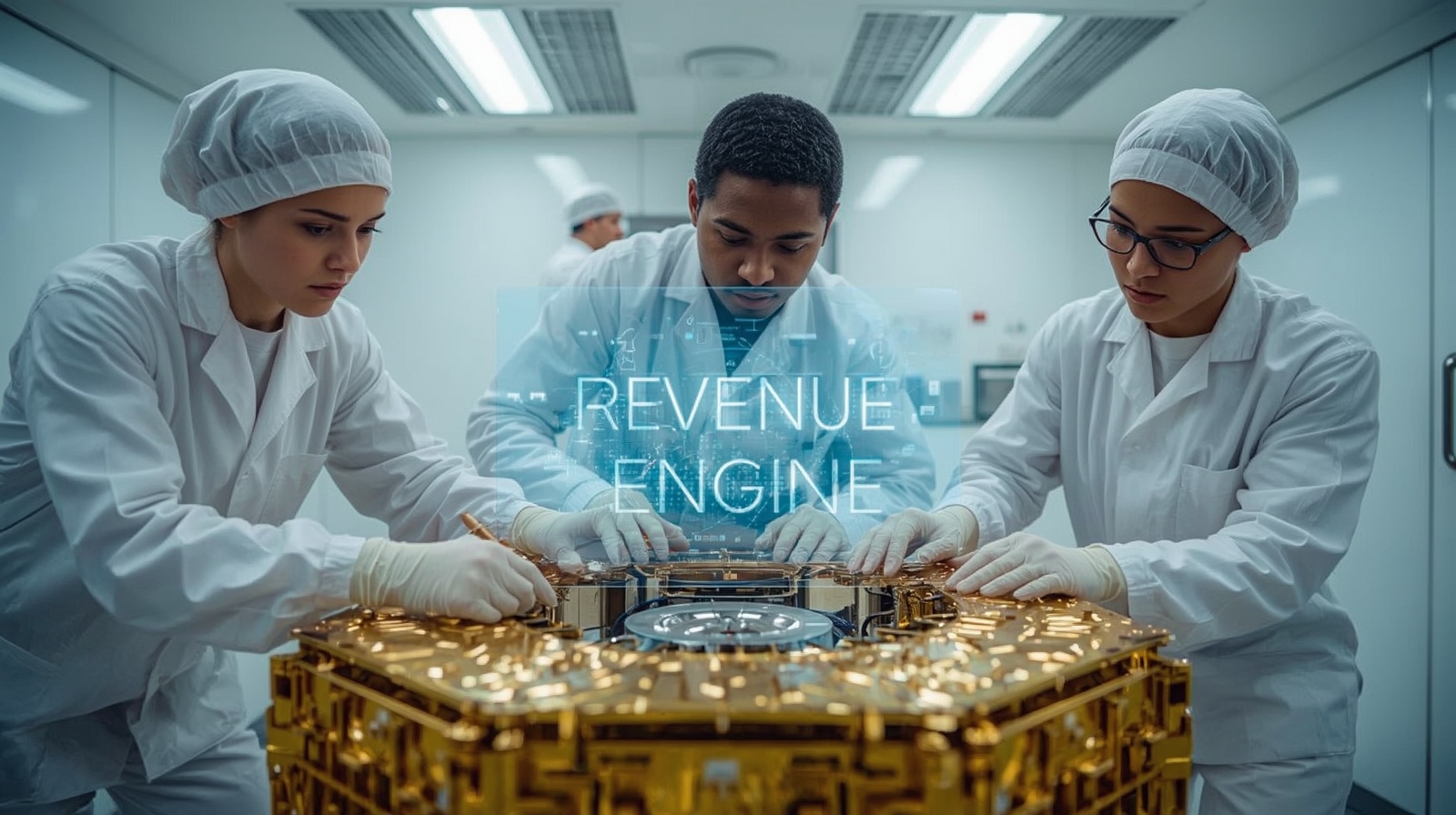
Moat & Defensibility The “End-to-End” moat is real. A customer can walk in with a sensor and ask Rocket Lab to: design the satellite chassis, provide the power and propulsion, write the flight software, launch it on an Electron or Neutron, and operate it in orbit. No other competitor (besides SpaceX) offers this seamless integration.
5. Financial Analysis & Growth Outlook
Note: Based on Q3 2025 Data.
Recent Performance Rocket Lab delivered a blowout Q3 2025, reporting record revenue of $155 million, a massive 48% year-over-year increase.
- Gross Margin Expansion: GAAP gross margins hit a record 37% in Q3 2025, up from negative margins just a few years prior. This proves the unit economics of Electron are solidifying and the Space Systems business is highly profitable.
- Backlog: The backlog has swelled to over $1.1 billion (before the massive Dec 2025 SDA win), providing clear revenue visibility for the next 2-3 years.
Balance Sheet The company ended Q3 2025 with over $1 billion in cash and equivalents, bolstered by a strategic capital raise. This war chest is critical for finishing Neutron development without the immediate threat of further dilution.
Valuation Context With the stock trading near all-time highs (around $70-$74 range in late Dec 2025), the valuation reflects high expectations. The market is pricing RKLB not just as a launch company, but as a critical defense prime.
6. Risk Analysis
- Neutron Execution Risk: The maiden flight of Neutron has slipped to Q1 2026. Any catastrophic failure on the pad or during early flights could severely damage the stock and delay the entry into the lucrative constellation market.
- Valuation Premium: RKLB has run up >170% YTD in 2025. It is priced for perfection. Any stumble in earnings or launch cadence could trigger a sharp pullback.
- SpaceX Starship: If SpaceX successfully operationalizes Starship in 2026 with full reusability, the cost-per-kg to orbit could drop to levels that make Neutron economically pressured, though Neutron’s “taxi” utility for specific orbits offers some protection.
- Insider Selling: Recent heavy insider selling by CEO Peter Beck and others in late 2025 raises questions about valuation, although this is common after massive run-ups.
7. Investment Outlook
The Base Case (2026-2027) Rocket Lab successfully debuts Neutron in 2026. The Space Systems division executes on the $1.3B+ in SDA contracts. Revenue grows 40-50% YoY, and the company approaches GAAP profitability. The stock holds its premium multiple as the clear “Number 2” to SpaceX.
The Bull Case Neutron works perfectly on the first or second try. Rocket Lab announces a massive commercial constellation deal (e.g., Amazon Kuiper) for Neutron. Space Systems margins expand to >40%. The company becomes an acquisition target for a legacy defense prime or remains a compounding independent giant.
The Bear Case Neutron suffers a major failure, grounding the program for 12+ months. SpaceX Starship sucks up all commercial demand. DoD budget cuts delay SDA tranches. The stock could re-rate 50% lower to align with legacy aerospace multiples.
Verdict: Rocket Lab is a high-conviction growth hold. It is the only “safe” way to invest in the space race outside of SpaceX. Volatility will be extreme, but the fundamental trajectory is undeniable.
8. Who Should Invest? (Suitable Investor Profile)
Investing in Rocket Lab is not for everyone; it requires a specific mindset and portfolio strategy. Based on the current market dynamics, RKLB is suitable for:
- The “SpaceX Proxy” Seeker: Since SpaceX remains private, Rocket Lab is currently the only high-quality, publicly traded “pure play” on the launch and space systems market. If you want exposure to the commercial space race but cannot access private equity markets, RKLB is the most viable “shadow stock” to SpaceX.
- The “Volatility Veteran” (High Risk Tolerance): This stock is not for the faint of heart. Investors must be psychologically prepared for massive swings, drawdowns of 50% and rallies of 200% are par for the course in this pre-maturity phase. If a 30% drop in a month causes you to panic sell, this asset does not fit your risk profile.
- The Long-Horizon Visionary (5-10 Years): This is not a “get rich quick” trade; it is a “venture capital” style bet in the public markets. Suitable investors are those looking at 2030-2040, believing that space infrastructure (internet, manufacturing, data centers) will inevitably become a trillion-dollar economy. You are investing in the “railroad” of the 21st century before the trains are fully running.
- The “Picks and Shovels” Strategist: You are not just betting on rockets; you are betting on the infrastructure. This appeals to investors who prefer the “selling shovels in a gold rush” model, Rocket Lab profits whether a client’s satellite mission changes the world or not, because they sold the bus, the solar panels, and the launch ride.
9. Final Taught
Rocket Lab has graduated from the startup phase. By securing the massive SDA contract and pushing margins to 37%, it has proven it can scale profitably. 2026 is the year of the Neutron, the bridge that will take RKLB from a $30B company to potentially a $100B titan over the next decade. For investors, the volatility is the price of admission for owning the most capable public space company in the world.

Disclaimer: This article is for educational purposes only and does not constitute investment advice. Investors should conduct their own due diligence before making any financial decisions. We are not responsible for any investment losses incurred based on the information provided in this article.