
The SpaceX IPO 2026: Why Elon Musk’s Starship Empire Could Redefine the Global Space Economy
$1.7 Trillion SpaceX – Elun Musk’s Last Company
Few companies have reshaped an entire industry as dramatically as SpaceX.
A $1.7 trillion company… that most investors still can’t buy.
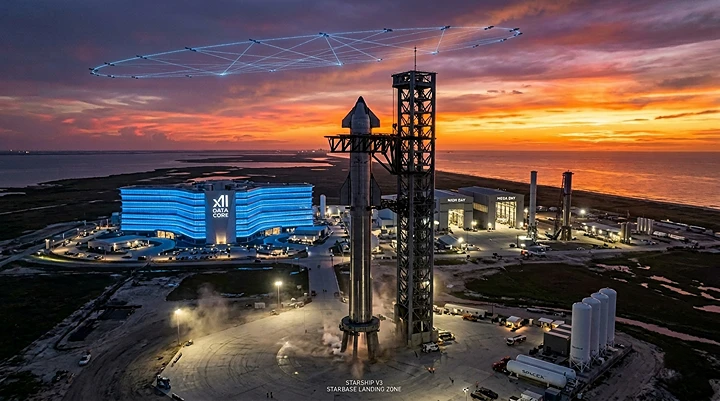
While markets obsess over artificial intelligence stocks and mega-cap tech giants, a different kind of company has been quietly compounding in the background, one that controls how we access space, how data moves across the planet, and potentially where computation happens in the future.
This isn’t just another aerospace story.
It’s the early formation of a new economic layer.
Companies like Amazon built the cloud. Tesla is redefining energy and transportation. But SpaceX is attempting something even more ambitious: a global infrastructure platform connecting space launch, satellite internet, artificial intelligence, social media influences and planetary logistics.
For investors, the question is no longer whether SpaceX is revolutionary.
The question is whether it could become the most important infrastructure company of the 21st century.
With a potential IPO valuation ranging from $1.5 to $1.7 trillion, SpaceX isn’t entering public markets as a typical growth company.
It’s entering as infrastructure.
And if that thesis is correct, the SpaceX IPO may not just be one of the biggest in history, it could mark the beginning of an entirely new category of trillion-dollar companies. And this will for sure makes SpaceX to be the world most valuable company in the world immediately.
The Rise of SpaceX: From Startup to Orbital Superpower
Founded in 2002 by Elon Musk, the company began as an audacious startup trying to reduce the cost of space travel. Two decades later, it has become the dominant launch provider on Earth, responsible for more orbital launches than the rest of the world combined.
When SpaceX launched its first rocket in 2006, the aerospace industry was dominated by government contractors such as:
- Boeing
- Lockheed Martin
- Arianespace
Launches were rare, extremely expensive, and often cost over $100 million per mission.
SpaceX changed this equation through one key innovation:
Reusable rockets.
The Falcon 9 became the first orbital rocket capable of landing and flying again. Over time, SpaceX refined the technology to the point where boosters could be reused multiple times.
The result was a dramatic drop in launch costs.
Today, SpaceX rockets launch more frequently and more cheaply than any competitor, giving the company a massive operational advantage.
By 2025, SpaceX reportedly conducted over 170 orbital launch attempts, representing roughly half of all launches worldwide.
This dominance created the foundation for the next phase of SpaceX’s strategy.
Starlink: The Engine Powering SpaceX’s Revenue
While rockets built SpaceX’s reputation, Starlink built its financial engine.
Starlink is a satellite broadband network consisting of thousands of low-Earth-orbit satellites designed to deliver high-speed internet anywhere on Earth.
The system solves a fundamental global problem: billions of people still lack reliable internet access.
Unlike traditional geostationary satellites, Starlink satellites orbit much closer to Earth. This allows them to provide low-latency broadband comparable to fiber connections.
By 2026, the constellation is expected to include nearly 10,000 satellites.
Subscriber growth has also accelerated rapidly.
Estimated Starlink metrics:
| Metric | 2024 | 2025 | 2026 Estimate |
|---|---|---|---|
| Subscribers | 4.6 million | 9+ million | 15–25 million |
| Revenue | $7.7B | ~$11B | $13B+ |
Starlink now generates the majority of SpaceX’s revenue and operates with exceptionally high margins for a hardware-heavy business.
Enterprise customers, including airlines, ships, and governments, pay significantly higher prices than residential users.
For example:
- Aviation connectivity can exceed $300,000 annually per aircraft
- Maritime terminals can generate tens of thousands per vessel
These high-value segments are turning Starlink into a global telecom platform operating from space.
Starship: The Rocket That Changes the Economics of Space
While Falcon 9 transformed launch economics, Starship could redefine the entire space industry.
Starship is the largest rocket ever built and is designed to be fully reusable.
Key capabilities include:
- Payload capacity of up to 150 tons to low Earth orbit
- Dramatically lower cost per kilogram
- Rapid launch cadence
If SpaceX successfully industrializes Starship, the cost of launching satellites could fall by as much as 70%.
This would unlock entirely new markets:
- massive satellite constellations
- space manufacturing
- lunar missions
- Mars transport
Starship is also critical for NASA’s Artemis lunar program, which aims to return astronauts to the Moon.
The Next Frontier: Orbital AI Infrastructure
One of the most intriguing long-term concepts surrounding SpaceX involves AI infrastructure in orbit.
As artificial intelligence models grow more powerful, they require enormous computing power. This creates huge demand for electricity and cooling capacity on Earth.
Data centers are already facing constraints due to:
- power grid limitations
- water usage
- land availability
In theory, space offers unique advantages:
- constant solar power
- natural vacuum cooling
- unlimited expansion potential
Some analysts believe SpaceX could eventually deploy AI compute platforms in orbit, powered by solar arrays and connected through the Starlink satellite network.
While this concept is still speculative, it highlights the scale of Musk’s vision.
The xAI Integration: SpaceX’s Strategic Leap Into AI Infrastructure
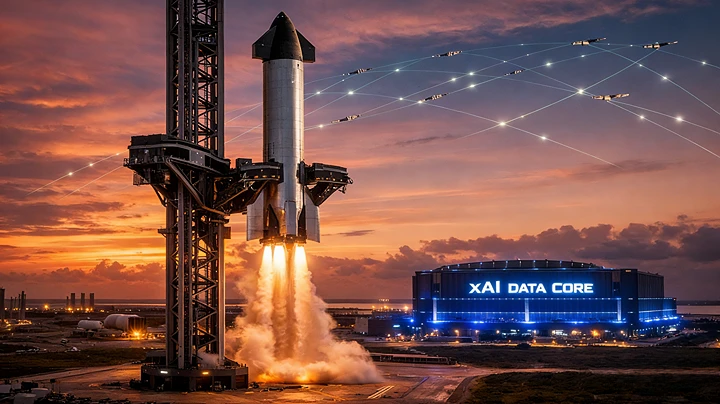
In early 2026, SpaceX took a decisive step toward this vision by formally integrating xAI into its corporate structure through an all-stock transaction, creating a combined entity valued at over $1 trillion. This move signals a strategic shift beyond launch services and satellite connectivity into the realm of artificial intelligence infrastructure.
By aligning AI model development with Starlink’s global data network and the massive payload capacity of Starship, SpaceX is positioning itself to become a vertically integrated platform spanning compute, connectivity, and transportation.
For investors, this integration introduces a powerful new layer to the thesis: SpaceX is no longer just enabling access to space, it is building the foundational stack for a future where data, intelligence, and computation extend beyond Earth.
This strategy is further reinforced by the recently announced TerraFab initiative, a joint semiconductor project with Tesla aimed at producing massive volumes of AI chips, effectively addressing one of the most critical bottlenecks in scaling both terrestrial and orbital intelligence systems.
The Mega Thesis: AI, Energy, Compute and Infrastructure Convergence
This integration reveals a broader and more powerful investment framework: SpaceX is evolving into a multi-layer platform spanning artificial intelligence, energy, infrastructure, and now compute.
At the intelligence layer, xAI provides the models and data capabilities required to power next-generation applications. At the infrastructure layer, Starlink and Starship form the physical backbone for global connectivity and mass deployment, enabling data and hardware to move at planetary scale.
At the energy layer, space-based solar generation and the natural thermal dynamics of orbit offer a long-term pathway to scale compute beyond the constraints of terrestrial power grids. This is increasingly critical as artificial intelligence systems demand exponentially more energy to operate.
Crucially, this stack is now anchored by TerraFab, a semiconductor initiative designed to produce large-scale AI chips, effectively introducing a fourth layer: compute manufacturing. By moving into chip production, SpaceX is not only consuming compute, it is beginning to control its supply, addressing one of the most significant bottlenecks in the global AI race.
When viewed through this lens, SpaceX begins to resemble not a traditional aerospace company, but a vertically integrated system similar in ambition to Amazon (AWS + logistics) or Tesla (energy + transportation), but extended beyond Earth.
This convergence of intelligence, energy, infrastructure, and compute is what underpins the growing narrative that SpaceX could become one of the most important infrastructure companies of the 21st century.
The SpaceX Full Stack: From Launch to Compute
Government Contracts and the Starshield Program
Another major pillar of SpaceX’s business is government and defense contracts.
Through a specialized division known as Starshield, SpaceX provides secure satellite services to military and intelligence agencies.
In recent years the company has secured several large government contracts, including multi-billion-dollar launch agreements with the U.S. Department of Defense.
These contracts provide:
- predictable revenue
- strategic national importance
- political protection
In effect, SpaceX has become a critical component of U.S. national security infrastructure.
The Competitive Landscape: Emerging Challengers vs. SpaceX’s Structural Advantage
Despite its dominance, SpaceX does face a growing field of competitors across different segments of the space economy.
In satellite internet, the most notable challenger is Amazon’s Project Kuiper, which plans to deploy more than 3,000 satellites to compete directly with Starlink while leveraging deep integration with AWS, the world’s leading cloud platform.
In parallel, Blue Origin, founded by Jeff Bezos, is advancing its position in heavy-lift launch and lunar infrastructure, particularly through NASA partnerships and long-term government contracts.
At the same time, a new generation of space companies is gaining traction in public markets. Rocket Lab (NASDAQ: RKLB) has established itself as a leader in the small satellite launch segment and is expanding into medium-lift capability with its upcoming Neutron rocket.
Similarly, Firefly Aerospace is positioning itself at the intersection of commercial launch and defense, with increasing involvement in NASA lunar missions and national security programs.
However, while these competitors highlight the growing momentum behind the space economy, they operate at fundamentally different scales and strategic scopes. Unlike SpaceX’s vertically integrated model, spanning reusable launch systems, global satellite internet, and increasingly artificial intelligence infrastructure, most emerging players remain focused on specific segments of the value chain.
This distinction is critical. SpaceX is not simply competing within the aerospace sector; it is building a multi-layer platform that combines infrastructure, connectivity, and compute. As a result, the company’s rapid launch cadence, cost leadership, and vertical integration create a structural advantage that remains extremely difficult for competitors to replicate.
SpaceX’s Competitive Moat
SpaceX’s dominance comes from several key advantages.
Vertical Integration
Unlike traditional aerospace companies, SpaceX manufactures most of its components internally.
This includes:
- rocket engines
- avionics
- satellite hardware
- user terminals
Vertical integration allows the company to control costs and innovate rapidly.
Launch Cadence
SpaceX launches rockets far more frequently than competitors. This creates operational experience that is difficult for rivals to replicate.
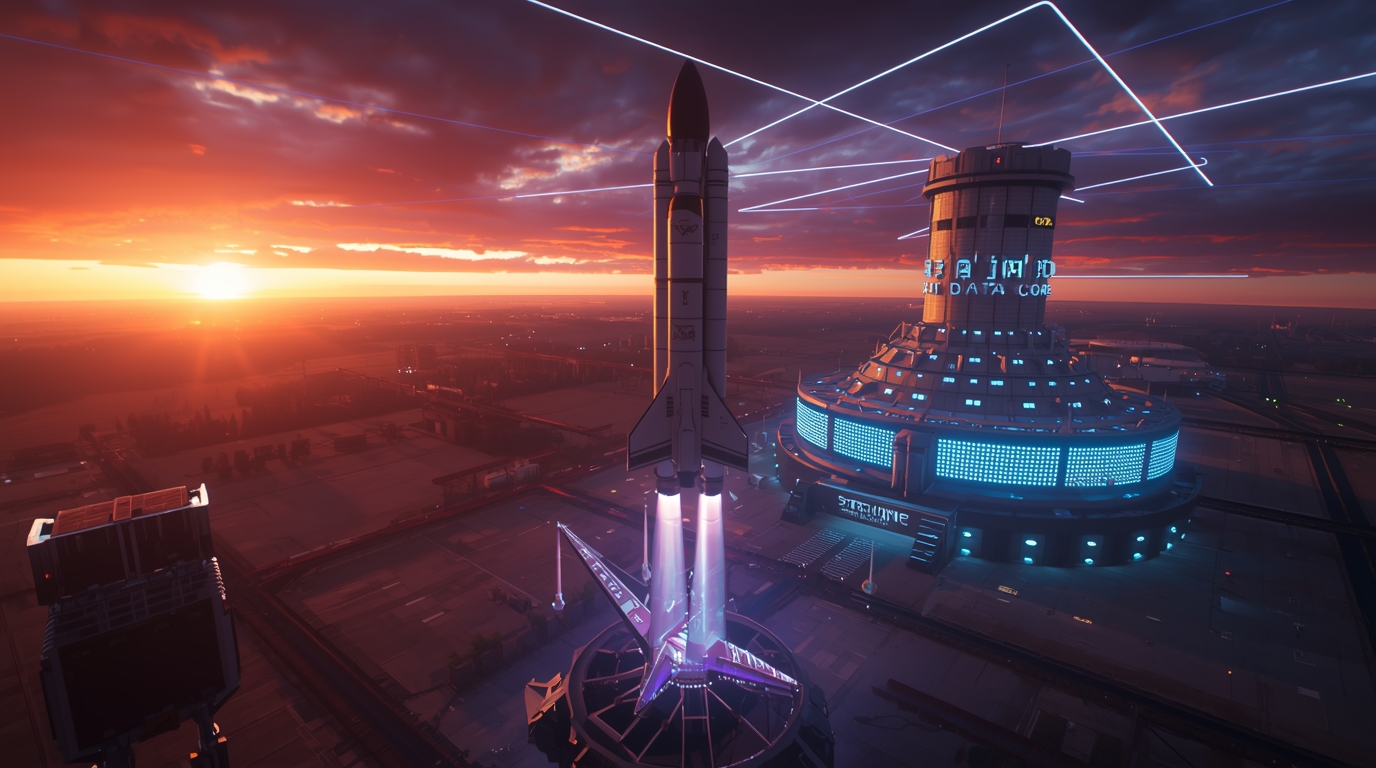
Cost Leadership
Because rockets are reusable, SpaceX’s launch costs are dramatically lower than competitors using expendable rockets.
Risks Investors Should Consider
Despite its enormous potential, investing in SpaceX would also carry significant risks.
Technical Risk
Rocket development is inherently dangerous. A major failure could delay programs and impact investor confidence.
Regulatory Risk
Mega-constellations raise concerns about orbital debris and space traffic management. Governments may impose stricter regulations.
Elon Musk Key-Person Risk
Much of SpaceX’s vision and strategy revolves around Elon Musk himself. Leadership changes could impact investor perception.
The Valuation Question
If SpaceX eventually goes public at a valuation near $1.5–$1.7 trillion, investors will inevitably debate whether the price is justified.
To support such a valuation, SpaceX must be viewed not just as a launch provider but as a global infrastructure platform.
A rough valuation framework might look like this:
| Segment | Potential Value |
|---|---|
| Starlink | $800B – $1T |
| Launch Services | $200B – $350B |
| AI / Future Infrastructure | $200B+ |
| Exploration & Lunar Logistics | speculative upside |
This type of sum-of-the-parts valuation suggests the trillion-dollar narrative is at least plausible if the company continues executing successfully.
Catalysts: The 2026-2027 Roadmap to $2 Trillion
Investors should monitor several specific milestones that will validate or invalidate the $1.75 trillion thesis:
- Confidential IPO Filing (March 2026): The first definitive step toward the public markets, allowing for regulatory feedback on the company’s complex financials.
- Starship Flight 12 (April 2026): The premier test for the V3 vehicle, validating the increased thrust and airframe stability required for bulk Starlink deployments.
- The “Fast Entry” Nasdaq-100 Inclusion (June/July 2026): If the IPO is successful, SpaceX could be added to the index within 30 days, forcing massive institutional buying.
- Orbital Propellant Transfer (Mid-2026): Proving that Starship can be refueled in LEO, a “hard milestone” that unlocks the Moon and Mars.
- Starlink V3 Production (Late 2026): The shift to the 1 Tbps laser-mesh hardware, providing the backbone for the space-based AI data centers.
SpaceX Long Term Investment Thesis: A Full-Stack Infrastructure Monopoly in the Making
The investment case for SpaceX is no longer defined solely by its leadership in launch technology or its dominance in satellite internet. Instead, it rests on the emergence of a vertically integrated, multi-layer platform that spans infrastructure, intelligence, energy, and compute.
1. Infrastructure Dominance (Starship + Starlink)
SpaceX controls the physical backbone of the space economy. With industry-leading launch cadence and the rapidly expanding Starlink network, the company has established a near-monopolistic position in orbital access and global connectivity.
2. Intelligence Layer (xAI)
Through the integration of xAI, SpaceX gains direct exposure to the exponential growth of artificial intelligence. This positions the company not just as a data transporter, but as a processor and creator of intelligence itself.
3. Energy as the Scaling Unlock
As AI demand accelerates, energy becomes the primary constraint. Space-based solar generation and orbital thermal dynamics offer a long-term pathway to scale compute without the limitations of Earth-based infrastructure.
4. The Compute Layer (TerraFab)
The addition of TerraFab introduces a critical strategic advantage: control over compute supply. By moving into semiconductor manufacturing, SpaceX reduces its dependence on third-party chipmakers and positions itself to meet the massive demand for AI processing power at scale.
5. The Flywheel Effect
These layers are not independent, they reinforce each other:
- Starship reduces launch costs
- → enabling Starlink expansion
- → generating recurring cash flow
- → funding AI and compute infrastructure
- → increasing demand for global connectivity
This creates a self-reinforcing flywheel that compounds over time.
Final Perspective
Taken together, SpaceX is evolving into something far larger than an aerospace company. It is becoming a full-stack infrastructure platform for the AI-driven economy, one that spans from Earth to orbit and potentially beyond.
If this thesis plays out, SpaceX may not simply participate in the next technological wave.
It may define it.
Final Thoughts before SpaceX IPO in 2026
The potential SpaceX IPO represents more than a financial event.
It may mark the moment when the global space industry transitions from a government-dominated sector into a major commercial technology platform.
With reusable rockets, a rapidly expanding satellite network, powerful xAI and computer power integration and an ambitious long-term vision for humanity beyond Earth, SpaceX has already changed the trajectory of aerospace innovation.
If the company eventually becomes publicly traded, investors may gain access to one of the most ambitious technological enterprises ever created.
Whether SpaceX ultimately reaches a multi-trillion-dollar valuation remains uncertain.
But one thing is already clear.
The future of space and perhaps the future of the global technology stack, will be shaped by the last company Elon Musk built.
Disclaimer: This article is for educational purposes only and does not constitute investment advice. Investors should conduct their own due diligence before making any financial decisions. We are not responsible for any investment losses incurred based on the information provided in this article.