
Coherent (COHR) Stock Analysis 2026: The AI Photonics Giant Powering NVIDIA’s Optical FutureIs
Coherent DeepDive – NVIDIA Partnership, 1.6T Optics, AI Datacenters & Massive Growth Potential
Artificial intelligence is rapidly evolving into one of the largest infrastructure buildouts in modern technology history, casting a massive spotlight on Coherent (COHR). Yet while most investors remain focused on GPUs, AI models, and semiconductor compute performance, a quieter battle is taking place deeper within the physical architecture of the datacenter itself.
The problem is no longer simply about generating more compute power. The real challenge is moving enormous amounts of data between GPUs fast enough to keep next-generation AI systems operating efficiently.
That challenge is becoming increasingly severe.
As hyperscale AI clusters expand toward hundreds of thousands and eventually millions of interconnected accelerators, traditional copper-based networking systems are approaching physical limitations in bandwidth, latency, thermal efficiency, and power consumption. The AI industry is therefore entering a new phase where optical networking and photonics infrastructure may become just as important as the GPUs themselves.
This is exactly where Coherent Corp. enters the picture.
Coherent has quietly transformed itself from a legacy industrial laser and materials company into one of the most strategically important suppliers within the AI infrastructure ecosystem. Through advanced photonics technologies, optical transceivers, co-packaged optics, thermal management systems, and high-speed optical networking solutions, Coherent is positioning itself at the center of the next-generation AI datacenter architecture.
The company’s growing strategic relationship with NVIDIA has further amplified investor attention. NVIDIA’s multibillion-dollar commitment to Coherent signaled something extremely important to the broader market: the future scaling of AI infrastructure may depend heavily on advanced optical networking technologies.
For investors searching for the next layer of the AI infrastructure opportunity beyond GPUs themselves, Coherent may represent one of the most compelling long-term photonics and optical networking plays in the market today.
Why Optical Networking Is Becoming Critical for AI
The explosive growth of artificial intelligence is fundamentally reshaping datacenter architecture.
Training large-scale AI models requires enormous computational density. Modern AI systems now depend on thousands of GPUs working simultaneously across highly interconnected clusters. However, scaling these systems introduces a major engineering problem: data movement.
GPUs are becoming so powerful that the physical networking layer connecting them is increasingly turning into the primary bottleneck. Traditional copper interconnects struggle to handle the bandwidth demands required by modern AI workloads. As networking speeds climb toward 800G, 1.6T, and eventually beyond, copper-based systems consume substantially more power while generating significantly more heat.
This creates multiple problems simultaneously:
- Rising energy costs
- Higher thermal loads
- Increased latency
- Signal degradation
- Distance limitations
Optical networking solves many of these challenges by replacing electrical signals with light transmitted through optical fiber.
Instead of electrons moving through copper, optical systems use lasers and photonic technologies to transmit data at dramatically higher speeds with lower power consumption and reduced latency. This transition is becoming increasingly necessary as AI datacenters continue scaling aggressively.
The implications are enormous.
The companies supplying the optical infrastructure layer could become some of the most strategically important players in the entire AI ecosystem. While GPUs receive most of the public attention, the physical infrastructure required to connect those GPUs efficiently may ultimately determine how far and how fast artificial intelligence can scale.
That reality is one of the core reasons why Coherent’s investment thesis has strengthened so dramatically over the past two years.
Core Business Analysis: What Coherent (COHR) Actually Does
Coherent operates within one of the most technically sophisticated areas of the semiconductor and networking ecosystem: photonics.
At its core, the company develops technologies that enable extremely high-speed optical communication systems. These technologies include optical transceivers, lasers, semiconductor materials, photonic integrated circuits, thermal management systems, and advanced networking components designed for AI infrastructure and hyperscale datacenters.
In simple terms, Coherent helps AI systems communicate using light instead of electricity.
This capability is becoming increasingly critical as AI infrastructure evolves toward larger and more power-intensive computing clusters.
Today, Coherent’s products are used across several major industries including:
- AI datacenters
- Cloud computing infrastructure
- Telecommunications
- Optical networking
- Industrial lasers
- Semiconductor manufacturing
- High-performance computing
However, the company’s fastest-growing business is clearly tied to AI networking infrastructure.
This shift is important because many investors still partially associate Coherent with its legacy industrial laser operations. In reality, the company is increasingly transforming into a premium AI infrastructure supplier focused on some of the most critical bottlenecks in accelerated computing.
That transformation may still be underappreciated by the broader market.
Corporate Strategy: The Evolution From II-VI to Coherent (COHR)
Understanding Coherent’s history is important because the company’s current competitive advantages were built over decades.
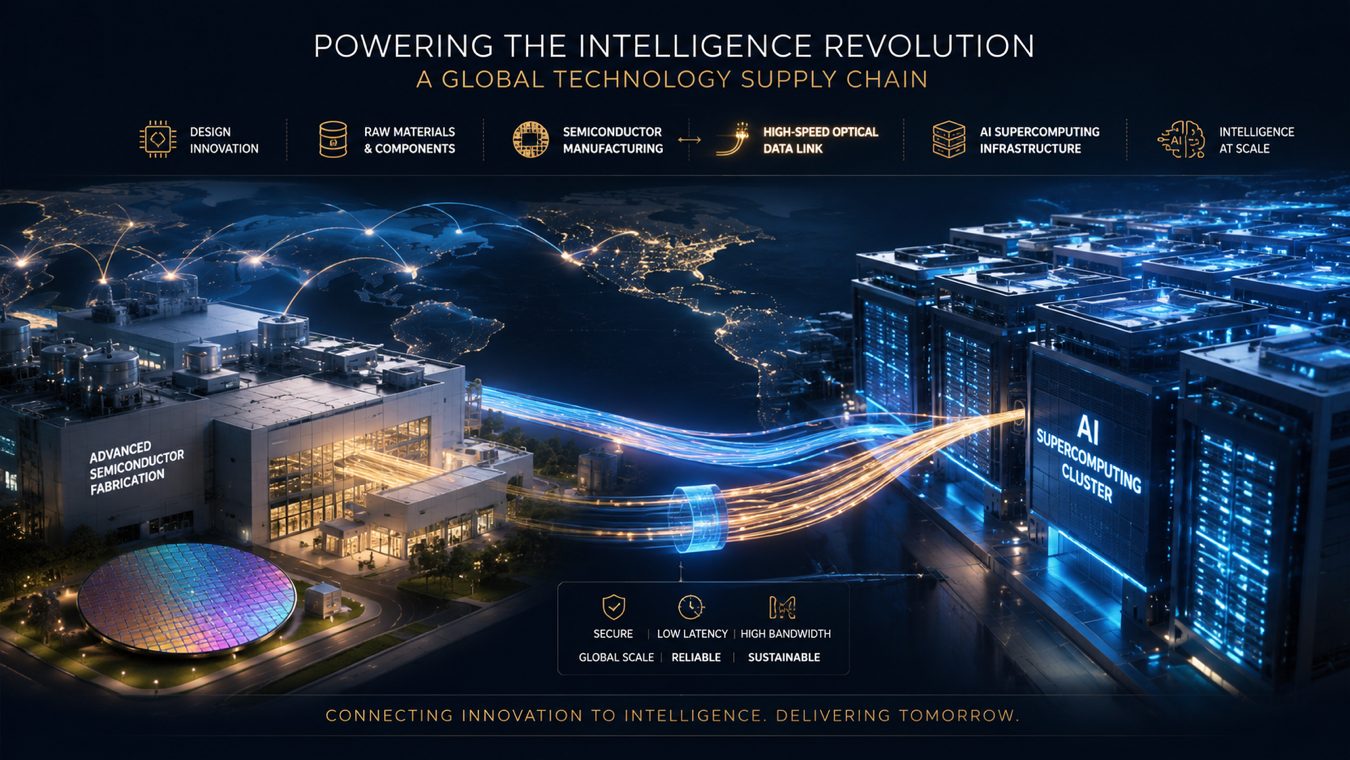
The business originally began as II-VI Incorporated in 1971, specializing in advanced materials and optical technologies. Over time, management pursued an aggressive acquisition strategy that gradually expanded the company’s expertise across the entire photonics value chain.
Some of the company’s most important acquisitions included:
- Finisar
- EpiWorks
- Anadigics
- Coherent Inc.
The acquisition of Finisar in particular significantly strengthened the company’s position in optical communications and datacenter networking technologies.
Then came the transformational merger with Coherent Inc. in 2022.
That transaction fundamentally reshaped the company into one of the largest photonics and laser technology providers globally. More importantly, it expanded Coherent’s capabilities across lasers, semiconductor materials, optical networking, and advanced photonics manufacturing.
Under CEO Jim Anderson, the company has increasingly streamlined operations to prioritize high-growth AI infrastructure opportunities. Non-core business segments have gradually been reduced while resources are increasingly directed toward datacenter communications, photonics, optical transceivers, and AI networking technologies.
This strategic repositioning is now becoming visible in both revenue growth and margin expansion.
The AI Infrastructure Opportunity Could Be Massive
The broader AI infrastructure market is still in its early stages.
Most investors currently focus heavily on GPU manufacturers, AI software platforms, and hyperscale cloud providers. However, AI infrastructure is ultimately a full-stack ecosystem that requires:
- Compute
- Memory
- Networking
- Power delivery
- Cooling
- Optical interconnects
- Semiconductor packaging
- Advanced materials
Coherent participates in several of these layers simultaneously.
This is what makes the company particularly interesting.
Unlike many semiconductor companies that focus on a narrow component category, Coherent operates across multiple critical infrastructure bottlenecks within the AI datacenter ecosystem.
The company’s exposure to:
- Optical networking
- Co-packaged optics
- High-speed transceivers
- External laser sources
- Thermal management
- Silicon Carbide technologies
creates a highly diversified AI infrastructure opportunity.
As AI clusters scale larger, the importance of efficient optical communication becomes increasingly difficult to overstate. Some analysts now believe that future AI datacenters may eventually contain more investment dollars in networking infrastructure than in compute hardware itself.
If that thesis proves correct, companies like Coherent could become increasingly central to the future of accelerated computing.
Coherent’s Core Technology Advantage
One of Coherent’s biggest competitive strengths comes from its deep vertical integration.
Unlike many competitors that rely heavily on outsourced suppliers, Coherent controls much of its manufacturing pipeline internally. This includes semiconductor materials, wafer fabrication, laser technologies, photonic components, and final optical module assembly.
This level of integration provides several advantages.
First, it improves supply chain control during periods of industry shortages. Second, it allows the company to capture margins across multiple layers of production. Third, it accelerates product development by allowing tighter integration between materials science and final optical systems.
Most importantly, vertical integration creates a stronger competitive moat.
The AI optical networking industry is becoming increasingly complex. As networking speeds rise toward 1.6T and beyond, manufacturing precision becomes critically important. Companies that control their own photonics stack may therefore gain substantial advantages in both product quality and scalability.
This is one reason why Coherent has attracted growing attention from hyperscalers and AI infrastructure companies.
Why 6-Inch Indium Phosphide Wafers Matter
One of Coherent’s most important technological advantages involves Indium Phosphide, commonly called InP.
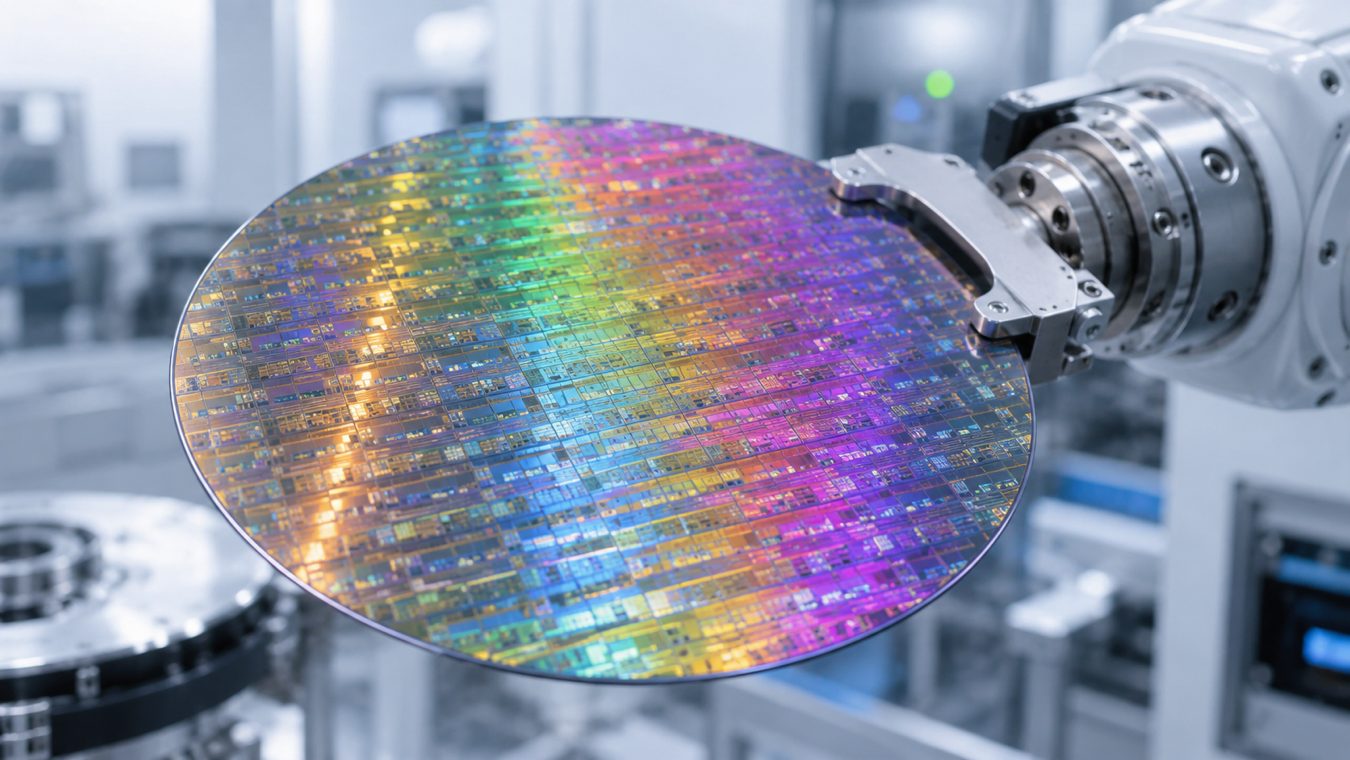
Indium Phosphide is a compound semiconductor material highly optimized for optical communications because it efficiently emits light at telecom wavelengths. These properties make it extremely valuable for:
- Optical transceivers
- AI networking systems
- Laser technologies
- Co-packaged optics
- High-speed optical communication
Historically, the industry relied on smaller 3-inch or 4-inch InP wafers.
Coherent, however, has pioneered large-scale 6-inch Indium Phosphide manufacturing.
The economics here are extremely important.
The surface area of a wafer scales according to:
A=π(2d)2
Doubling wafer diameter dramatically increases usable manufacturing area, allowing significantly more chips to be produced per wafer. This improves manufacturing efficiency while lowering production costs.
Coherent’s 6-inch InP manufacturing capability may therefore provide:
- Better economies of scale
- Lower per-unit costs
- Higher gross margins
- Greater manufacturing efficiency
- Stronger competitive positioning
This manufacturing lead appears especially important because many competitors are still ramping their own next-generation production lines.
In an industry where supply constraints are becoming increasingly important, manufacturing scale itself may become one of the most valuable competitive advantages.
NVIDIA Partnership and Strategic Importance
The biggest turning point in Coherent’s investment narrative came when NVIDIA announced its strategic partnership with the company.
NVIDIA’s multibillion-dollar investment and long-term supply agreement represented far more than a simple financial transaction. It was effectively an industry-wide validation of the importance of optical networking within future AI infrastructure.
The agreement provides Coherent with:
- Long-term revenue visibility
- Capacity expansion funding
- Strategic ecosystem integration
- Deepened hyperscaler relationships
- Greater credibility within AI infrastructure markets
More importantly, NVIDIA’s involvement suggests that optical communication technologies are becoming increasingly central to future GPU architectures and AI cluster scaling.
This matters tremendously for investors.
When NVIDIA allocates billions of dollars toward securing future optical networking capacity, it signals that networking bottlenecks may become one of the defining constraints of the next AI expansion cycle.
Coherent is now positioned directly within that bottleneck.
Co-Packaged Optics Could Reshape AI Networking
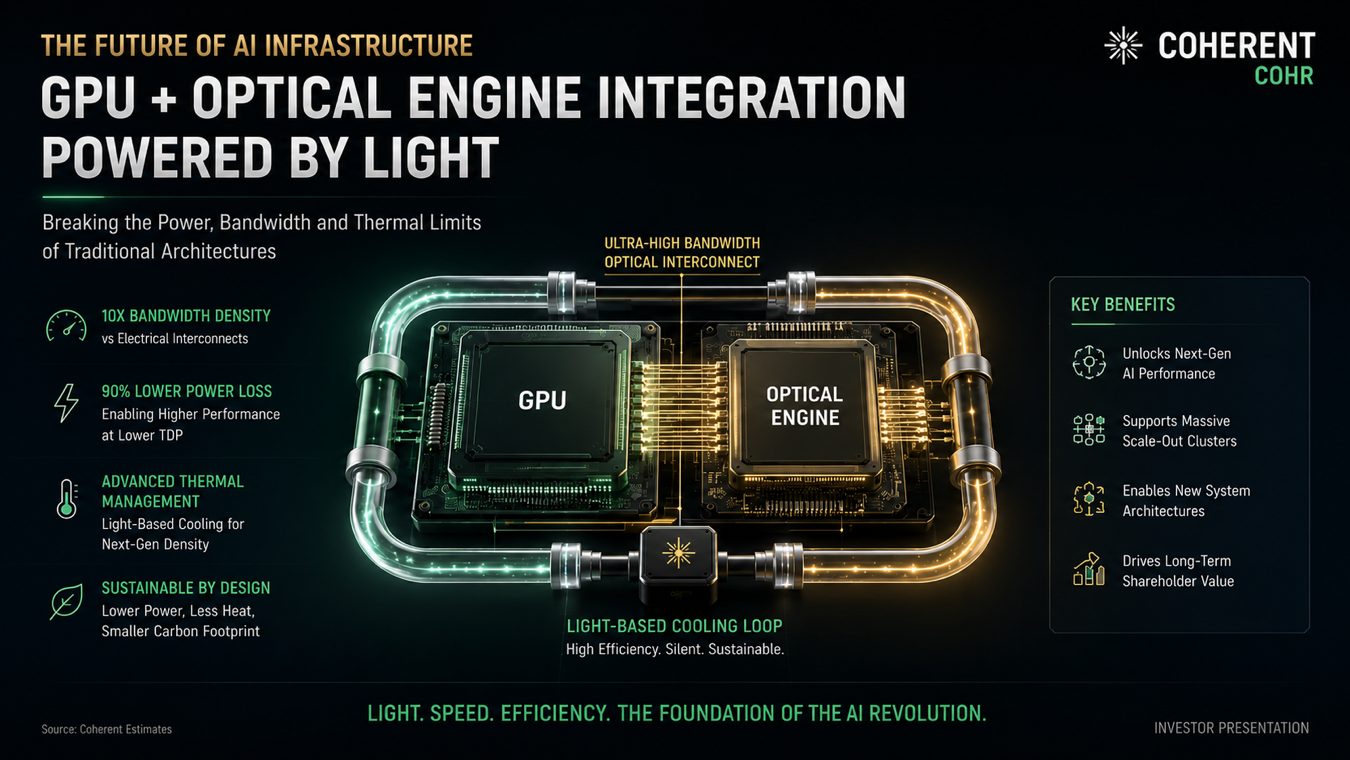
One of the most important long-term technologies in AI infrastructure is Co-Packaged Optics, or CPO.
Traditional networking architectures use pluggable optical transceivers connected externally to switches and processors. However, as bandwidth demands continue increasing, this architecture becomes increasingly inefficient.
Co-Packaged Optics changes the model entirely by integrating optical engines directly alongside processors and networking silicon.
This offers several major advantages:
- Lower power consumption
- Reduced latency
- Improved signal integrity
- Higher bandwidth density
- Better scalability
Coherent has aggressively invested in CPO technologies, including:
- External laser sources
- Silicon photonics integration
- Advanced optical engines
- High-speed modulators
The long-term implications could be enormous.
If the AI industry transitions heavily toward co-packaged optical architectures, companies with deep photonics expertise and manufacturing scale may become foundational infrastructure suppliers.
While commercial adoption timelines remain uncertain, Coherent is positioning itself early for what could eventually become one of the largest networking transitions in decades.
Thermal Management Is Becoming Another AI Bottleneck
Networking is not the only challenge facing AI infrastructure.
Power density is rising rapidly across modern datacenters. Some next-generation AI accelerators are already approaching power envelopes near 1,000 watts per chip.
That creates an enormous cooling problem.
Traditional thermal solutions are increasingly struggling to handle the heat generated by advanced AI systems. This is where Coherent’s Thermadite 800 technology becomes strategically interesting.
The company’s advanced thermal composite combines diamond materials with Silicon Carbide to create extremely high thermal conductivity solutions designed for AI cooling systems.
This matters because future AI infrastructure may increasingly depend on advanced thermal management technologies just as much as networking technologies.
The market opportunity here could become substantial over time as datacenter power density continues rising.
Financial Performance and Growth Outlook
Coherent’s recent financial performance strongly reflects accelerating AI infrastructure demand.
Revenue growth has improved meaningfully, particularly within the Datacenter & Communications segment. Demand for 800G optical transceivers, AI networking systems, and advanced photonics products continues strengthening as hyperscalers scale AI infrastructure aggressively.
At the same time, margins are improving due to:
- Better manufacturing efficiency
- Higher AI product mix
- Scaling 6-inch InP production
- Improved operational execution
This combination is important because Coherent may now be entering a powerful operating leverage phase.
As production volumes rise, fixed manufacturing costs become spread across larger output levels. If demand for high-speed optical networking products remains strong, margin expansion could accelerate over the next several years.
The company’s balance sheet has also improved significantly following NVIDIA’s strategic investment. Lower leverage provides greater financial flexibility for:
- Capacity expansion
- R&D investment
- Manufacturing automation
- AI infrastructure scaling
Management has also signaled strong long-term demand visibility extending several years into the future.
That type of visibility is relatively rare within cyclical semiconductor industries.
Q3 2026 Financial Results: The AI Tailwinds Materialize
Coherent’s Q3 fiscal 2026 earnings (released May 6, 2026) show that AI infrastructure demand is actively driving top- and bottom-line growth. Driven by high-speed optical networking, the company delivered a solid revenue and earnings beat.
Key Performance Indicators (Q3 FY26)
- Revenue: Reached $1.81 billion, a 21% increase year-over-year (27% on a pro forma basis), beating consensus estimates.
- Adjusted EPS: Surged 55% year-over-year to $1.41, beating the $1.39 Wall Street forecast. GAAP EPS came in at $0.97.
- Gross Margins: Non-GAAP gross margin expanded to 39.6% (up 105 bps YoY), driven by yield improvements on their new 6-inch Indium Phosphide lines.
- Balance Sheet: Cash reserves sat strong at $3.0 billion, bolstered by the closure of NVIDIA’s $2 billion strategic investment.
The AI Portfolio Shift
The results reveal a stark contrast between Coherent’s legacy footprint and its hyper-growth AI division:
- Datacenter & Communications (75% of revenue): Grew over 40% year-over-year. Data center revenue alone climbed 37% YoY and 13% sequentially, fueled by relentless hyperscaler demand for 800G and 1.6T transceivers.
- Industrial & Electronics (25% of revenue): Declined 16% year-over-year, highlighting the ongoing cyclical contraction in legacy industrial lasers.
Forward Outlook
Management issued bullish Q4 FY26 revenue guidance of $1.91 billion to $2.05 billion and non-GAAP EPS of $1.52 to $1.72. CEO Jim Anderson noted that backlog visibility now extends into calendar year 2028. To capture this demand, Coherent plans to double its internal Indium Phosphide capacity by next quarter and double it again by the end of calendar 2027.
Competitive Landscape: Coherent vs Lumentum, Corning, Ciena, and Marvell
Coherent operates within a rapidly evolving competitive ecosystem.
Lumentum Holdings remains one of the company’s closest competitors in photonics and optical networking. However, Coherent currently appears to hold advantages in vertical integration and large-scale Indium Phosphide manufacturing.
Corning dominates optical fiber infrastructure itself. While Corning benefits from growing AI datacenter demand, Coherent focuses more directly on the photonic engines and optical communication hardware inside those systems.
Ciena operates more heavily within networking systems and telecom infrastructure. Coherent instead focuses deeper within the photonics hardware layer.
Meanwhile, Marvell Technology plays a major role in AI networking silicon and custom datacenter semiconductors. Over time, Marvell and Coherent technologies may become increasingly interconnected inside advanced AI architectures.
The broader point is this: the AI infrastructure ecosystem is becoming highly specialized.
Coherent occupies a differentiated position directly within the optical communication layer itself.
Key Risks Investors Must Understand
Despite its strong positioning, Coherent remains a higher-risk investment.
The company operates within highly technical industries where execution mistakes can become extremely costly. Manufacturing advanced photonic components at scale is difficult, especially when working with brittle semiconductor materials like Indium Phosphide.

Yield problems or production bottlenecks could impact margins and customer deliveries.
The company also remains exposed to cyclical industry conditions. Semiconductor and networking markets historically experience periods of rapid expansion followed by slower demand cycles.
Competition is another important risk. Companies across the optical networking industry are investing heavily in next-generation photonics technologies. If competitors successfully narrow manufacturing or technology gaps, pricing pressure could increase over time.
There is also uncertainty surrounding the pace of co-packaged optics adoption. While many industry participants believe CPO represents the future of AI networking, commercialization timelines could take longer than expected.
Investors should therefore recognize that Coherent is not a low-risk infrastructure utility. It is a technologically complex growth company operating within a rapidly evolving market.
Valuation Framework: Bull, Bear, and Base Cases
To evaluate Coherent (COHR) as a true investment thesis rather than a pure technology play, we must model how its expanding AI transceiver business pairs against its cyclical legacy operations. Below is our structural framework for how the stock could perform through 2027.
📈 The Bull Case (Target: $450+)
- The Thesis: Hyper-scale cloud providers transition to 1.6T optical architectures faster than expected. Coherent successfully maintains its premium supplier status with NVIDIA, and its internal 6-inch Indium Phosphide (InP) wafer yields scale flawlessly, pushing non-GAAP gross margins past 42%.
- Financial Catalyst: Datacenter revenue sustains a >45% CAGR, completely overwhelming the legacy industrial slowdown. Operating leverage kicks in aggressively, driving adjusted EPS north of $7.50 by fiscal year 2027.
- Multiplier Shift: Wall Street completely stops valuing Coherent as a cyclical manufacturing company and re-rates it as a pure-play AI infrastructure asset, expanding its forward P/E multiple to 60x.
📊 The Base Case (Target: $340 – $360)
- The Thesis: Coherent executes exactly according to management’s current guidance. 800G and 1.6T transceiver demand remains strong, but competitors like Lumentum split a portion of the market share. The legacy industrial laser business continues to drag on performance but bottoms out by late 2026.
- Financial Catalyst: Overall corporate revenue grows at a steady 20% to 25% clip. Non-GAAP gross margins hover consistently around 39.5% to 40%, delivering an adjusted EPS of roughly $6.00 by late 2027.
- Multiplier Shift: The stock trades near its current forward P/E multiple of 55x to 58x, tracking earnings growth sequentially.
📉 The Bear Case (Target: $200 – $220)
- The Thesis: A macroeconomic slowdown forces hyperscalers to extend capital expenditure cycles, creating a temporary digestion period for optical networking hardware. Concurrently, Coherent encounters unexpected manufacturing yield bottlenecks on its new 6-inch InP production lines, and Lumentum aggressively cuts prices to steal market share.
- Financial Catalyst: Datacenter growth slows to a modest 15%, while the industrial division’s contraction deepens. Gross margins collapse back to 35%, dragging adjusted annual EPS down to $4.00.
- Multiplier Shift: Investors lose faith in the pure-play AI narrative. The valuation multiple de-rates heavily to a historically normal industrial semiconductor multiple of 50x.
Final Verdict: Is Coherent (COHR) a Buy in 2026?
Coherent is no longer simply a laser company.
It is rapidly evolving into one of the foundational infrastructure suppliers powering the future of accelerated computing.
The company sits directly at the intersection of several massive secular trends including:
- AI datacenter expansion
- Optical networking adoption
- Co-packaged optics
- High-speed transceivers
- Thermal management
- Advanced photonics infrastructure
Its leadership in 6-inch Indium Phosphide manufacturing, growing strategic relationship with NVIDIA, and deep positioning within hyperscale AI infrastructure create a highly differentiated long-term investment thesis.
The stock will likely remain volatile because the underlying industry itself is evolving rapidly. However, for investors with long-term conviction in AI infrastructure growth, Coherent may represent one of the most compelling photonics and optical networking opportunities in the market today.
As AI continues scaling globally, the companies enabling the movement of data may ultimately become just as important as the companies generating the compute itself.
Coherent is positioning itself to become one of those companies.
FAQ Section
What does Coherent Corp (COHR) do?
Coherent Corp. develops photonics, lasers, optical transceivers, semiconductor materials, and networking technologies used in AI datacenters and optical communications.
Why is Coherent important for AI infrastructure?
AI datacenters require extremely high-speed optical networking to move data between GPUs efficiently. Coherent provides optical transceivers, lasers, and photonics technologies essential for these systems.
What is Co-Packaged Optics (CPO)?
Co-Packaged Optics integrates optical networking components directly with AI chips and GPUs to reduce latency, improve bandwidth, and lower power consumption.
Why did NVIDIA invest in Coherent?
NVIDIA invested $2 billion into Coherent to secure long-term access to advanced optical networking technologies for future AI datacenters.
What makes Coherent different from competitors?
Coherent has strong vertical integration, advanced 6-inch Indium Phosphide wafer manufacturing, broad photonics expertise, and deep exposure to AI networking growth.
Disclaimer: This article is for educational purposes only and does not constitute investment advice. Investors should conduct their own due diligence before making any financial decisions. We are not responsible for any investment losses incurred based on the information provided in this article.