Robinhood Stock Tokens: What the AMC Clash Really Means
Robinhood Stock Tokens: What the AMC Clash Really Means
1. Introduction: Why Tokenized Stocks Matter Now
Tokenized equities stopped being a conference slide this month and became a public argument between two chief executives. On 3 September 2026, AMC Entertainment chief executive Adam Aron attacked Robinhood over stock tokens that track AMC’s share price, and the exchange refused to withdraw them.
The reason this matters is not the insult trading. It is that a listed company said out loud what the tokenization industry has been quietly working around: someone can create a tradable claim referencing your shares without asking you, and sell it to people who will not appear on your register.
For readers who own crypto, this is the clearest test yet of where tokenized real world assets are actually allowed to go. It is also a useful lesson in what a token that “tracks” something does and does not give you.
| Data Point | Value |
|---|---|
| Robinhood Chain launch | 1 July 2026 |
| Stock tokens live | More than 190 |
| Cumulative stock token volume | Over $3 billion |
| Cumulative DEX volume on chain | About $34.6 billion |
| Chain TVL (DefiLlama, 3 Sep 2026) | About $791 million |
| Bridged TVL (DefiLlama, 3 Sep 2026) | About $2.78 billion |
| Stablecoins on chain | About $868 million |
| Transactions since launch | About 576 million |
| Addresses since launch | About 12.3 million |
| Token issuer | Robinhood Assets (Jersey) Limited |
| Offering exemption | Regulation S, non-US persons only |
Data as of 8 September 2026. Verify before relying on any figure.
2. What Actually Happened Between AMC and Robinhood
The sequence was compressed into about four days, which is part of why it moved markets.
- 3 September 2026. Aron publicly objected to Robinhood’s AMC Stock Token, calling the practice “contemptible, outrageous, disgusting, detestable, inexcusable, vile,” questioning how it could be legal, and saying AMC would bring in outside securities counsel.
- 4 September 2026. Aron escalated, calling on Robinhood to cease and desist trading the AMC token and saying AMC would take the matter to the US Securities and Exchange Commission. AMC shares jumped close to 20 percent in early premarket trading.
- Robinhood’s answer. Chief executive Vlad Tenev replied with a short “What’s the concern?” Chief legal officer Dan Gallagher pushed back harder, saying the firm understands securities law and has no intention of stopping. Tenev then said publicly that Robinhood stands behind its stock tokens.
Aron’s substantive complaint, once the adjectives are stripped out, has three parts. The tokens could complicate AMC’s ability to raise capital. Holders get no shareholder rights. And a parallel market now trades on AMC’s name without AMC’s consent, while AMC itself spends millions a year on US securities compliance.
3. What a Robinhood Stock Token Actually Is
This is the part most coverage skipped, and it is the part that decides who is right.
According to Robinhood’s own offering documents, the stock tokens are issued by Robinhood Assets (Jersey) Limited, a private company incorporated in Jersey in the Channel Islands. They are structured as tokenized debt securities offered under Regulation S, the cross-border safe harbour that permits offers and sales made outside the United States to non-US persons.
What that structure means in practice:
- You get price exposure to the underlying share, and nothing more.
- You get no legal ownership of the share itself.
- You get no voting rights, no seat on the register, and none of the protections that come with being a shareholder.
- The instrument is not registered under US securities law and cannot be offered or sold to US persons.
- Your counterparty risk sits with the Jersey issuing entity, not with AMC and not with a US broker.
So Robinhood’s narrow defence is accurate: these are not AMC shares, and Robinhood never claimed they were. Aron’s objection is a different one, and it is not answered by that defence. He is arguing that an offshore entity is monetising his company’s ticker while carrying none of the compliance cost that gives that ticker its meaning.
4. Robinhood Chain: Real Usage or Bought Attention?
OneMoreBitcoin’s standing test is whether usage is genuine and growing, or whether it is incentives dressed up as adoption. Robinhood Chain, an Ethereum layer 2 network launched on 1 July 2026, has numbers that are hard to dismiss.
By early September the chain had recorded roughly 576 million transactions across about 12.3 million addresses, and around $34.6 billion in cumulative decentralised exchange volume, with daily volume running toward $2 billion on strong days. Stock tokens specifically had passed $3 billion in cumulative volume across more than 190 listings, including a batch of 100 added on 13 August 2026.
Two caveats belong next to those numbers, and both are the kind on-chain readers should apply generally:
- TVL depends entirely on the methodology. DefiLlama showed roughly $791 million of chain TVL on 3 September alongside about $2.78 billion bridged and $868 million of stablecoins, while Robinhood’s own framing of “protocol TVL” was materially higher at about $1.27 billion. These are not the same measurement, and neither is wrong.
- Transaction counts on a cheap layer 2 are weak evidence. Address counts are weaker still. Volume backed by fees is the number that carries information, and stock token volume is the more meaningful line here.
The honest read is that Robinhood Chain has real, growing activity, concentrated in a product whose legal foundation is now being publicly contested. That combination is the whole story.
5. The Memecoin Sideshow, and Why It Is the Warning
Within hours of Aron’s outburst, a token called “A Meme Coin” launched on Robinhood Chain, trading on the joke that AMC could stand for “A Meme Coin.” It is not issued by AMC and not issued by Robinhood.
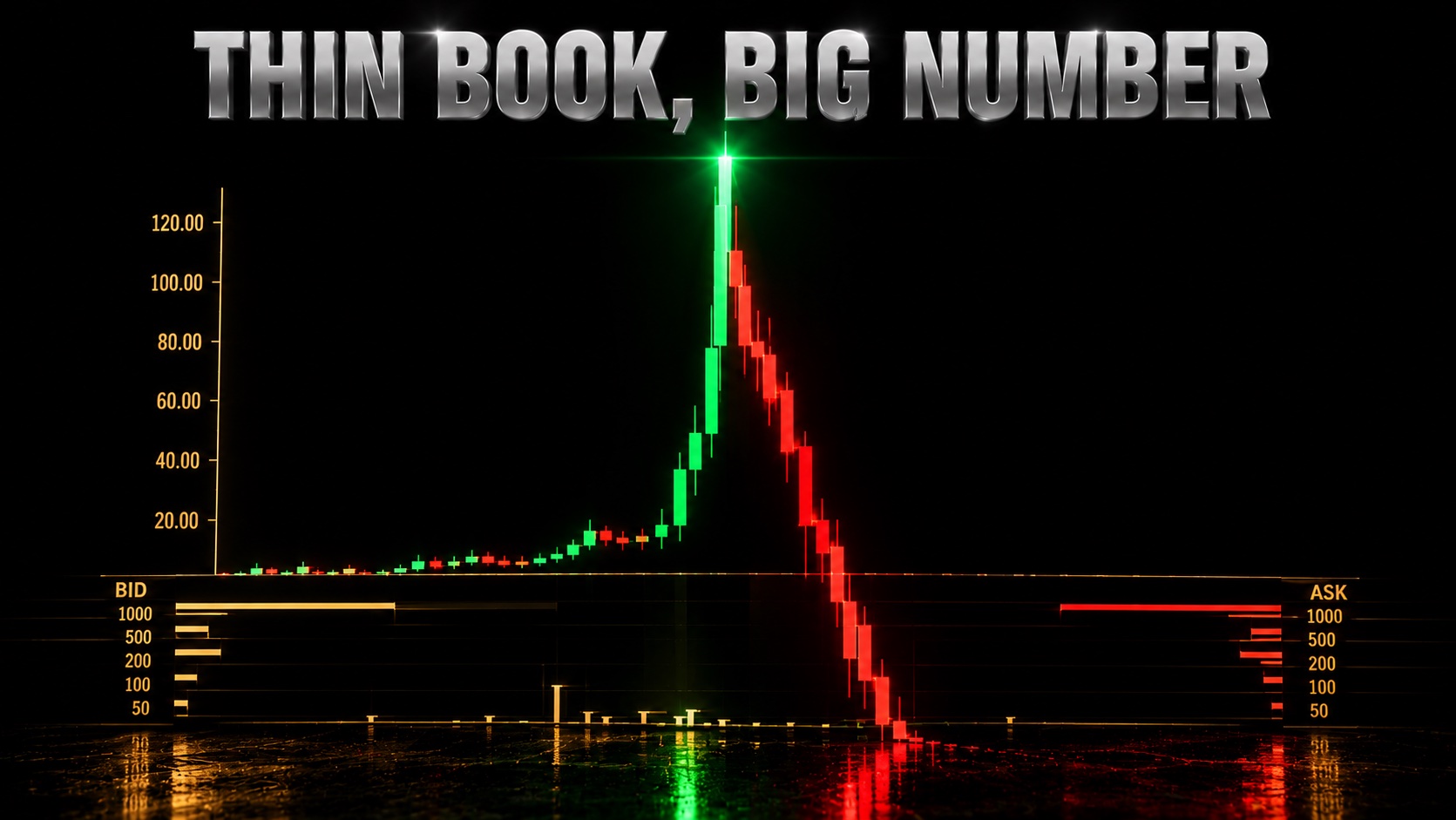
Its trajectory was violent even by memecoin standards. It went from a market capitalisation of a few million dollars to roughly $100 million within about twelve hours, later approaching $150 million, and it printed an all time high of about $0.1509 against an all time low near $0.00008571. On-chain trackers followed individual positions of a few thousand dollars that were briefly worth over a million, almost all of it unrealised. When Tenev followed the project’s account, the token jumped again by more than 150 percent.
It then fell hard. Market capitalisation quotes as of 8 September 2026 diverge sharply across data providers, from the high eighty millions down to figures implying a drawdown of more than 90 percent from the peak. That divergence is itself the finding. When reputable trackers cannot agree on what something is worth within a factor of two, what you are looking at is thin liquidity and reflexive pricing, not a valuation.
This site does not cover memecoins as investments, and it is not covering this one as an investment now. It matters for one reason: it shows how quickly a serious question about market structure gets converted into a leveraged bet on attention. Readers who want the longer pattern can read our history of meme coins and the risks they carry.
6. The Regulatory Question That Decides This
Aron’s “how is this legal” is not rhetorical. It has a partial answer already on the record.
On 28 January 2026, the SEC’s Divisions of Corporation Finance, Investment Management, and Trading and Markets issued a joint staff statement on tokenized securities. Its central point was that the format in which a security is issued, and the method by which holders are recorded, does not change whether federal securities laws apply. Putting an instrument on a blockchain does not move it outside the rules.
The statement also drew the distinction that matters here. Issuer-sponsored tokenization, where the company itself authorises the token and it is recorded against the official register, can represent genuine ownership. Third-party products that reference a stock without the issuer’s involvement generally deliver only synthetic exposure or a custodial entitlement, and staff signalled a preference for keeping synthetic equity away from retail while encouraging issuer-approved structures.
Robinhood’s design sits deliberately on the other side of that line and outside US jurisdiction: offshore issuer, Regulation S, no US persons. That is a defensible structure, not an obviously illegal one. The open questions are whether the Regulation S perimeter genuinely holds when the product trades on a permissionless chain that anyone can reach, and whether a dispute this loud pulls forward US rulemaking on stock tokens. AMC’s referral to the SEC is what makes the second question live.

7. Competition: Who Else Is Tokenizing Equities
Robinhood is not alone, and the competitive shape explains why this dispute is strategically important rather than merely noisy.
- Issuer-sponsored and institutional platforms work with the company or with regulated transfer agents, so they inherit legitimacy but move slowly. Our earlier look at Ondo Finance and its stock tokenization push covers this model.
- Offshore synthetic issuers, Robinhood’s chosen route, ship fast and reach global retail, but carry issuer-consent and jurisdictional risk exactly like the one now playing out.
- Regulated tokenized funds and treasuries remain the least contested corner of the sector, which is why most institutional real world asset capital has gone there first.
Distribution is Robinhood’s genuine advantage, and it is why users would stay. It is also why an adverse regulatory outcome would be expensive. For the equity side of that question, our analysis of Robinhood’s crypto business model is the better starting point, since company fundamentals are OneMoreStock’s territory rather than ours.
8. Bull vs Bear Case
🐂 Bull Case
- Tokenized equity demand is demonstrably real, with over $3 billion of cumulative stock token volume in roughly two months.
- Robinhood Chain shows genuine breadth, at about 576 million transactions and 12.3 million addresses since 1 July 2026.
- The Regulation S structure is a recognised exemption, not a loophole invented for this product.
- Public conflict with a listed issuer may accelerate US rules, and clear rules favour the largest compliant distributor.
- Twenty four hour access to equity price exposure solves a real problem for non-US investors in markets with poor brokerage access.
🐻 Bear Case
- Holders own no equity, hold no shareholder rights, and carry credit exposure to an offshore issuer most have never assessed.
- The SEC’s January 2026 statement explicitly disfavours synthetic equity reaching retail, which is close to what this is.
- More issuers may follow AMC, and a coordinated objection is harder to absorb than a single one.
- Enforcement or a forced delisting of contested tokens would remove the fastest growing use case on the chain.
- The surrounding memecoin activity attracts precisely the speculative flow that invites regulatory attention.
9. What Would Break the Thesis
The tokenized equity thesis breaks if any of the following happens.
- The SEC, or a non-US regulator, finds that the Regulation S perimeter is not effective for a token trading on a permissionless chain.
- A court or regulator establishes that referencing a listed company’s shares requires that company’s consent.
- Robinhood is compelled to delist contested tokens, which would strand holders in an illiquid instrument.
- The Jersey issuing entity proves undercapitalised relative to the exposure it has written.
- Stock token volume turns out to be concentrated in a small number of tickers driven by attention rather than genuine access demand.
10. Investment Outlook
Tokenized equities are the most commercially obvious form of real world asset tokenization, and this dispute is the moment the sector’s central unresolved question got asked in public: does referencing a company’s shares require that company’s permission?
Nothing in the past week resolves it. What the week did establish is that the growth is real, the legal foundation is contested, and the two facts are now visibly in tension. Readers holding exposure to tokenized equities anywhere should understand that they hold a claim on an issuer, not a share, and should size that position as the credit and regulatory exposure it actually is. Readers tempted by the memecoin attached to the story should read the drawdown numbers again.
This remains a sector to follow closely rather than one to act on quickly. The next meaningful signal is regulatory, not price.
Follow OneMoreBitcoin on YouTube for regular crypto market updates.
FAQ
Do Robinhood stock tokens make me a shareholder?
No. Robinhood’s own disclosures describe them as tokenized debt securities that provide price exposure to a stock. They confer no legal ownership, no voting rights, and none of the protections a registered shareholder receives.
Can US investors buy Robinhood stock tokens?
No. They are offered under Regulation S, which permits sales outside the United States to non-US persons only, and they are not registered under US securities law.
Is what Robinhood is doing illegal?
That has not been established. Regulation S is a recognised exemption and Robinhood says it is confident in its legal position. AMC disputes it and has said it will raise the matter with the SEC, which is where the question will be tested.
Why did AMC’s share price rise on the dispute?
AMC shares rose close to 20 percent in early premarket trading on 4 September 2026 following the public exchange. Attention-driven moves in a heavily retail-held stock are not the same as a change in the underlying business.
What is the AMC memecoin, and is it connected to AMC Entertainment?
It is a token called “A Meme Coin” that launched on Robinhood Chain on 3 September 2026, playing on AMC as an acronym. It is not issued by AMC Entertainment and not issued by Robinhood, and it has already seen a drawdown of more than 90 percent from its peak by some measures.
How is this different from tokenized funds or tokenized treasuries?
Those are usually issuer-sponsored or run through regulated structures, so the tokenization is authorised by whoever controls the underlying asset. The contested category here is third-party synthetic exposure created without the referenced company’s involvement.
Disclaimer:
This article is for educational and informational purposes only. It does not constitute investment, financial, legal or tax advice, and it is not a recommendation to buy, sell or hold any digital asset.
Cryptocurrency is highly volatile and speculative. Prices can move sharply at any hour of any day, and you can lose some or all of the capital you invest. Digital assets are not bank deposits, they are generally not covered by deposit protection or investor compensation schemes, and the regulatory treatment of a token, platform or service can change quickly. Further risks include exchange or custodian failure, smart contract vulnerabilities, bridge and oracle failure, loss of private keys, and scheduled token unlocks that expand supply.
Investors should conduct their own due diligence and consider their own circumstances, time horizon and risk tolerance before making any financial decision. Consult a licensed financial adviser if you are unsure. Past performance is not indicative of future results.
OneMoreBitcoin and OneMoreMoney.com accept no responsibility for any loss incurred from reliance on the information provided in this article.