Bitcoin Cold Wallet Myths: 7 Beliefs That Cost Real Money
Bitcoin Cold Wallet Myths: 7 Beliefs That Cost Real Money
1. Introduction: Why Bitcoin Cold Wallet Myths Cost Money Now
Bitcoin trades near $64,559, roughly 49% below its October 2025 high, and the on-chain pattern in a drawdown is familiar: coins leave exchanges and move into cold storage. That behaviour is sensible. What follows it often is not, because many first-time cold storage users are working from a mental model of the device that is simply wrong.
The last twelve months have been expensive for people holding that model. A five-year-old firmware defect drained more than 1,800 BTC from Coldcard users who had done everything the industry told them to do. A counterfeit wallet app cleared Apple’s review process and took roughly $1.8 million from three holders who typed their recovery words into it. A $1.5 billion multisig cold wallet was emptied while three hardware devices sat on the desk, dutifully signing.
None of those were failures of Bitcoin. All three were failures of a belief about what the hardware does. Below are seven claims that circulate constantly about the Bitcoin cold wallet, each marked true or false, with the incident that settles it.
Cold Storage in Context
| Metric | Value |
|---|---|
| Bitcoin price | About $64,559 |
| Bitcoin market cap | About $1.30 trillion |
| All-time high | $126,080 on 6 October 2025 |
| Drawdown from that high | About 49% |
| Circulating supply | About 20.07 million of 21 million BTC |
| Coldcard firmware exploit, from 30 July 2026 | About 1,816 BTC, roughly $116 million (TRM Labs) |
| Addresses drained in that exploit | More than 5,200 |
| Bybit multisig loss, 21 February 2025 | About 401,000 ETH, roughly $1.5 billion |
| Fake Sparrow Wallet App Store claims, filed 24 July 2026 | About $1.8 million across three plaintiffs |
| Mt. Gox loss disclosed February 2014 | 850,000 BTC, of which 750,000 were customer coins |
| FTX petition date valuation of Bitcoin | $17,036 per BTC on 11 November 2022 |
| Seed phrase entropy, 12 words vs 24 words | 128 bits vs 256 bits |
Data as of 19 August 2026. Verify before publishing.
The Four Things People Confuse
Six of the seven misunderstandings collapse the moment these four are separated:
- The blockchain is the public ledger. It records which addresses control which coins, and it is not stored on your device.
- The private key is the authority to move coins from an address. Whoever holds it can spend.
- The cold wallet is a signing device. It holds private keys in isolation and produces signatures without exposing those keys to an internet connected computer or phone.
- The seed phrase is the recovery backup, a word sequence from which every private key in the wallet can be regenerated on any compatible device.
Note that “cold” does not mean permanently disconnected. A hardware wallet is routinely plugged into a laptop to send a transaction. The isolation claimed is narrower: the private key never leaves the device.
2. Myth 1: “If I Lose the Device, My Crypto Is Gone”
Verdict: false.
Your Bitcoin is recorded on the blockchain, not stored inside the hardware. Lose the device and you have lost a tool, not an asset. Buy a compatible replacement, restore from the recovery phrase, and the same addresses and balances reappear.
The exception is the one that matters:
- Restoration works only if you still hold the correct recovery phrase.
- It works only if that phrase has not been seen by anyone else.
- If both the device and the phrase are gone, and no other valid backup exists, recovery is generally impossible.
The practical inversion is worth stating plainly. Most new holders guard the device and treat the paper backup casually. The correct priority is the reverse: the device is replaceable hardware, the phrase is the asset.
3. Myth 2: “A Bitcoin Cold Wallet Is Completely Safe Because It Is Offline”
Verdict: false.
Offline storage removes one attack surface, remote extraction of the private key, and it removes it well. It does not remove the rest:
- Phishing sites and fake support agents that ask for recovery words
- Counterfeit wallet applications
- Tampered or counterfeit hardware bought outside the manufacturer’s own channel
- Defective firmware, including firmware shipped by the legitimate vendor
- Approving a transaction that does something other than what you were shown
- Sending to a wrong address, or to the right address on the wrong network
- Physical theft or coercion
Two 2026 incidents make the point. In the Coldcard case, a build configuration error introduced in firmware 4.0.1 in March 2021 caused seed generation to fall back on a weak software random number generator instead of the device’s hardware entropy source. Effective key strength collapsed from a designed 128 bits to roughly 40 bits on Mk2 and Mk3 devices, inside brute-force range for a well-funded attacker. Nothing was phished and no device was touched. We covered the sequence, affected models and migration steps in our full breakdown of the Coldcard seed flaw.
Separately, a lawsuit filed in California on 24 July 2026 alleges a counterfeit Sparrow Wallet app on Apple’s App Store drained about $1.8 million from three users, each of whom entered a recovery phrase into it. The real Sparrow developer had publicly reported impostor apps to Apple in January 2024. A hardware wallet in a drawer offers no defence against software its owner installed and trusted.
Bottom line: a cold wallet is a strong security layer, not a shield. It protects the key. It cannot protect the judgement of the person holding it.
4. Myth 3: “If I Lose the Seed Phrase Paper, the Funds Are Gone Forever”
Verdict: conditionally true, and sometimes fixable.
This depends entirely on what access you still have, and it is the myth where acting quickly changes the outcome.
If the phrase is missing but the hardware wallet still works, you retain the ability to spend, which means you retain the ability to migrate. The sequence:
- Do not create a digital copy of the old phrase. That converts one problem into two.
- Generate a completely new wallet with a brand-new recovery phrase on a device you have verified.
- Confirm the new wallet works by sending a small test transaction and checking it arrives.
- Move the remaining balance across.
- Treat the old wallet as compromised from that point and stop using it.
- Back up the new phrase offline before the balance is meaningful.
Move directly to a newly generated self-custody wallet where you can. Routing the balance through an exchange or a hot wallet as an intermediate step adds a counterparty and an internet-connected key for no benefit.
If both the phrase and the device are gone, there is no procedure. No vendor, support desk or regulator can regenerate the key. That is why this myth is only half a myth: the emergency is real, and the window to fix it closes the moment the device also fails.
5. Myth 4: “Crypto Is Downloaded Into the Device Like Files on a USB Drive”
Verdict: false.
Bitcoin is not a file that gets copied onto hardware. When you receive Bitcoin, the network records that a particular address controls a particular amount. Nothing is transferred to your device at all.
The hierarchy is simple once it is written down:
- Blockchain: records the assets
- Wallet address: identifies where they are controlled
- Private key: authorises transactions from that address
- Cold wallet: protects the key and performs the signing
- Seed phrase: regenerates the key if the device is lost
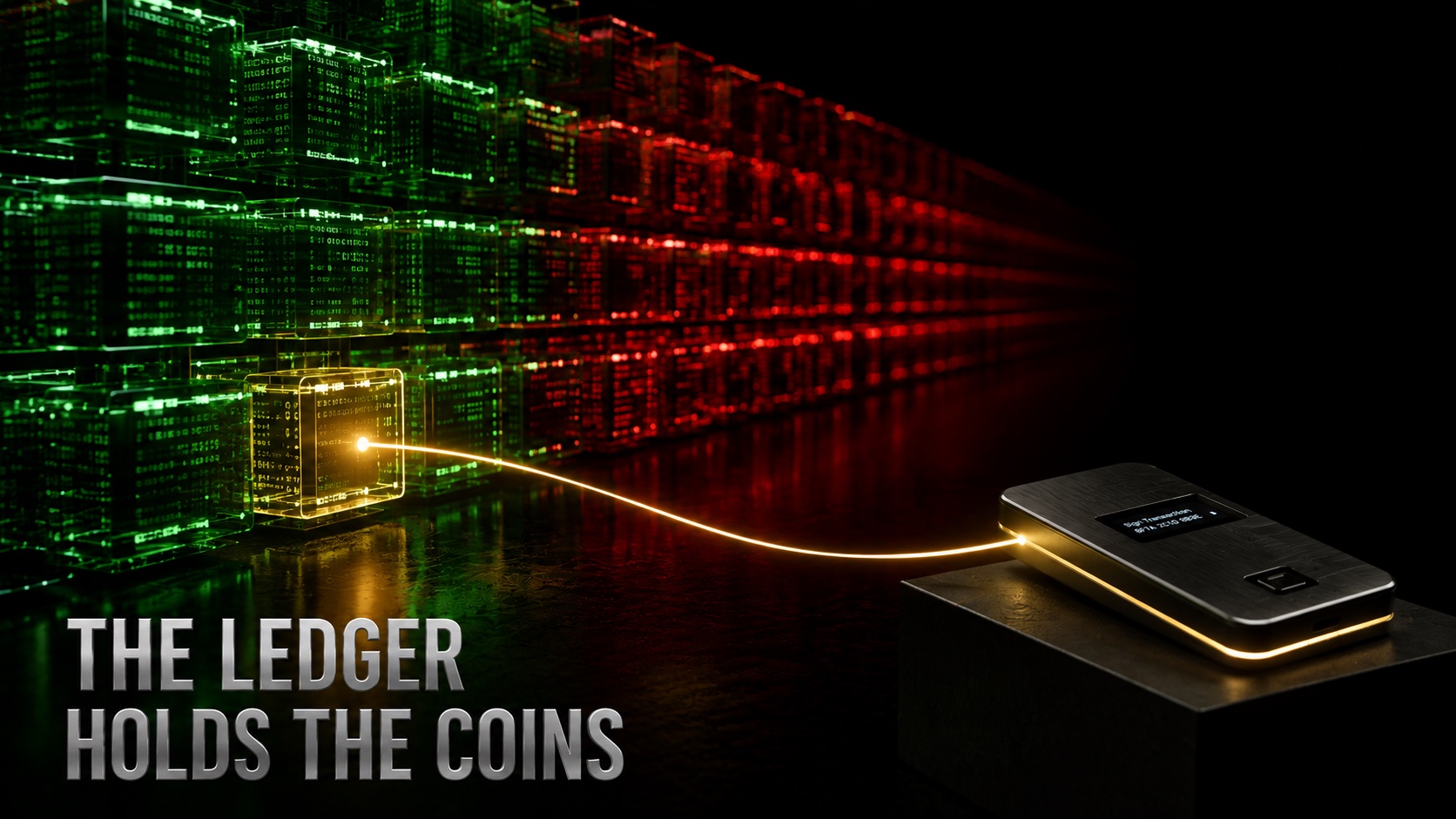
This is why Myth 1 falls apart, and it is also why a hardware wallet with no balance showing is usually a connectivity or derivation-path problem rather than a loss. The coins never moved. Something in the software asking the ledger a question moved.
6. Myth 5: “An Exchange Balance Is Fine for Long Term Storage”
Verdict: false, and the highest-cost item on this list.
A balance displayed in an exchange app is an entry in that company’s internal accounting system. It is a claim against the exchange, not control of a blockchain address. The exchange holds the keys, withdrawal depends on it continuing to operate and choosing to honour the request, and access can be restricted by insolvency, regulatory action, a hack or an operational failure.
The historical record is unambiguous:
- Mt. Gox disclosed in February 2014 that 850,000 BTC were missing, 750,000 of them customer coins. About 200,000 were later recovered, and creditor repayments did not begin until 2024.
- FTX filed on 11 November 2022. The FTX Recovery Trust has paid out in stages, with the fifth distribution beginning 31 July 2026 and cumulative recovery running above 100% of claim value for customer entitlement classes.
That FTX figure is widely misread as a happy ending. Under US bankruptcy law a claim is valued as of the petition date, and Bitcoin was priced at $17,036 on 11 November 2022. A creditor recovering 105% recovered 105% of that dollar figure, not the coins. Bitcoin trades near $64,559 today, close to 3.8 times the petition-date price. In Bitcoin terms those creditors took a severe loss while the statistic reads as a gain.
This is the same counterparty logic we applied to issuer risk in the S&P downgrade of USDT: identify the entity whose failure costs you everything, then decide whether you meant that exposure.
None of this makes exchanges useless. They are the right tool for buying, selling and moving between assets, and the listed ones are real businesses with real disclosure, as we covered in our look at Robinhood’s crypto business model. The distinction is between a venue you transact on and a vault you rely on for years.
7. Myth 6: “The Seed Phrase Is Just a Password, So I Can Save It Digitally”
Verdict: false, and this is the most dangerous item here.
A password can be reset. A bank can freeze a transfer. A recovery phrase can do neither. It hands whoever reads it direct, immediate and irreversible control of every address the wallet derives.
Do not store a recovery phrase in:
- Phone notes or any note-taking app
- Email, including drafts
- Cloud storage or automatic photo backup
- Screenshots or photographs
- Messaging apps
- Unencrypted documents on a laptop
- Anything that syncs
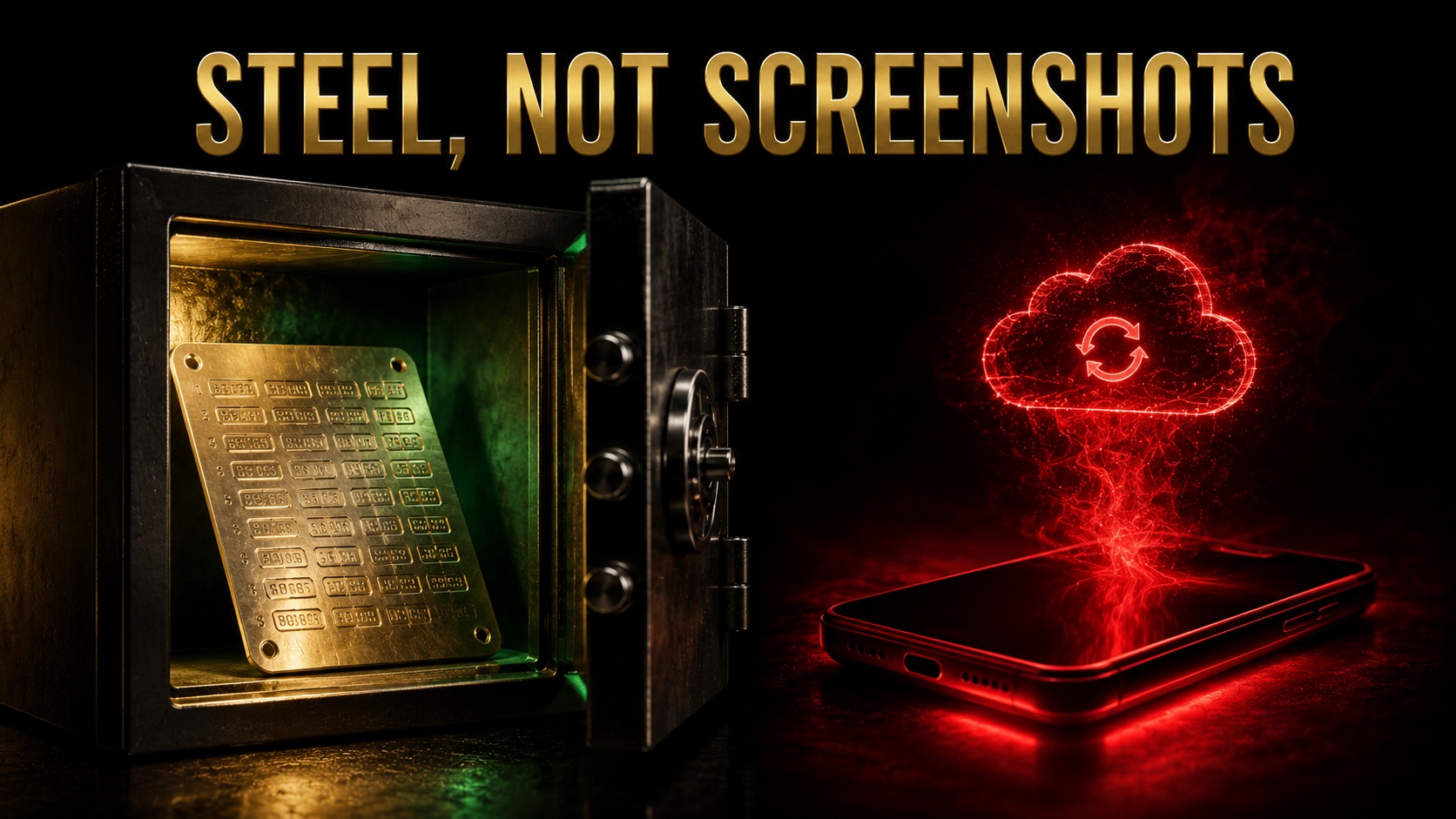
Infostealer malware is an industrialised business in 2026 and it hunts wallet files, screenshots and phrase-shaped strings specifically. A photo taken once and forgotten still sits in a cloud backup years later.
Write the phrase on paper for redundancy and, for meaningful balances, stamp it into steel, which survives fire and water in a way paper does not. Keep more than one copy, in more than one location. The BIP-39 specification defines five valid lengths, 12, 15, 18, 21 and 24 words, drawn from a fixed 2,048-word list and carrying 128 to 256 bits of entropy. Twelve and 24 are the common choices, and both sit far beyond brute-force reach when generated correctly. The Coldcard failure was not a break in that maths. It was a break in the randomness fed into it.
8. Myth 7: “Once It Is in Cold Storage, I Can Never Lose It”
Verdict: false.
Cold storage improves key protection substantially. It also transfers full operational responsibility to you, and one category of loss the device cannot address at all: it can protect a key perfectly while signing something you should never have approved.
The Bybit hack on 21 February 2025 is the clearest case on record. Attackers compromised a Safe{Wallet} developer environment and injected malicious JavaScript into the front end Bybit’s signers used. The interface displayed a routine 30,000 ETH transfer. What actually reached the hardware devices was a delegatecall to an attacker-controlled contract. All three signers approved it on their Ledger devices, each showing structured parameters it could not decode into anything a human could evaluate. About 401,000 ETH, roughly $1.5 billion, left a cold multisig wallet. The devices did exactly what they were designed to do.
Loss routes that survive cold storage:
- Sending to a wrong address, or on the wrong network
- Approving a malicious smart contract or a transaction you cannot read
- Phishing and counterfeit wallet software
- Losing the phrase, or backing it up incorrectly
- Signing under coercion
- Dying without an inheritance plan, which quietly destroys more Bitcoin than hacking does
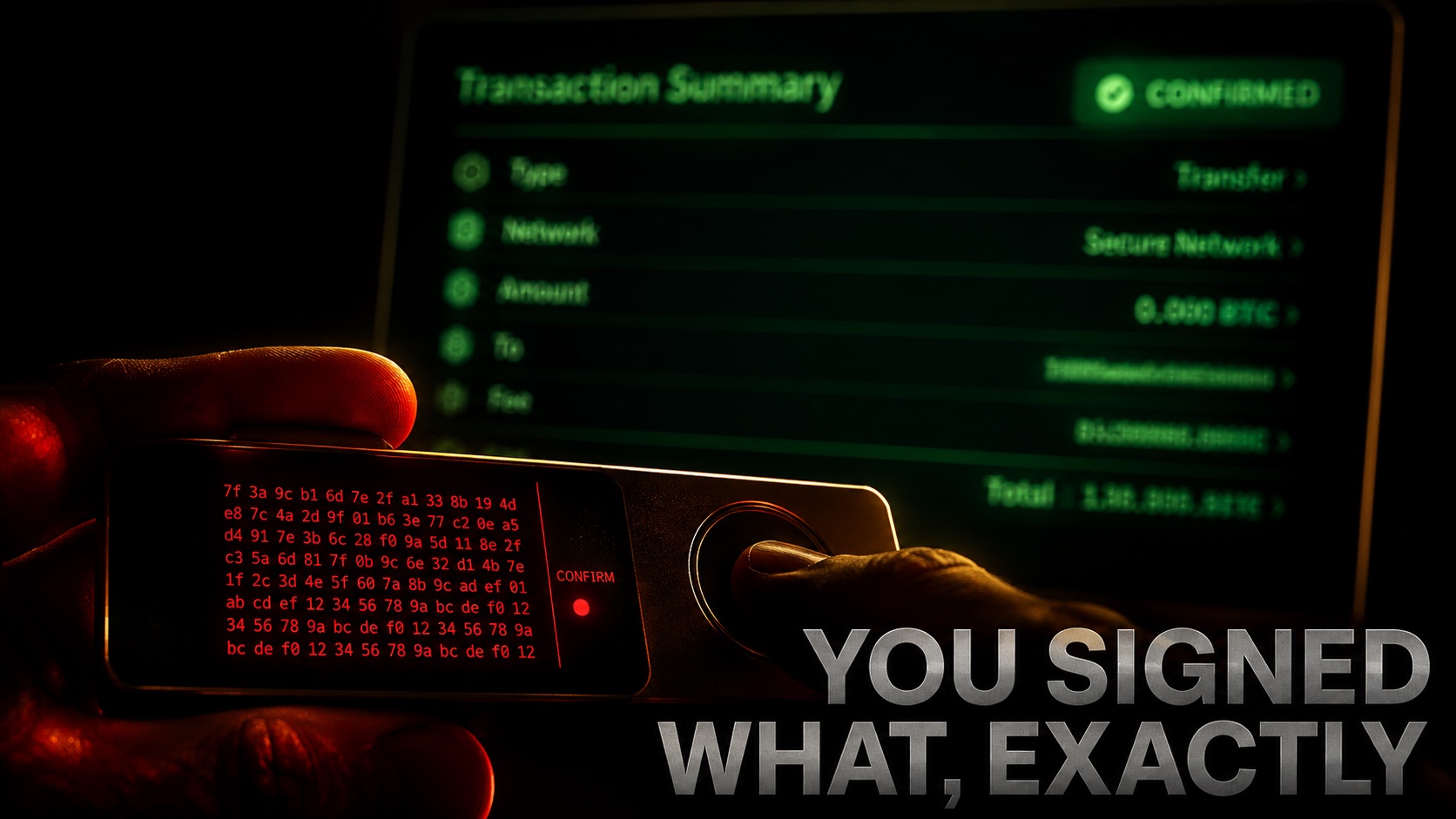
Bottom line: protecting the key and understanding what you are signing are two different disciplines. The hardware only covers the first.
9. The Custody Hierarchy That Makes All Seven Myths Obvious
Every myth here comes from the same error: treating the device as the asset. It is not. The asset is a record on a public ledger, and what you own is the ability to authorise changes to that record.
Hold that shape in your head and the answers fall out. Lose the device, keep the phrase, and nothing is lost. Lose both, and nothing can be done. Store the phrase where a stranger can read it, and the hardware becomes decorative. Sign a transaction you cannot read, and the security model never engaged at all.
It also explains why “which wallet should I buy” is the wrong opening question. The device is one component in a system spanning seed generation, backup durability, transaction verification, purchase channel and inheritance planning. Coldcard broke seed generation, the fake app broke the install channel, Bybit broke transaction verification. In each case the hardware itself worked.
10. The Case For and Against Cold Storage
🐂 The case for holding your own keys
- It removes the failure mode that has destroyed the most value in crypto history: exchange insolvency and fraud.
- Self-custody failures are legible. They happen on a public ledger and can be traced within hours, unlike an opaque balance sheet.
- Bitcoin’s own cryptography has never been broken. Every incident here was a defect in software, hardware supply or human process.
- Structural fixes exist. Multisig across devices from different manufacturers would have contained the Coldcard defect completely.
- The cost of doing it properly is one device, a metal backup and an afternoon of setup.
🐻 The case against do-it-yourself custody
- It does not remove third parties. It swaps an exchange for a hardware vendor, a firmware team, a chip supplier and a build pipeline, none of which you can audit.
- The Coldcard defect was silent for over five years with no symptom a careful user could detect. Discipline was no defence.
- Most retail holders run single-signature setups on one device, precisely the configuration swept first.
- There is no recourse. No insurance, no reversal, no regulator, and generally no reimbursement.
- Doing it properly means multisig, separated backups, periodic restore tests and an inheritance plan. Most people will not sustain that.
Our reading is that the real distinction is not self-custody versus custodian. It is whether a single point of failure exists. One device, one vendor, one paper backup in one drawer is a concentration risk regardless of the brand printed on it. A holder unwilling to run a distributed setup should be honest that a regulated custodian or a spot ETF may fit their circumstances better, and that this is a legitimate answer rather than a failure of conviction.
11. What to Actually Do
None of the above argues against a Bitcoin cold wallet. It argues against the version of it people carry in their heads. A workable baseline:
- Buy from the manufacturer directly. Never a marketplace listing, and never a device that arrives with a pre-printed recovery phrase.
- Generate the seed on the device yourself and verify it restores before funding it.
- Back up on metal, in at least two separate physical locations, and never in anything digital.
- Send a small test transaction to any new address before moving a meaningful balance.
- Read what the device screen says, not what the computer screen says. If the device cannot show you what you are approving, do not approve it.
- Keep firmware current, and follow the vendor’s own advisory rather than third-party instructions during an incident.
- For balances that would genuinely hurt to lose, use multisig spanning two or three manufacturers so no single vendor defect can spend your coins.
- Write down how someone you trust would recover the wallet if you could not.
Worth watching over a longer horizon: whether independent entropy audits become standard across manufacturers, and how key formats evolve as computing changes, a question we examined in our piece on the quantum computing threat to Bitcoin.
Follow OneMoreBitcoin on YouTube for regular crypto market updates.
The one sentence worth keeping from all seven myths: a cold wallet protects your authority over coins that were never inside it, and everything that has gone wrong has gone wrong somewhere else in that chain.
FAQ
Is my Bitcoin actually stored inside a cold wallet?
No. Bitcoin exists only as records on the blockchain. A cold wallet stores the private keys that prove you control specific addresses and signs transactions without exposing them. Losing the hardware does not move or destroy a single coin.
What happens if I lose my hardware wallet?
You buy a compatible replacement, restore from your recovery phrase, and the same balances reappear. This works only if you still hold the correct phrase and nobody else has seen it. If both the device and the phrase are gone, recovery is generally impossible.
Is a cold wallet completely safe because it is offline?
No. Being offline removes remote key extraction, a real gain, but phishing, counterfeit apps, tampered hardware, defective firmware and approving a malicious transaction all remain live. The 2026 Coldcard entropy defect drained more than 5,200 addresses without an attacker touching a device.
Can I store my seed phrase in a password manager or cloud drive?
Treat that as unsafe. A recovery phrase gives immediate and irreversible control of every address in the wallet, unlike a password, which can be reset. Infostealer malware hunts specifically for wallet files and phrase-shaped strings, so keep the backup offline and in more than one location.
Are exchanges safe for long term Bitcoin storage?
An exchange balance is a claim against a company, not control of a blockchain address. FTX creditors were repaid against a Bitcoin price of $17,036 fixed at the November 2022 petition date rather than in coins, a severe loss in Bitcoin terms despite recovery above 100% of claim value.
If I use a hardware wallet, can I still be hacked?
Yes, through what you approve rather than through the key. In the February 2025 Bybit incident a compromised interface showed signers a routine transfer while sending a different instruction to their devices, which could not decode it. Roughly $1.5 billion left a cold multisig wallet with every device working correctly.
Disclaimer:
This article is for educational and informational purposes only. It does not constitute investment, financial, legal or tax advice, and it is not a recommendation to buy, sell or hold any digital asset.
Cryptocurrency is highly volatile and speculative. Prices can move sharply at any hour of any day, and you can lose some or all of the capital you invest. Digital assets are not bank deposits, they are generally not covered by deposit protection or investor compensation schemes, and the regulatory treatment of a token, platform or service can change quickly. Further risks include exchange or custodian failure, smart contract vulnerabilities, bridge and oracle failure, loss of private keys, and scheduled token unlocks that expand supply.
Investors should conduct their own due diligence and consider their own circumstances, time horizon and risk tolerance before making any financial decision. Consult a licensed financial adviser if you are unsure. Past performance is not indicative of future results.
OneMoreBitcoin and OneMoreMoney.com accept no responsibility for any loss incurred from reliance on the information provided in this article.