Uniswap (UNI) Deep Dive: Did the Fee Switch Fix the Token?
Uniswap (UNI) Deep Dive: Did the Fee Switch Fix the Token?
1. Introduction: Why Uniswap Matters Now
For most of its life, Uniswap was the clearest example of a problem that runs through the whole of crypto. The protocol worked. It processed enormous volume, it generated hundreds of millions of dollars in trading fees every year, and it survived every market cycle thrown at it. The token did none of that work and received none of that money.
That gap is what made UNI such a frustrating asset to own. A holder could watch the protocol set volume records and still see the token drift sideways, because the two were connected by nothing more than a shared name and a voting contract. The bear case was never that Uniswap would fail. It was that Uniswap would succeed and the token would not care.
In late December 2025 that structure changed. Governance voted through a proposal called UNIfication, which switched on protocol fees and routed them into an automated buyback and burn. It is now roughly nine months later, the mechanism has been live through a full range of market conditions, and there is real data instead of theory.
This deep dive covers what Uniswap actually does, how the new fee structure works, what the burn has done to supply, whether the token has re-rated because of it, and what could still break the thesis.
| Metric | Value |
|---|---|
| Price | $6.51 |
| Market Cap | $4.05B |
| Market Cap Rank | #26 |
| Fully Diluted Valuation | $5.78B |
| 24h Volume | $649M |
| Circulating Supply | 623.2M UNI |
| Total Supply | 890.5M UNI |
| Max Supply | 1,000,000,000 UNI (capped, now deflationary) |
| 12-Month Range | $2.40 to $9.62 |
| All-Time High | $44.92 (2 May 2021) |
| ATH Drawdown | -85.5% |
| 30-Day Price Change | +99.1% |
| 1-Year Price Change | -28.8% |
| Staking Yield | None. UNI is not a staking asset |
Data as of 15 September 2026. Verify before publishing.
2. What Is Uniswap? A Plain Explanation
Uniswap is a decentralised exchange, or DEX. It lets anyone swap one token for another directly from a wallet, with no account, no broker and no order book in the traditional sense. It launched on Ethereum in 2018, built by Hayden Adams, and it popularised the automated market maker model that most of DeFi now runs on.
An automated market maker replaces buyers and sellers matching with each other with a pool of two assets and a formula. Liquidity providers, usually just called LPs, deposit both assets into the pool. Traders swap against the pool, the formula adjusts the price after each trade, and the trader pays a small fee for the privilege. That fee is the entire business.
The key thing to understand, and the thing this whole article turns on, is that for the first seven years every cent of that fee went to the liquidity providers. The protocol took nothing. UNI holders, who nominally governed the thing, received nothing.
- Protocol type: automated market maker DEX, deployed across roughly 48 chains
- Core use cases: spot token swaps, liquidity provision, on-chain routing for wallets and aggregators
- Ecosystem: the Uniswap web app and wallet, Unichain (its own Ethereum layer 2), and integrations across most major DeFi front ends
- Token: UNI, launched September 2020 with a 1 billion supply cap
3. Technology and Core Innovation
Uniswap has shipped four generations of its core exchange, and each one addressed a genuine weakness in the last. Version 2 made pooled AMM trading reliable and became the template every fork copied. Version 3 introduced concentrated liquidity, letting LPs commit capital to a specific price band instead of spreading it across every possible price, which increased capital efficiency dramatically and made competitive pricing on major pairs possible.
Version 4 changed the architecture rather than the maths. It moved every pool into a single contract, which cut the gas cost of creating and using pools, and it introduced hooks: attachable modules that let a pool run custom logic at defined points in a swap. That turned Uniswap from a fixed product into something closer to a platform other teams build on.
Alongside the exchange sits Unichain, Uniswap’s own layer 2 built on the OP Stack. It exists so that the protocol controls its own block space and, importantly for this article, earns its own sequencer revenue. By mid 2026 Unichain had shipped 200 millisecond pre-confirmations and had processed hundreds of millions of transactions. For context on the base layer it settles to, see our Ethereum 2026 outlook.
- Known limitations: AMM pricing still exposes LPs to adverse selection and impermanent loss
- Known limitations: hooks widen the smart contract attack surface, since a pool is only as safe as the hook attached to it
- Roadmap direction: extending fee collection and burn coverage to more pool versions and more chains, an effort that has continued through 2026
4. The Uniswap Fee Switch: What Actually Changed
This is the section that makes the rest of the article make sense.
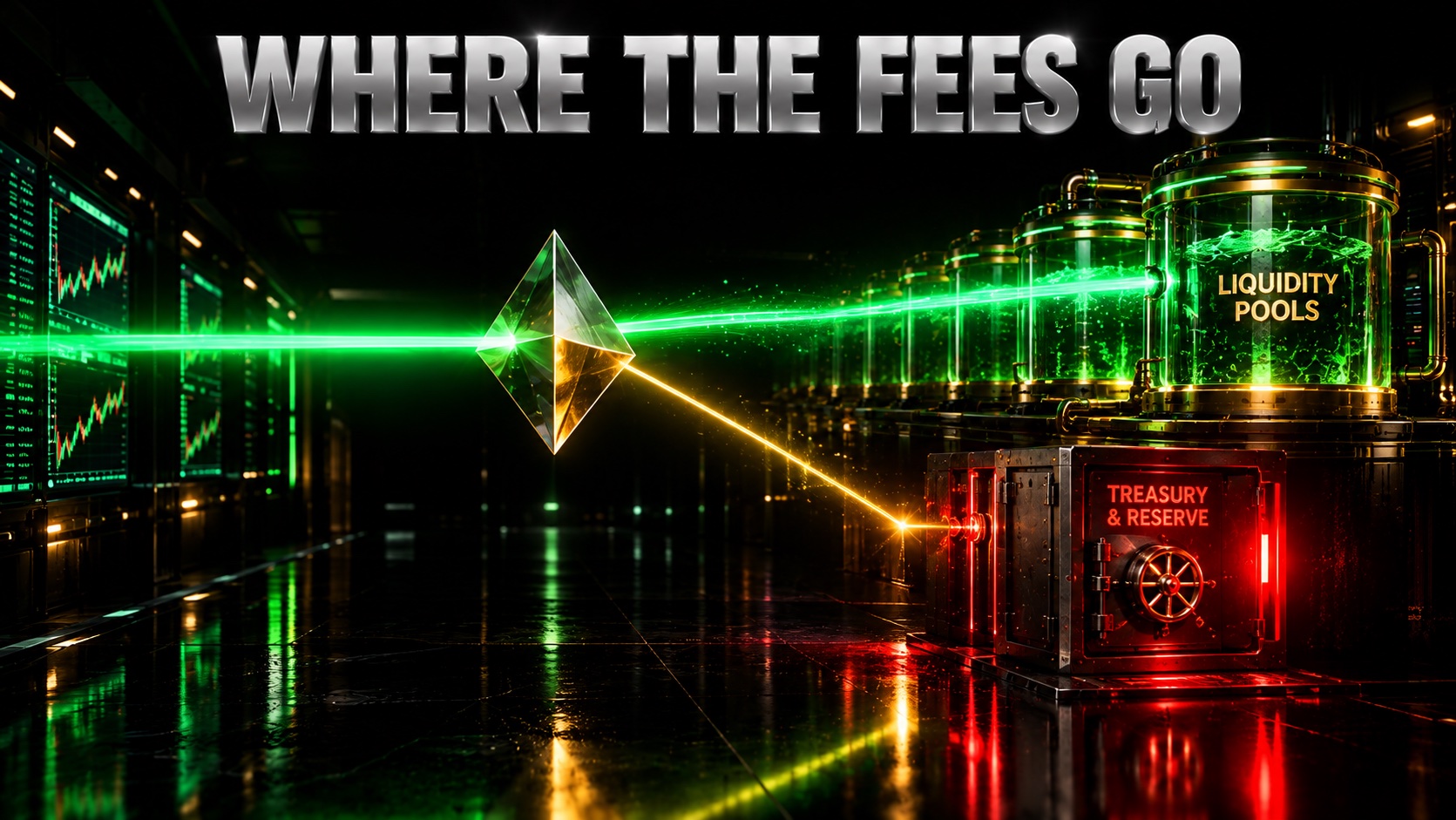
Before UNIfication, a swap on Uniswap v2 charged 0.30% and all of it went to LPs. After UNIfication, that same swap still charges 0.30%, but the split changed: LPs keep 0.25% and 0.05% goes to the protocol. On v3 the protocol takes a fraction of the LP fee, set at one quarter on the smaller fee tiers and one sixth on the larger ones. The trader pays no more than before. The money is taken out of the LP’s share, not out of the user’s pocket.
What happens to the protocol’s cut is the important part. It is not distributed as a dividend. It is used to buy UNI on the open market and destroy it. Unichain sequencer revenue, net of layer 1 data costs and the Optimism share, flows into the same mechanism. Governance also approved a retroactive burn of 100 million UNI directly from the treasury, representing an estimate of what the protocol would have earned had the switch been on from the beginning. That burn executed on 28 December 2025 and destroyed roughly $596 million of tokens in a single transaction.
The buyback-and-burn design was deliberate rather than accidental. A direct dividend to token holders looks a great deal like a security in most regulatory frameworks, which was precisely the risk that had kept the fee switch off for years. A burn returns value to every holder proportionally without paying anyone anything.
The rollout has been incremental rather than a single flip. It began with v2 and the v3 pools representing the large majority of Ethereum mainnet LP fees, then widened. A further proposal executed on 27 July 2026 extended the machinery to v4 pools across seven networks including Ethereum, Arbitrum, Base, BNB Chain, Polygon, OP Mainnet and Robinhood Chain. The full proposal text remains published at the Uniswap UNIfication announcement.
5. Tokenomics and Supply Analysis
UNI launched in September 2020 with a hard cap of 1 billion tokens. The distribution was 60% to the community, about 21.3% to the team and future employees, about 18% to investors and 0.69% to advisors, with the last three categories vesting linearly over four years.
That vesting schedule is the honest explanation for a large part of UNI’s historical weakness. Close to 40% of the total supply was released on a daily drip from 2020 through September 2024, into a market that spent a good portion of that window in a downturn. Steady, mechanical supply met inconsistent demand, and the token had no offsetting sink whatsoever. There was no burn, no staking lock, no fee claim. Nothing pulled tokens back out.
Both halves of that problem are now resolved. The vesting ran to completion in September 2024, so there is no scheduled unlock overhang left. And as of September 2026 total supply stands at roughly 890.5 million against the 1 billion cap, meaning about 109.5 million UNI have been permanently destroyed: the 100 million retroactive burn plus roughly 9.5 million bought and burned by the live mechanism since.
- Total supply: 890.5M, down from a 1B cap
- Circulating supply: 623.2M, about 70% of remaining supply
- Emissions: none from the protocol, though governance funds a 20 million UNI annual growth budget from treasury, distributed quarterly from 1 January 2026
- Burn rate: founder Hayden Adams noted on 9 September 2026 that the trailing seven-day annualised burn had crossed $250 million, up from roughly $200 million days earlier
- Net effect: UNI is now structurally deflationary as long as volume holds, though the growth budget partially offsets the burn
The burn rate figure deserves a caveat that most coverage skips. An annualised rate calculated from seven days of record volume is not a forecast. It is a snapshot of an unusually good week extrapolated across a year. Earlier in 2026 the same measure sat closer to $170 million. Treat the range, not the peak, as the real number.
6. Business Model and Ecosystem
Uniswap’s business is simple to describe and hard to displace: it takes a small cut of a very large flow. Over the twelve months to September 2026 the protocol generated roughly $914 million in total fees, and cumulative fees since launch have passed $5.9 billion. Recent activity has been running near $179 million over thirty days, or roughly $5.6 million a day.
Those fees are not all protocol revenue. The great majority still goes to liquidity providers, which is exactly as it should be, since liquidity is the product. The protocol’s slice is the part that now funds the burn, and it is a modest fraction of the headline number. Anyone modelling UNI off gross fees rather than the protocol cut will arrive at a valuation that is far too generous.
The demand side has shifted in an interesting direction during 2026. A meaningful share of recent volume has come from Robinhood Chain, where Uniswap has handled as much as 98% of decentralised exchange activity. That chain crossed $3 billion in daily DEX volume on 4 September 2026, driven by a mix of tokenised equities and speculative trading, and it directly produced the largest UNI burn day on record. We covered the tokenised-equity side of that story in our piece on Robinhood stock tokens and the AMC dispute.
This is worth flagging plainly rather than celebrating. Volume driven by a single distribution partner, and partly by speculative trading of the kind we examined in our meme coin history piece, is real revenue but it is not diversified revenue. It can leave as quickly as it arrived.
7. On-Chain and Market Data
- Fees, 24 hours: roughly $5.6 million
- Fees, 30 days: roughly $179 million
- Fees, trailing year: roughly $914 million
- Fees, all time: roughly $5.9 billion
- Record daily burn: about 184,000 UNI, worth roughly $1.15 million, on 4 September 2026
- Prior burn records: about 186,000 UNI by token count on 5 June 2026, and roughly $590,000 by value on 21 August 2026
- Deployment breadth: roughly 48 chains, with liquidity heavily concentrated on Ethereum
- Spot market position: Uniswap remains the largest spot DEX by volume across its multi-chain footprint
The single most useful number here is the relationship between the last two burn records. In under three weeks the daily burn roughly doubled in dollar terms. That tells you the mechanism responds sharply to volume, which cuts both ways: it scales up fast in good conditions and it will scale down just as fast when volume normalises.
8. Macro, Regulation and the Competitive Landscape
The regulatory picture improved materially before UNIfication was ever proposed, and that sequence is not a coincidence. The SEC issued Uniswap Labs a Wells notice in spring 2024, alleging it operated as an unregistered exchange and broker and had issued an unregistered security. In February 2025 the SEC closed that investigation with no enforcement action. Removing the threat that a fee distribution would be read as a securities offering is what made the burn design politically and legally viable.
That does not make regulatory risk zero. It makes it different. Enforcement posture can change with an administration, the treatment of governance tokens is still unsettled in several major jurisdictions, and a protocol earning revenue is a more obvious target than one that earns none.
On competition, Uniswap leads spot DEX volume but does not own the category. PancakeSwap dominates BNB Chain, Aerodrome captures the majority of Base volume, and in perpetual futures Hyperliquid is in a class of its own with the large majority of market share. Hyperliquid also matters as a precedent, because it was returning exchange revenue to token holders long before Uniswap did, which is part of why its token behaved so differently. Our Hyperliquid deep dive covers that model in detail. For the broader shift of real-world assets onto these rails, see our ONDO Finance analysis.
9. Bull vs Bear Case
🐂 Bull Case
- Value capture is no longer theoretical. Protocol fees and Unichain sequencer revenue now buy and destroy UNI automatically, and roughly 109.5 million tokens are already gone against a 1 billion cap.
- The supply overhang is genuinely finished. Team, investor and advisor vesting completed in September 2024, so there is no scheduled unlock left to absorb.
- The burn scales with usage. At the September 2026 run rate it represents a meaningful annual percentage of market capitalisation, which is a real bid that did not exist before.
- The legal cloud lifted. The SEC closed its Uniswap Labs investigation with no action in February 2025, which is what allowed the fee switch to be switched on at all.
- Distribution keeps widening. Uniswap is the default swap engine inside an increasing number of front ends, including Robinhood Chain, where it handled up to 98% of DEX volume.
🐻 Bear Case
- The re-rating may already be priced. UNI has roughly doubled in thirty days and trades far above both its 50-day and 200-day moving averages, which is not the profile of an undiscovered story.
- The burn is volume-dependent and volume is cyclical. A quiet quarter cuts the burn proportionally, and the annualised figures quoted in headlines are extrapolated from record weeks.
- Revenue concentration is a real risk. A large share of recent burn activity traces to one chain and one distribution partner.
- The protocol still gives most fees away. LPs keep the bulk, correctly, but it caps how much value the token can ever capture from a given amount of volume.
- Competition is structural, not temporary. PancakeSwap, Aerodrome and Hyperliquid each dominate a niche, and fee competition between AMMs has historically only moved one direction.
- Hooks expand the attack surface. A single exploited hook or a bridge failure on a supported chain would hit both volume and confidence.
10. Technical Price Analysis
UNI has been in a strong uptrend since mid-2026. The token trades near $6.51, against a 50-day moving average of roughly $4.74 and a 200-day of roughly $3.72. Price sitting well above both, with the shorter average above the longer, is a textbook uptrend structure.
The context matters as much as the trend. Over the last twelve months UNI has ranged between roughly $2.40 and $9.62, and despite a 99% gain in thirty days the token is still down about 29% year on year and roughly 85.5% below its May 2021 all-time high. This is a recovery from a deep base, not a breakout to new territory.
- Immediate resistance: the recent 90-day high near $7.29, then the 12-month high near $9.62
- First support: the 50-day moving average near $4.74
- Deeper support: the 200-day moving average near $3.72
- Caution flag: price roughly 37% above its 50-day average is an extended reading and mean reversion is normal from here
None of this is a recommendation to buy or sell at any level. Levels are context for risk management, not entry signals.
11. Investment Outlook
The honest summary is that Uniswap fixed the specific flaw that made UNI uninvestable, and the market noticed. That is a genuine structural improvement and it is not reversible without another governance vote. What is not yet proven is whether the burn survives a full cycle, because every figure we have comes from a rising market with record volume.
Anyone considering exposure should size it as a cyclical, volume-linked crypto asset rather than as a yield instrument. UNI pays nothing. The burn benefits holders only through scarcity, and scarcity only helps if demand holds up.
- Thesis improves if: the burn holds through a quiet quarter, and volume diversifies away from any single chain
- Thesis breaks if: protocol fee capture is competed away, a major hook or bridge exploit lands, or regulators revisit revenue-generating governance tokens
- Most likely to disappoint: anyone extrapolating a record week’s annualised burn rate into a valuation model
Follow OneMoreBitcoin on YouTube for regular crypto market updates.
12. Conclusion
Uniswap matters because it is the closest thing DeFi has to a piece of public infrastructure that also runs a real business. For seven years that business and its token were separate things, and the token was rightly punished for it. UNIfication connected them.
The biggest opportunity is that a cash-generating protocol with a hard supply cap and an automated buyback is now, for the first time, a coherent asset rather than a voting receipt. The biggest risk is that the entire mechanism is a function of trading volume, and trading volume in crypto is the least reliable variable there is.
What would change the thesis is straightforward to watch. Track the burn through a genuinely slow quarter. If it holds at a respectable fraction of today’s rate when volume halves, the re-rating was justified. If it collapses, then what happened in 2026 was a volume story wearing a tokenomics costume.
FAQ
Is UNI a good investment in 2026?
UNI is a fundamentally different asset than it was before December 2025, because protocol fees now buy and burn the token instead of bypassing holders entirely. That fixes the structural flaw, but it does not remove the volatility or the dependence on trading volume. It suits an investor who wants exposure to DeFi infrastructure and can tolerate large drawdowns, not one looking for income or stability.
How does the Uniswap fee switch work?
A portion of each swap fee is diverted from liquidity providers to the protocol. On v2 that is 0.05% out of the 0.30% fee, and on v3 it is a fraction of the LP fee depending on the tier. The protocol uses that revenue, plus Unichain sequencer revenue, to buy UNI on the open market and destroy it. Traders pay no more than they did before.
Why did UNI underperform for so long?
Two reasons compounded. The protocol captured no fees at all, so no matter how much volume Uniswap did, none of it reached the token. At the same time close to 40% of total supply vested linearly from 2020 to September 2024, creating steady sell pressure with no offsetting sink to absorb it.
How much UNI has been burned?
Total supply has fallen from the 1 billion cap to roughly 890.5 million as of September 2026, so about 109.5 million UNI have been destroyed. That consists of a one-off retroactive burn of 100 million from the treasury on 28 December 2025, worth roughly $596 million at the time, plus continuing burns from live protocol revenue.
Does holding UNI pay a dividend or staking yield?
No. UNI has no staking mechanism and pays no dividend. The buyback-and-burn design was chosen deliberately over direct distributions, partly because a dividend to token holders carries far greater securities-law risk than reducing supply does.
Is Uniswap still the largest DEX?
Uniswap remains the largest spot DEX by volume across its multi-chain deployment, but the category is fragmented. PancakeSwap dominates BNB Chain, Aerodrome leads on Base, and Hyperliquid holds the large majority of decentralised perpetual futures volume, a different market from spot trading.
What is the biggest risk to the UNI burn?
Volume. The burn is a direct function of trading activity, so a sustained slowdown reduces it proportionally. A further concern is concentration, since a large share of recent burn volume has come from a single chain, which makes the current run rate less diversified than the headline figure suggests.
Disclaimer:
This article is for educational and informational purposes only. It does not constitute investment, financial, legal or tax advice, and it is not a recommendation to buy, sell or hold any digital asset.
Cryptocurrency is highly volatile and speculative. Prices can move sharply at any hour of any day, and you can lose some or all of the capital you invest. Digital assets are not bank deposits, they are generally not covered by deposit protection or investor compensation schemes, and the regulatory treatment of a token, platform or service can change quickly. Further risks include exchange or custodian failure, smart contract vulnerabilities, bridge and oracle failure, loss of private keys, and scheduled token unlocks that expand supply.
Investors should conduct their own due diligence and consider their own circumstances, time horizon and risk tolerance before making any financial decision. Consult a licensed financial adviser if you are unsure. Past performance is not indicative of future results.
OneMoreBitcoin and OneMoreMoney.com accept no responsibility for any loss incurred from reliance on the information provided in this article.