Meme Coin History: How a 2013 Joke Became a $150B Market
Meme Coin History: How a 2013 Joke Became a $150B Market
1. Introduction: The $150 Billion Joke, Twelve Years On
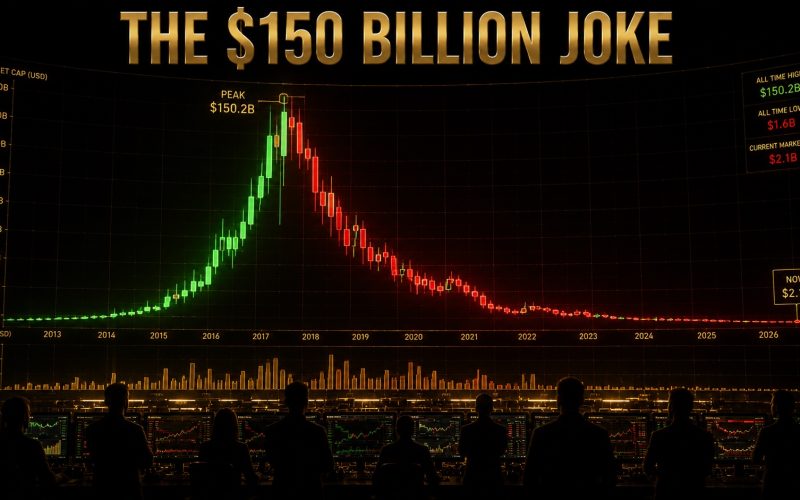
In December 2013 two engineers built a cryptocurrency to make fun of cryptocurrency. Eleven years later, in December 2024, the asset class they accidentally founded was worth more than $150 billion. Today, on 1 September 2026, the same category is worth roughly $31 billion. Nothing about the technology changed in between. Only attention did.
That single fact is the most useful thing a crypto investor can learn from meme coins. Every other asset in this market has some anchor to argue about: a fee stream, a security budget, a settlement guarantee, a reserve attestation. Meme coins have none of those by design, which makes them an unusually clean experiment in what happens when price is made of sentiment alone.
This article traces the full twelve year history, from the Dogecoin fork to the industrialised launchpad economy, and then does the part most meme coin coverage skips: it explains the actual on-chain machinery, shows where the money went, and sets out what can be verified before you interact with one of these tokens. The conclusion is not that meme coins are going away. It is that they are a permanent, structurally negative-sum corner of the market, and that the people who lose money in it are almost always the people who did not know which numbers to check.
2. Meme Coin Market Snapshot
| Metric | Value |
|---|---|
| Meme coin category market cap | $31.4 billion |
| Category 24h volume | $2.39 billion |
| Total crypto market cap | $2.64 trillion |
| Meme share of total crypto | ~1.2% |
| Category all-time high | ~$150.6 billion (December 2024) |
| Drawdown from category peak | ~79% |
| Bitcoin dominance | 59.1% |
| DOGE price / market cap | $0.0828 / $12.9 billion (rank 12) |
| DOGE drawdown from ATH | -88.7% (ATH $0.7316, May 2021) |
| SHIB drawdown from ATH | -94.0% (ATH October 2021) |
| PEPE drawdown from ATH | -87.4% (ATH December 2024) |
| WIF drawdown from ATH | -95.8% (ATH $4.83, 31 March 2024) |
| TRUMP drawdown from ATH | -96.8% (ATH $73.43, 19 January 2025) |
Data as of 1 September 2026, sourced from CoinGecko. Verify before acting on any figure.
Read that table as one sentence: the category is down about four fifths from its peak, and every individual token in it is down further than the category, because the category keeps being refilled with new tokens as old ones die.
3. From Dawkins to Dogecoin: Where the Idea Came From (2013 to 2015)
The word “meme” is not internet slang in origin. Richard Dawkins coined it in The Selfish Gene in 1976, from the Greek mimema, meaning that which is imitated. His argument was that ideas replicate and compete for host attention the way genes compete for hosts. A meme coin is that idea given a settlement layer: a cultural replicator with a transferable price attached.
Dogecoin launched on 6 December 2013. Billy Markus, an American programmer and former IBM engineer, wrote the software; Jackson Palmer, then working in marketing at Adobe in Sydney, supplied the concept and the name. Both thought the crypto market of 2013 was taking itself far too seriously, and Dogecoin was built as satire of the endless stream of altcoins promising to change the world.
The technical detail matters more than the joke, because it is routinely reported wrong. Dogecoin was not a direct copy of Bitcoin. It was derived from Luckycoin and Litecoin, which use scrypt in their proof-of-work algorithm, and was only later refactored toward Bitcoin’s codebase.
- Consensus: scrypt proof-of-work, later merge-mined with Litecoin
- Block time: 1 minute, far faster than Bitcoin’s ten
- Supply: originally intended to cap at 100 billion coins. In February 2014 Palmer announced the cap would not be added to the codebase
- Issuance today: a fixed 5 billion new DOGE every year, permanently inflationary
- Funding: no ICO, no venture round, no whitepaper, no premine sold to investors
That last line is why Dogecoin still deserves respect on its own terms. It is the rare meme coin with no insider allocation to dump, and its 2013 to 2015 community was built on tipping and charity stunts rather than exit liquidity. It proved something genuinely new: that social consensus alone can hold a non-zero monetary value open for over a decade, with no utility, no cash flow and no marketing budget.
4. Governance by Tweet: The Musk Era (2020 to 2021)
The satire stopped being satire when Elon Musk started posting about it. Through 2020 and into 2021, his social media attention repeatedly moved Dogecoin’s price, and by early May 2021 the market capitalisation of a joke had passed $85 billion. The all-time high of about $0.7316 printed in early May 2021, a level DOGE has never revisited.
Then came the demonstration. Musk hosted Saturday Night Live on 8 May 2021, and during a Weekend Update sketch a character he played agreed that Dogecoin was “a hustle.” The price fell as much as 29.5% during the broadcast itself, and by the following morning in New York it was trading near $0.46, roughly a third below the high it had set hours earlier.
Three lessons come out of that weekend, and all three still apply in 2026:
- Sentiment assets have no structural floor. There is no book value, no fee stream and no redemption mechanism to arrest a fall. When the narrative stops, the bid stops.
- Attention is an asymmetric information advantage. The person who moves the price knows when they are going to move it. Nobody else does.
- The peak is usually set before the event, not at it. The rally was priced on anticipation. The event itself was the exit.
5. The Multi Chain Expansion: SHIB, PEPE and Solana (2021 to 2024)
Dogecoin’s success created a template, and the template spread across chains.
Shiba Inu (SHIB) launched on Ethereum in 2020 from an anonymous developer using the name Ryoshi, who sent half the total supply to Vitalik Buterin’s public address. That turned out to be a serious miscalculation. In May 2021 Buterin donated 50 trillion SHIB, worth roughly $1.2 billion at the time, to Sandeep Nailwal’s India Crypto Covid Relief Fund, then burned more than 410 trillion tokens, around 90% of what he held and roughly $6 billion at prevailing prices, sending them to an unspendable address. He said explicitly that he did not want that kind of power over the project. It remains the largest involuntary tokenomics reset in the category’s history.
Pepe (PEPE) launched on Ethereum on 17 April 2023 with no roadmap and no utility claims at all, and reached roughly $1.6 billion in market capitalisation within weeks. A Binance Innovation Zone listing inside three weeks of launch confirmed that centralised exchanges would now list a pure meme on volume alone.
dogwifhat (WIF) went live on Solana in late 2023 and crossed a $4 billion market capitalisation on 31 March 2024, at an all-time high of $4.83. It beat PEPE to that milestone, and it did so on a chain whose low fees and fast blocks made launching and trading tokens close to frictionless.
That last point is the structurally important one. Solana did not just host meme coins, it was substantially monetised by them: meme trading became a primary driver of Solana DEX volume, and therefore of network fee revenue. Anyone forming a view on Solana as a network needs to understand how much of its throughput has historically been this activity, which is one reason we covered the chain’s mechanics separately in our Solana deep dive. Solana-native meme coins are still worth about $3.6 billion today, the largest single-chain meme cluster after Dogecoin’s own.
6. The Mechanics: How a Meme Coin Is Actually Built
Strip away the branding and a meme coin launch is four steps, none of which require novel engineering.
Step one: deployment. The creator deploys a standard token contract, an ERC-20 on Ethereum or Base, or an SPL token on Solana. These are template contracts. In the overwhelming majority of launches there is no custom code, no audit worth reading and no technical innovation of any kind.
Step two: liquidity provisioning. The new token is paired against a base asset, typically ETH, SOL or USDC, inside an automated market maker pool on a decentralised exchange such as Uniswap or Raydium. The AMM sets price by formula from the ratio of the two assets in the pool, which means the creator, who supplies the initial pool, chooses the opening price and controls the only place the token can be sold.
Step three: distribution. Between deployment and public awareness there is a window, sometimes a single block, in which insiders can accumulate supply at the opening price using scripted wallets. This is the part the marketing never mentions.
Step four: the meme. Only now does the cultural asset get attached. The image, the ticker, the account, the community. Memetic recognition is instant and requires no technical education from the buyer, which is precisely what makes it a more efficient distribution mechanism than a whitepaper.
The economics that fall out of this structure are unforgiving:
- No cash flow. There is no fee burn, no staking yield backed by protocol revenue, no earnings. The only source of price support is new buyer capital.
- Price is reflexive. Rising price is itself the marketing, which attracts buyers, which raises price. The mechanism runs identically in reverse.
- Contract privileges are common. Template contracts are frequently modified to add unlimited minting, transfer blacklists, adjustable sell taxes, or an unlocked liquidity pool the creator can withdraw at will.

If the AMM mechanics above are unfamiliar, the same primitives are what make perpetual decentralised exchanges work, and we walked through them in more depth in our Hyperliquid deep dive.
7. The Industrial Launch Economy and the Graduation Problem
By 2024 the launch process described above had been packaged into a product. Launchpads let anyone deploy a token, seed a bonding curve and reach a live market in under a minute, for a few dollars. Pump.fun on Solana became the dominant venue and, at its peak, accounted for the large majority of Solana meme coin creation.
The resulting data is the single most important thing in this article. Research on Pump.fun’s own numbers found that of roughly seven million tokens launched, about 97,000 ever sustained even $1,000 of liquidity. Solidus Labs classified 98.6% of tokens launched on the platform as rug pulls or pump and dump schemes.
“Graduation,” the point at which a token accumulates enough liquidity to move from the launchpad’s bonding curve onto an open market, is the industry’s own survival metric. It has collapsed:
- A 2025 study of 655,770 tokens measured a graduation rate of 0.63%
- A 2026 survival analysis of 832,941 launches measured a pooled rate of 0.198%, a 3.18x decline
- By mid-2026 the observed rate was around 0.26%, down roughly 80% over three months
Put plainly: on the largest meme coin launchpad in the world, roughly two tokens in a thousand reach an open market at all, and the great majority of those still fail afterwards. This is not a market where careful selection improves your odds at the margin. It is a market where the base rate is close to total loss, and the winners are visible only in hindsight.
8. Forensics of a Rug Pull: Squid Game, LIBRA and TRUMP
Three cases, spanning five years, show the same playbook maturing.
SQUID (November 2021) rode the Netflix series to a rise of more than 90,000% in a week, peaking at $2,861.80 from a fraction of a cent. The contract was a honeypot: buying worked, selling was blocked by hidden logic. On 1 November 2021 the developers drained roughly $3.38 million from the liquidity pool and vanished. Every holder was left with a token that could not be sold at any price.
TRUMP (January 2025) was the moment the format went fully mainstream. The token peaked at $73.43 on 19 January 2025. Nansen’s wallet-level analysis found that just under 500,000 wallets realised roughly $4 billion in profits, overwhelmingly early sellers, while close to one million wallets were left down about $3.81 billion. The token trades near $2.38 today, about 97% below that high.
LIBRA (February 2025) was the sharpest illustration of the whole thesis. On 14 February 2025, Argentine president Javier Milei posted about the token to millions of followers. Its market capitalisation passed $4.5 billion within an hour and collapsed roughly 96% by the following morning. Chainalysis traced eight wallets, funded directly by the token’s creator, withdrawing about $99 million from the liquidity pool. Nansen found that 86% of traders lost more than $1,000, with roughly $251 million in aggregate retail losses.
The mechanics repeat because they work:
- Insider bundling. Scripted wallets acquire a large share of supply at launch, before any public promotion, so the “distribution” chart looks organic while the ownership is concentrated.
- Liquidity extraction. The creator removes the paired ETH or SOL from the AMM pool, leaving holders with tokens and no counterparty.
- Honeypot logic. Sell taxes near 100%, transfer restrictions or blacklists prevent exit while buying remains open.
- Paid promotion with silent supply. Promoters are compensated to generate attention while selling their own allocation into the volume that attention creates.
9. Regulation: Why “Not a Security” Was Not Good News
On 27 February 2025, staff in the SEC’s Division of Corporation Finance published a statement concluding that meme coins meeting certain conditions are not securities under US federal law. Applying the Howey test, the staff reasoned that buying a meme coin is not an investment in a common enterprise with profits expected from the managerial efforts of others. Value comes instead from speculative trading and collective sentiment, which makes the asset closer to a collectible than to a share.
A great deal of coverage read this as regulatory approval. It is closer to the opposite, and the distinction matters for anyone holding these assets:
- No registration means no disclosure. There is no prospectus, no audited financials, no insider holding disclosure and no requirement to reveal the allocation schedule. The information asymmetry the LIBRA and TRUMP cases exploited remains entirely legal to maintain.
- No securities protections. Investor compensation and the remedies attached to securities offerings do not apply.
- Fraud is still fraud. Anti-fraud statutes, wire fraud liability and market manipulation enforcement continue to apply to promoters and developers regardless of whether the token is a security.
- The framing is conditional. The staff statement applies to tokens with the characteristics described, including limited or no functionality and explicit risk statements. A token engineered to look like a meme while behaving like an investment contract is a different analysis.
Regulatory treatment also varies sharply by jurisdiction. MiCA in the EU and MAS rules in Singapore approach these assets on their own terms, and none of this constitutes an endorsement of the asset class anywhere.
10. Institutionalisation: Spot ETFs and the Attention Trade
The strangest development of the past two years is that the joke acquired an exchange traded wrapper. Four US spot Dogecoin ETFs now trade:
| Fund | Ticker | Listed | Expense ratio |
|---|---|---|---|
| REX-Osprey DOGE ETF | DOJE | Cboe BZX, 18 Sep 2025 | 1.50% |
| Grayscale Dogecoin Trust ETF | GDOG | NYSE Arca, 24 Nov 2025 | 0.35% |
| Bitwise Dogecoin ETF | BWOW | NYSE Arca | 0.34% |
| 21Shares Dogecoin ETF | TDOG | Nasdaq, 22 Jan 2026 | 0.50% |
TDOG was the first spot Dogecoin ETF to receive formal SEC sign-off rather than launching under an alternative structure. DOJE drew close to $17 million on its first day of trading, a real number but a small one against a token with a $12.9 billion market capitalisation.
The honest reading is that a wrapper changes the distribution channel, not the asset. A regulated fund holding DOGE removes custody risk and adds a familiar brokerage line item. It does not create a cash flow, cap the 5 billion coin annual issuance, or give the token a floor. Institutional participation in top-tier meme coins is real, but it is largely liquidity provision and volatility trading rather than allocation on a thesis.
11. Bull vs Bear Case
🐂 Bull Case
- Attention is a real, tradeable variable. Top-tier meme coins are the most liquid pure expression of retail risk appetite, and $2.39 billion of daily category volume is a genuine market, not a ghost town.
- Network monetisation is measurable. Meme trading drove real DEX volume and real fee revenue on Solana and Base, so the activity has second-order value even where the tokens do not.
- Brand durability at the top is non-trivial. Dogecoin has held a top-15 market capitalisation across three full cycles and twelve years, which no other zero-utility asset has managed.
- Regulatory clarity improved. The February 2025 SEC staff position removed a specific overhang, and spot ETF wrappers give the largest names a compliant access route.
- Structural liquidity for market makers. Deep order books and high realised volatility make the top names useful instruments to trade, independent of any view on their value.
🐻 Bear Case
- The category is down about 79% from its December 2024 peak and now represents roughly 1.2% of total crypto market capitalisation.
- Distribution is negative-sum at the wallet level. In TRUMP, roughly a million wallets lost about $3.81 billion; in LIBRA, 86% of traders lost more than $1,000. These are measured outcomes, not warnings.
- The base rate of failure is close to total. Two tokens in a thousand graduate on the dominant launchpad, and 98.6% of its launches were classified as rug pulls or pump and dumps.
- No value accrual mechanism exists. No fees, no burn tied to revenue, no staking backed by real yield. DOGE is permanently inflationary at 5 billion coins a year.
- Recovery is statistically improbable. WIF is 95.8% below its high, BONK 94.6%, SHIB 94.0%. Attention does not return to an old meme; it moves to a new one.
- Concentration risk is invisible without on-chain work. Ownership can be bundled across dozens of fresh wallets that look like organic holders on any front-end chart.
12. A Practical On Chain Safety Checklist
If you interact with these assets at all, these checks are the minimum, and every one of them is verifiable by you before you transact.
- Confirm the liquidity pool is burned or locked. Verify it on-chain, on the actual LP token, not from a claim in a Telegram post. If the creator can withdraw the pool, the token has no floor at any price.
- Inspect the top wallet distribution. Use a block explorer such as Etherscan or Solscan, or a clustering tool, and look at the top ten holders. Fresh wallets funded from the same source within a few blocks of launch are bundling, not community.
- Read the contract for privileged functions. Look for mint authority that has not been revoked, adjustable sell taxes, transfer blacklists and pausable transfers. A sell tax above a few percent, or one the owner can change, is a honeypot in waiting.
- Test the exit before you size the entry. If the token cannot be sold in a small size, it cannot be sold in a large one.
- Size it as a total loss. Any position should be capital you can write to zero without changing your financial plan. Given the base rates above, that is not conservatism, it is arithmetic.
- Control your keys and your approvals. Revoke stale token approvals and keep long-term holdings off the wallet you trade with. We covered the custody side of this in our guide to cold wallet myths.
13. Investment Outlook: Who Should and Should Not Hold This
The twelve year record supports a narrow, honest conclusion. Meme coins are a permanent feature of permissionless markets, because the cost of creating one is near zero and human attention is not going to stop being tradeable. They are also, at the wallet level, a reliably negative-sum arena in which the participants with the most information are structurally on the other side of retail flow.
For a long-term crypto allocator, the defensible position is that this category is not an allocation. It has no cash flow to value, no supply discipline to underwrite and no mechanism by which patience is rewarded. Holding through a drawdown, which works for a network with growing usage, has no basis here: there is nothing accruing while you wait.
What would change that view is a genuine functional pivot. If a major meme asset developed a real fee-generating product, with revenue that measurably accrued to the token and usage independent of speculation, it would stop being a meme coin and start being something you could value. That has been promised repeatedly across three cycles. It has not yet happened at scale.
The related risk worth watching is spillover. Leverage and liquidation dynamics in the speculative tail feed back into majors, which is exactly what we traced in our analysis of Bitcoin’s August 2026 short squeeze. You do not have to own meme coins to be affected by the liquidity they move.
Follow OneMoreBitcoin on YouTube for regular crypto market updates.
FAQ
Are meme coins a good investment in 2026?
As a category, the evidence says no. Meme coins are down roughly 79% from their December 2024 peak and now make up about 1.2% of the total crypto market. They generate no fees, no yield and no revenue, so there is no mechanism by which holding one is rewarded over time. Any exposure should be treated as speculation sized for total loss, not as an investment allocation.
Why do most meme coins go to zero?
Because their only source of price support is new buyer capital, and that flow is finite. Research on the largest Solana launchpad found that of roughly seven million tokens launched, only about 97,000 ever sustained $1,000 of liquidity, and 98.6% were classified as rug pulls or pump and dump schemes. Once attention moves on, there is no fee stream, no buyback and no product to hold the price up.
Are meme coins legal or regulated?
In February 2025, SEC staff stated that meme coins meeting certain conditions are not securities under US federal law, comparing them to collectibles. That is not an endorsement. It means no registration, no prospectus and no disclosure of insider allocations, so buyers get fewer protections rather than more. Fraud, manipulation and wire fraud statutes still apply to promoters and developers.
What is a rug pull and how do I spot one?
A rug pull is when a token’s creator removes the paired ETH or SOL from its liquidity pool, leaving holders with tokens nobody can buy. Before transacting, verify that liquidity pool tokens are burned or locked on-chain, check the top ten holders on a block explorer for wallets funded from a single source at launch, and read the contract for mint authority, adjustable sell taxes and transfer blacklists.
Is Dogecoin different from other meme coins?
Structurally, yes, in one important way. Dogecoin had no ICO, no venture allocation and no premine sold to investors, so it has never carried the insider overhang that defines most launches. It also has a twelve year track record and four US spot ETFs. It still has no cash flow and issues 5 billion new coins every year, so it is inflationary and unvalued by any fundamental measure.
Did meme coins actually help Solana?
They contributed real activity. Meme trading drove a substantial share of Solana DEX volume and network fee revenue through 2024 and 2025, and Solana-native meme coins are still worth around $3.6 billion. That is a genuine second-order benefit to the network, and it is also a dependency: a decline in speculative trading shows up directly in the chain’s fee numbers.
How much have the big meme coins fallen from their highs?
As of 1 September 2026, Dogecoin is 88.7% below its May 2021 high, Shiba Inu is 94.0% below its October 2021 high, PEPE is 87.4% below its December 2024 high, dogwifhat is 95.8% below its March 2024 high, and TRUMP is 96.8% below its January 2025 high. These drawdowns have persisted across a full market cycle.
Disclaimer:
This article is for educational and informational purposes only. It does not constitute investment, financial, legal or tax advice, and it is not a recommendation to buy, sell or hold any digital asset.
Cryptocurrency is highly volatile and speculative. Prices can move sharply at any hour of any day, and you can lose some or all of the capital you invest. Digital assets are not bank deposits, they are generally not covered by deposit protection or investor compensation schemes, and the regulatory treatment of a token, platform or service can change quickly. Further risks include exchange or custodian failure, smart contract vulnerabilities, bridge and oracle failure, loss of private keys, and scheduled token unlocks that expand supply.
Investors should conduct their own due diligence and consider their own circumstances, time horizon and risk tolerance before making any financial decision. Consult a licensed financial adviser if you are unsure. Past performance is not indicative of future results.
OneMoreBitcoin and OneMoreMoney.com accept no responsibility for any loss incurred from reliance on the information provided in this article.