Cardano ADA Analysis: Academic Masterpiece or Ghost Chain?
Cardano ADA Analysis: Academic Masterpiece or Ghost Chain?
1. Introduction: The Great Cardano Divide
Few networks split opinion like Cardano. To its supporters it is the most carefully engineered blockchain in the industry, built on peer-reviewed research and formal methods rather than hurried code. To its critics it is a “ghost chain”: a large market capitalisation sitting on top of very little real economic activity.
Both camps are pointing at something real, and that is what makes ADA worth studying properly. The network has run since September 2017, it has one of the highest staking participation rates in crypto, and it now governs itself on-chain. Yet the amount of capital actually deployed in its applications is a rounding error next to Ethereum or Solana.
Before anything else, the risk needs stating plainly. ADA trades roughly 92% below its 2021 all-time high, it has fallen about 69% over the past year, and it has just risen about 23% in a single week. That is the volatility profile of a speculative asset, and anyone holding it should be prepared for a total loss scenario, not just a bad quarter.
This Cardano ADA analysis treats the debate as an engineering trade-off rather than a popularity contest. We cover how Cardano actually works, what its design gets right, where the live data backs up the critics, and what would have to happen for the thesis to change.
| Metric | Value |
|---|---|
| Price | $0.253 |
| Market Cap | $9.49B |
| Market Cap Rank | #18 |
| 24h Volume | $850M |
| Circulating Supply | ~37.5B ADA |
| Max Supply | 45B ADA (fixed) |
| 52-Week Range | $0.144 to $0.874 |
| All-Time High | $3.09 (September 2021) |
| ATH Drawdown | about -92% |
| ADA Staked | ~21.4B ADA (about 58% of circulation) |
| DeFi TVL | ~$66M |
Data as of 22 September 2026, from CoinGecko, DefiLlama and on-chain ledger data (epoch 657). Verify before publishing.
2. What Is Cardano ADA? A Plain Explanation
Cardano is a Layer 1 blockchain: a base network that settles its own transactions and runs its own smart contracts, in the same category as Ethereum and Solana. ADA is the native token of that network. The distinction matters because the two are often used interchangeably, but they do different jobs.
ADA is used to pay transaction fees, to stake (delegate to the operators who produce blocks), and to vote on how the protocol changes. Its smallest unit is the lovelace, and 1 ADA equals 1,000,000 lovelace.
The project was conceived in 2015 by Charles Hoskinson, a co-founder of Ethereum, and Jeremy Wood, who together founded the engineering company IOHK (now Input Output, or IOG). The network is named after the Italian mathematician Gerolamo Cardano, and the token after Ada Lovelace. Mainnet launched in September 2017.
- Protocol type: Layer 1, proof of stake
- Consensus: Ouroboros, a family of peer-reviewed proof-of-stake protocols
- Ledger model: Extended UTXO (eUTXO), unlike Ethereum’s account model
- Core languages: the node is written in Haskell; smart contracts compile to Plutus
- Founding entities: IOG (engineering), the Cardano Foundation (a Swiss non-profit), and EMURGO (commercial adoption)
- Block time: about 20 seconds
Cardano’s differentiator has always been its method. Major protocol components are published as academic research before they are built, and formal specification is treated as part of the engineering, not an afterthought. The rest of this article is really about the cost and the benefit of that choice.
3. Architecture Unpacked: How Cardano Actually Works
The eUTXO Model vs the Ethereum Account Model
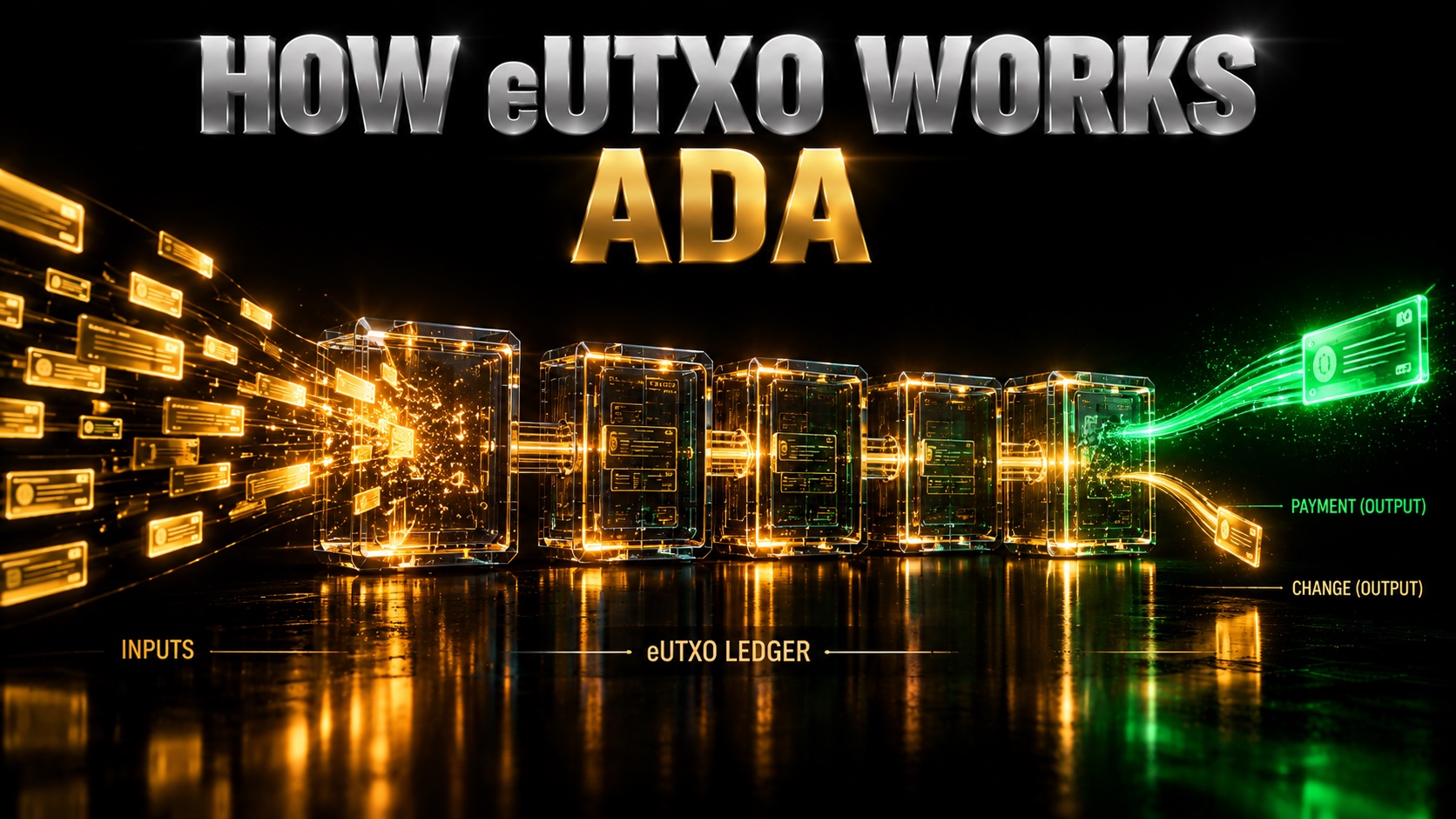
eUTXO stands for Extended Unspent Transaction Output, an accounting model that treats crypto balances like physical cash notes rather than a single bank account balance. Bitcoin uses the plain UTXO version. Cardano extends it so that outputs can carry data and be governed by smart contract logic.
On Ethereum, your address has a balance, and a transaction edits that balance in place, much like a bank updating an account. On Cardano, a transaction consumes specific existing outputs in full and creates new ones. If you hold a 50 ADA “note” and pay 10 ADA, the 50 is spent and two new outputs appear: 10 to the recipient and the change back to you.
| Feature | Cardano eUTXO | Ethereum Account Model |
|---|---|---|
| How balances are stored | Discrete outputs, like cash notes | A single balance per address |
| What a transaction does | Spends whole outputs and creates new ones | Edits shared global state |
| Knowing the outcome in advance | Deterministic: validity and fee can be computed before submitting | Depends on state at execution time |
| Failed transaction cost | Scripts are checked locally first, so failed script execution is rare | A failed transaction can still consume gas |
| Parallel processing | Natural, because independent outputs do not touch each other | Harder, because transactions contend for shared state |
| Main drawback | Many users touching one contract must be coordinated carefully | Simpler to build shared, pooled applications |
The practical benefit is predictability. Because a transaction names exactly which outputs it spends, a wallet can compute whether it will succeed and what it will cost before it is ever broadcast. The base fee formula is public and fixed by protocol parameters: currently 0.155381 ADA plus 44 lovelace per byte of transaction size.
The cost is design friction. Applications where many users must interact with one shared pool, such as an automated market maker, are harder to build on eUTXO, because two users cannot spend the same output at once. Developers work around this with batching and other patterns, but it is one honest reason DeFi on Cardano developed more slowly than on account-based chains.
Native Tokens: Minting Without a Smart Contract
On Ethereum, a new token is a smart contract. Its transfer logic, its balances and its approval rules all live in custom code that someone wrote, which is why token contracts can contain bugs or hidden behaviour.
Cardano took a different route with the Mary hard fork in March 2021. Tokens other than ADA are tracked by the ledger itself, alongside ADA, in the same outputs. Creating a token requires a minting policy that defines who can issue or burn it, but moving the token afterwards does not run any custom contract code.
- Transfers use the same ledger rules as ADA itself
- There is no per-token transfer contract that can be exploited
- The ERC-20 style “approve” mechanism, a common route for wallet-draining scams, does not exist at the ledger level
- The minting policy still matters: a poorly designed policy can allow unlimited issuance, so readers should check it for any token they hold
Ouroboros Proof of Stake and Liquid Staking
Cardano secures itself with Ouroboros, a proof-of-stake protocol. Instead of miners, stake pool operators (SPOs) run the servers that produce blocks. ADA holders delegate their stake to a pool, and the more stake a pool attracts, the more often it is selected to produce a block and earn rewards.
The design choices here are genuinely unusual, and they are the strongest part of the Cardano user experience:
- No lock-up. Delegated ADA stays in your own wallet and remains spendable at any time.
- No delegator slashing. If a pool performs badly, you miss rewards for that period; your principal is not confiscated.
- No minimum. Any amount of ADA can be delegated.
- Low cost. Registering a stake key requires a refundable 2 ADA deposit plus a normal transaction fee.
This is sometimes called liquid staking by default. It contrasts sharply with models where validators or restakers can be slashed for misbehaviour, which we covered in our EigenLayer restaking explainer.
The participation numbers reflect that design. In epoch 656, about 21.4 billion ADA was actively staked, which is roughly 58% of the ledger’s circulating supply, spread across about 2,900 registered stake pools. Based on on-chain reward data from recent epochs, the gross reward rate is roughly 2% a year before pool fees. That is modest, and as section 5 explains, most of it is paid from a finite reserve rather than from fees.
4. Decentralised Governance: The Voltaire Era and DReps
The question every blockchain eventually faces is simple: who decides what changes? For most of its history, Cardano’s honest answer was IOG and the Cardano Foundation. The Voltaire era was designed to change that answer to ADA holders.
It arrived in two hard forks. Chang (1 September 2024) introduced the governance framework, and Plomin (29 January 2025) switched on full community governance, including the power to approve withdrawals from the on-chain treasury. The Cardano Constitution was then ratified with the support of about 85% of voting stake and enacted on-chain on 23 February 2025.
Decisions now pass through three bodies, each acting as a check on the others:
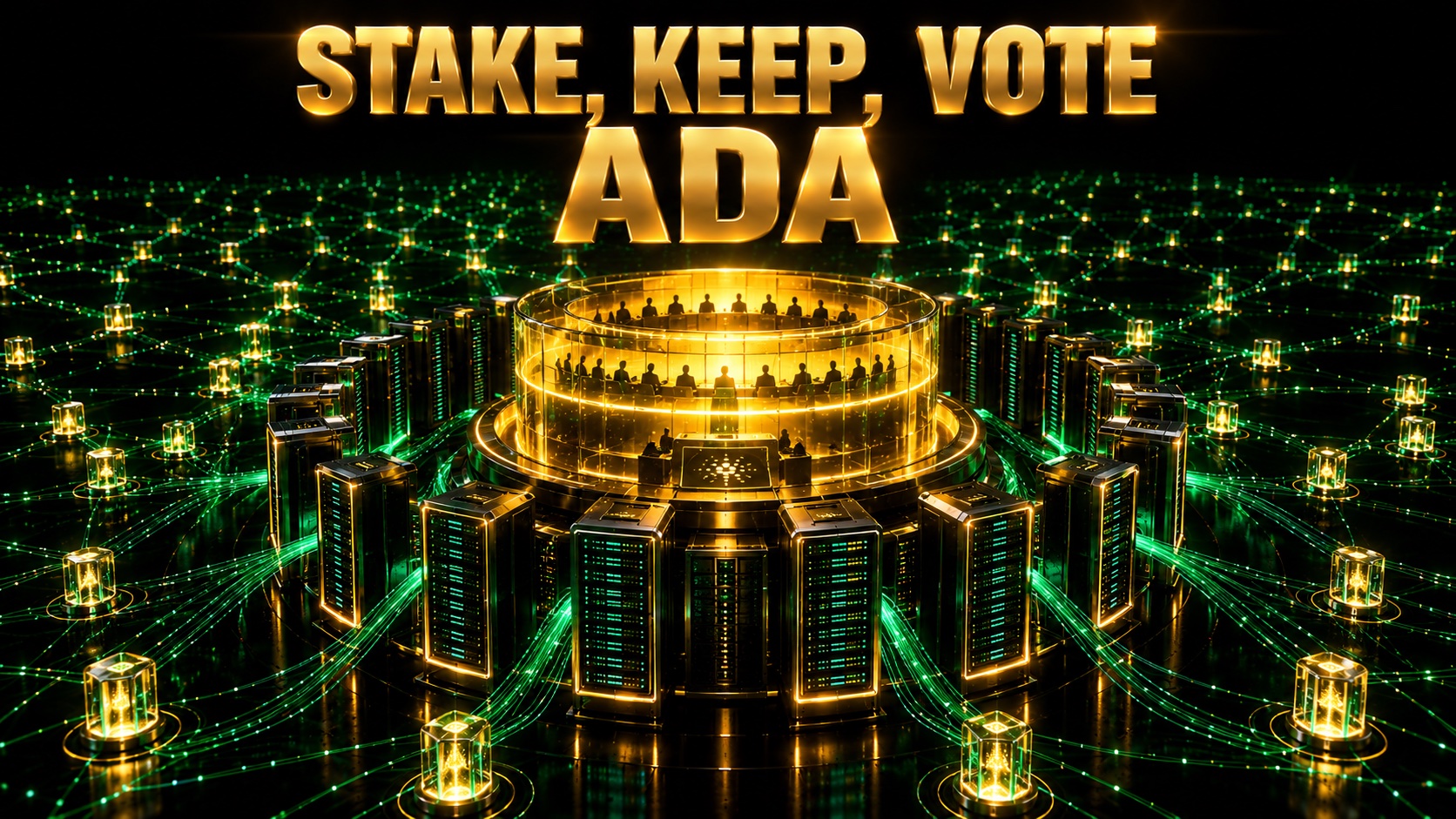
- Delegated Representatives (DReps): ADA holders delegate their voting weight to a DRep, much as they delegate stake to a pool. About 1,050 DReps were registered on-chain at the time of writing.
- Stake Pool Operators (SPOs): vote on specific action types, notably hard forks and certain security-related parameter changes.
- Constitutional Committee: checks that proposals are consistent with the on-chain constitution. It does not decide whether a proposal is a good idea, only whether it is constitutional.
As with staking, delegating a vote does not move or lock ADA. Holders keep full control of their tokens and can change their DRep at any time.
This matters for investors because the treasury is large. At epoch 657 the on-chain treasury held about 1.36 billion ADA, roughly $345 million at today’s price. How that money is spent, and whether spending produces real usage, is now decided by the community. That is a genuine decentralisation achievement. It is also a genuine risk, because a treasury can be spent badly by a vote just as easily as by a company.
5. Tokenomics and Supply Analysis
ADA has a hard cap of 45 billion tokens. Of that, about 38.9 billion has been issued, and roughly 6.1 billion remains in the protocol’s reserves, which fund staking rewards over time.
The emission mechanics are set by protocol parameters and are visible on-chain:
- Each epoch (five days), 0.3% of the remaining reserves is released into the reward pot, together with transaction fees
- 20% of that pot goes to the treasury before rewards are paid out
- Because the release is a percentage of a shrinking reserve, new issuance declines every epoch and approaches zero over time
- New supply comes from these reserve emissions, not from team or investor unlock cliffs
That structure is clean and legible, which the brand’s evidence rules favour. The harder question is what happens as the reserve shrinks.
Here the on-chain data is uncomfortable. In epoch 656, the network collected about 41,300 ADA in transaction fees, roughly $10,400 at today’s price, over five days. Reward distributions in recent epochs have run at about 6.2 million ADA each. Fees therefore cover well under 1% of what the network currently pays its stakers and pool operators. The rest is reserve emission.
That gap is not a crisis today, because the reserve still holds billions of ADA. It is, however, the single most important long-term number for this network. Security spending is being funded by a declining subsidy, and unless fee revenue grows by orders of magnitude, rewards will fall in step with the reserve.
6. Business Model and Ecosystem
Cardano is not a company, so it has no revenue in the corporate sense. Its “business model” is the fee market: users pay ADA to transact, and those fees plus reserve emissions pay the people who secure the network.
Who is using it? The honest answer is fewer people than the market cap suggests. Epoch 656 recorded about 127,000 transactions over five days, around 25,000 a day. The chain carries native tokens, NFT collections, decentralised exchanges and lending protocols, but none of these operate at the scale of their Ethereum or Solana equivalents.
- DeFi: about $66 million in total value locked, according to DefiLlama
- Stablecoins and real-world assets: present, but small relative to other major chains
- Enterprise and privacy: the Midnight partner chain (see section 8) is the most credible institutional story in the ecosystem today
- Institutional access: CME launched regulated ADA futures on 9 February 2026
Readers comparing chains should note that the Ethereum and Solana ecosystems we have covered separately, in our Ethereum 2026 outlook and Solana deep dive, each hold many times Cardano’s DeFi capital.
7. On-Chain and Market Data: Testing the Ghost Chain Claim
The fairest way to handle a loaded phrase like “ghost chain” is to put numbers against it.
- Staking participation: about 58% of circulating ADA is staked. This is high by industry standards and shows holders are engaged with the network’s security.
- Decentralisation of block production: about 2,900 stake pools are registered, and the protocol’s incentives are tuned toward 500 saturated pools, which discourages any single operator from growing too large.
- Transactions: around 25,000 a day in the most recent full epoch. The network is used, but lightly.
- Fees: about 41,300 ADA per five-day epoch, a very small figure for a network valued at roughly $9.5 billion.
- DeFi TVL: about $66 million, against roughly $54.3 billion on Ethereum and $6.5 billion on Solana.
The verdict from the data is mixed, and that is the honest answer. “Ghost chain” is wrong if it means nobody participates: the staking and governance numbers show a large, active holder base. It is closer to right if it means the chain carries little economic activity relative to its valuation. On fees and TVL, Cardano’s market cap is being priced on what the network might become, not on what it currently does.
8. Scaling and Privacy: What Lies Ahead
Solving Throughput: Ouroboros Leios and Hydra
The most repeated criticism of Cardano is throughput. The current consensus protocol, Ouroboros Praos, is deliberately conservative, and the chain processes transactions one block at a time.
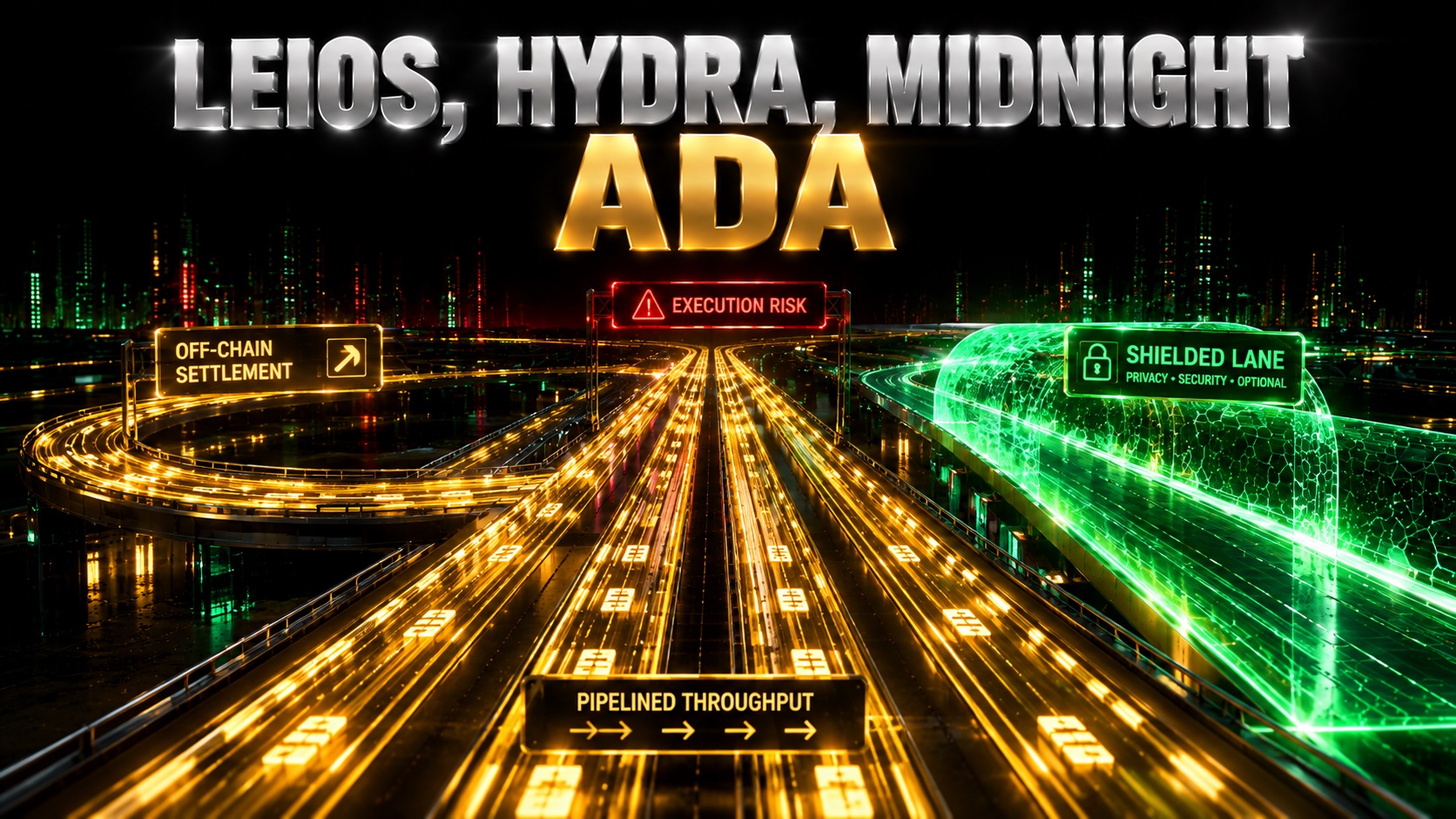
Ouroboros Leios is the answer at the base layer. Rather than doing every step of block production in sequence, Leios splits the work into stages that run in parallel, so the network can endorse far more transactions without weakening its security model. The Leios team’s published roadmap targets roughly 30 to 65 times current throughput. No mainnet activation date has been announced; development is ongoing, with a testnet being stabilised.
The groundwork is in place. The van Rossem hard fork activated on 18 July 2026, as recorded in Cardano’s official hard fork history, moving mainnet to protocol version 11 with ledger and Plutus improvements. Leios is expected to follow as a separate upgrade.
Hydra works differently. It is a Layer 2 protocol that lets a group of participants open an off-chain “head”, transact among themselves at high speed, and settle the result back to Cardano. The Hydra team announced in February 2026 that the project had entered an adoption phase focused on production use, with projects such as DeltaDeFi and Masumi building on it.
Data Protection: The Midnight Partner Chain
Midnight is a separate blockchain that operates alongside Cardano as a partner chain. It is built around Zero-Knowledge Proofs (ZKPs), a cryptographic method where one party can prove to another that a statement is true without revealing any underlying sensitive details.
The practical example is identity. A user could prove they are over 18, or that they passed a compliance check, without handing over the underlying personal data. That is a different goal from an anonymous privacy coin: Midnight is designed for selective disclosure that regulated businesses can work with.
- Midnight’s federated mainnet launched on 31 March 2026, with node operators that include Google Cloud and Vodafone
- Its token, NIGHT, first launched as a Cardano native asset in December 2025
- Holding NIGHT generates DUST, a shielded, non-transferable resource used to pay for transactions on Midnight
- The network is federated in its first phase, which means a curated set of operators, not open participation
For ADA holders the key question is value accrual. Midnight uses its own token, so its success does not automatically flow to ADA. It strengthens the Cardano ecosystem’s credibility with institutions, but it is not a fee stream for ADA.
9. Macro, Regulation and the Competitive Landscape
Cardano is an altcoin, and altcoins historically move with Bitcoin but with larger swings in both directions. ADA’s 23% weekly gain came during a broad crypto rebound, and its 69% annual decline reflects how much harder altcoins were hit than Bitcoin through the preceding drawdown.
On regulation, the picture has improved materially. The SEC named ADA as a security in its 2023 lawsuits against Coinbase and Binance, but the agency dismissed the Coinbase case in February 2025 and moved to dismiss the Binance case in May 2025. CME’s regulated ADA futures began trading in February 2026, and under the generic listing standards the SEC approved in September 2025, ADA crossed six months of regulated futures trading in August 2026. Grayscale has filed to convert its Cardano Trust into an exchange-traded fund under the ticker GADA. At the time of writing, no US spot ADA ETF is trading, and approval should not be assumed.
The competitive landscape is the hardest part of the thesis:
- Ethereum dominates smart contract capital, developers and institutional tokenisation
- Solana leads on raw throughput and retail trading activity
- Other Layer 1s and Ethereum Layer 2s compete for the same developers and liquidity
Cardano’s pitch is not to win on speed today. It is to be the chain where correctness, predictable costs and on-chain governance matter most. Whether enough users value those properties is the open question.
10. Bull vs Bear Case
🐂 Bull Case
- Security by design: peer-reviewed consensus, formal specification and deterministic eUTXO transactions reduce whole classes of failure that have cost other chains dearly
- Best-in-class staking UX: about 58% of supply staked, with no lock-up and no delegator slashing, gives the network a broad and sticky security base
- Real decentralised governance: a ratified constitution, over 1,000 DReps and a treasury of about 1.36 billion ADA controlled by holders, not a company
- Institutional plumbing is arriving: CME futures are live, ETF filings exist, and Midnight has enterprise node operators including Google Cloud
- Catalysts pending: Leios could address the throughput critique directly if it reaches mainnet at its targeted scale
🐻 Bear Case
- Thin economic activity: about $66 million in DeFi TVL and around $10,000 of fees per epoch do not support a roughly $9.5 billion valuation on current usage
- Subsidised security: fees cover well under 1% of staking rewards; the gap is filled by a reserve that shrinks every epoch
- Slow delivery: Leios has no mainnet date, and Cardano’s history is one of careful work that repeatedly arrives later than markets expect
- Developer friction: eUTXO and a Haskell-based toolchain make shared-state applications harder to build than on account-based chains
- Value leakage: Midnight’s success accrues primarily to NIGHT, not ADA
11. Technical Price Analysis
ADA is in a short-term rebound within a longer downtrend. The token trades near $0.253, above both its 50-day moving average (about $0.205) and its 200-day moving average (about $0.216). Price moving above both averages after a long decline is an early sign of a change in trend, but it is not confirmation of one.
The broader context is sobering. Over the past twelve months ADA fell from a high near $0.874 in October 2025 to a low near $0.144 in late June 2026, and today’s price sits right at the top of its 90-day range after a sharp one-week move.
- Immediate resistance: the current 90-day high near $0.253
- First support: the 200-day moving average near $0.216
- Deeper support: the 50-day moving average near $0.205, then the June low near $0.144
- Caution flag: a 23% gain in seven days is an extended move, and pullbacks after moves of this size are common
None of this is a recommendation to buy or sell at any level. Levels are context for risk management, not entry signals.
12. Investment Outlook
The honest summary is that Cardano is an engineering project priced as if its adoption problem will be solved. The protocol design, staking model and governance system are genuinely strong. The fee revenue and application activity that would justify the valuation on fundamentals are not there yet.
That makes ADA a long-duration bet on execution, suitable only as a small, speculative allocation for readers who can tolerate large drawdowns. It is not an income asset: staking rewards are modest and mostly funded by emissions.
- Thesis improves if: Leios reaches mainnet on schedule and fee revenue grows meaningfully, DeFi TVL rises in dollar terms rather than only in ADA terms, or a spot ETF brings sustained institutional demand
- Thesis breaks if: Leios slips again without usage growth, the treasury is spent on activity that does not stick, or the reserve runs down with fees still negligible
- Most likely to disappoint: anyone treating a strong week or an ETF headline as proof that the adoption problem is solved
For a contrast in how a protocol can connect real usage to its token, see our Uniswap fee switch deep dive.
Follow OneMoreBitcoin on YouTube for regular crypto market updates.
13. Conclusion
Cardano matters because it is the industry’s most serious attempt to build a blockchain the way critical infrastructure is built: specified first, verified carefully, and governed openly. Its staking and governance systems are proof that the method can deliver things other chains have not.
The biggest opportunity is that the pieces critics said were missing, scaling, privacy and institutional access, are now either live or in late-stage development. The biggest risk is that the market has been patient for nine years, and patience is not a business model. A network whose fees cover less than 1% of its security budget is still waiting for its users.
What would change the thesis is measurable. Watch fees per epoch, DeFi TVL in dollar terms and the Leios timeline. If those move together, the “ghost chain” label will fade on its own. If they do not, the careful engineering will have produced an excellent network that too few people use.
FAQ
What is the difference between Cardano and ADA?
Cardano is the Layer 1 blockchain network, and ADA is its native token. ADA is used to pay transaction fees, to delegate stake to the pools that produce blocks, and to vote on governance proposals. The smallest unit of ADA is the lovelace, and 1 ADA equals 1,000,000 lovelace.
Can you lose your ADA through staking slashing?
No. Cardano does not slash delegators, so a poorly performing pool only costs you rewards, not principal. Your ADA stays in your own wallet during delegation and remains spendable at any time. The usual risks of holding any crypto asset, including price falls and losing your keys, still apply.
What makes eUTXO safer than Ethereum’s model?
eUTXO transactions are deterministic. Because a transaction names exactly which outputs it spends, a wallet can check locally whether it will succeed and what it will cost before submitting it, which makes failed script execution and surprise fees rare. The trade-off is that applications with lots of users touching shared state are harder to build.
Is Cardano really a ghost chain?
Partly. About 58% of circulating ADA is staked and more than 1,000 DReps take part in governance, so holders are clearly active. But DeFi TVL is about $66 million and fees are around $10,000 per five-day epoch, which is very low for a network valued at roughly $9.5 billion.
Is Midnight a privacy coin on Cardano?
No. Midnight is a separate partner chain that uses zero-knowledge proofs for selective disclosure, so users and businesses can prove facts without revealing the underlying data. It launched a federated mainnet in March 2026 and uses its own token, NIGHT, rather than ADA.
Is there a spot Cardano ETF?
Not in the US at the time of writing. CME launched regulated ADA futures in February 2026, and Grayscale has filed to convert its Cardano Trust into an ETF under the ticker GADA. Approval depends on the SEC and should not be treated as certain.
What is the maximum supply of ADA?
ADA has a fixed maximum supply of 45 billion tokens. About 38.9 billion has been issued, and the remaining reserve is released gradually to fund staking rewards, at a rate that declines every epoch.
Disclaimer:
This article is for educational and informational purposes only. It does not constitute investment, financial, legal or tax advice, and it is not a recommendation to buy, sell or hold any digital asset.
Cryptocurrency is highly volatile and speculative. Prices can move sharply at any hour of any day, and you can lose some or all of the capital you invest. Digital assets are not bank deposits, they are generally not covered by deposit protection or investor compensation schemes, and the regulatory treatment of a token, platform or service can change quickly. Further risks include exchange or custodian failure, smart contract vulnerabilities, bridge and oracle failure, loss of private keys, and scheduled token unlocks that expand supply.
Investors should conduct their own due diligence and consider their own circumstances, time horizon and risk tolerance before making any financial decision. Consult a licensed financial adviser if you are unsure. Past performance is not indicative of future results.
OneMoreBitcoin and OneMoreMoney.com accept no responsibility for any loss incurred from reliance on the information provided in this article.