
SpaceX (SPCX) Q2 2026: A Big Beat and an $18B Capex Bill
SpaceX (SPCX) Q2 2026: A Big Beat and an $18B Capex Bill
SpaceX reported its first quarterly results as a public company on 4 August 2026, and the reaction told you more than the numbers did. Revenue beat. Earnings beat. Adjusted EBITDA beat by a wide margin. The stock fell anyway, to a fresh post-listing low of $108.27 on 5 August.
Then it reversed. The first lock-up tranche expired on 6 August without the flood of selling almost everyone expected, and the shares closed higher. A day later they jumped roughly 16% to about $133, finishing the week up 23%.
That round trip is the story. In three sessions the market moved from pricing a capital-spending panic to pricing a growth engine, without a single new earnings figure arriving. Understanding why requires separating what SpaceX earns from what SpaceX spends, because for the first time investors can see both.
Key Financial Metrics
| Metric | Q2 2026 |
|---|---|
| Share price (7 Aug close) | ~$133 |
| Market capitalisation | ~$1.75 trillion |
| Revenue | $7.81B (+92% YoY) |
| Adjusted EBITDA | $3.54B (+191% YoY) |
| Net loss | $541M |
| Diluted EPS | ($0.09) vs ($0.26) expected |
| Capital expenditure | $18.37B (of which $15.83B AI) |
| Connectivity revenue | $4.3B |
| AI revenue | $2.56B (+247% YoY) |
| Space revenue | $962M |
| Starlink subscribers | 12.0M (+100% YoY) |
| Backlog | $47.5B |
| Cash, equivalents and marketable securities | ~$100B |
Data as of 7 August 2026. Verify before publishing.
1. What Investors Actually Own Now
SpaceX today is not the launch company most people picture. It reports three segments, and launch is the smallest of them.
- Connectivity is Starlink, the satellite broadband business. At $4.3 billion it is roughly 55% of group revenue.
- AI is the former xAI, which SpaceX acquired in an all-stock deal on 2 February 2026 and folded into the parent as an internal division in May. It covers Grok, the Colossus data centre estate and the X platform.
- Space is launch and the Starshield government work, at $962 million the smallest line.
That structure matters because it changes the question. A reader evaluating SpaceX is not underwriting rockets. They are underwriting a satellite broadband utility with strong economics that is simultaneously financing a frontier AI compute business and a launch programme on one income statement. We covered the setup ahead of the listing in our SpaceX IPO 2026 analysis, and the first public quarter largely confirms that framing.
The company listed on Nasdaq on 12 June 2026 at $135 per share, raising about $85.7 billion including the overallotment. That is the largest IPO ever completed.
2. Why the Market Sold a Clean Beat
Every headline line came in ahead of expectations. Revenue of $7.81 billion grew 92% year over year against consensus near $6.72 billion. The loss per share of $0.09 was well inside the $0.26 the street modelled. Adjusted EBITDA of $3.54 billion rose 191%.
The problem sat below those lines. Capital expenditure came in at $18.37 billion, more than six times the year-ago figure, and $15.83 billion of it went into AI infrastructure. SpaceX spent well over twice its quarterly revenue on capital assets in a single quarter, and management issued revenue guidance while declining to give a capital spending envelope for the rest of the year.
That asymmetry is what broke the stock on 4 and 5 August. Investors were handed an upgraded revenue outlook and no way to price what it would cost to deliver.
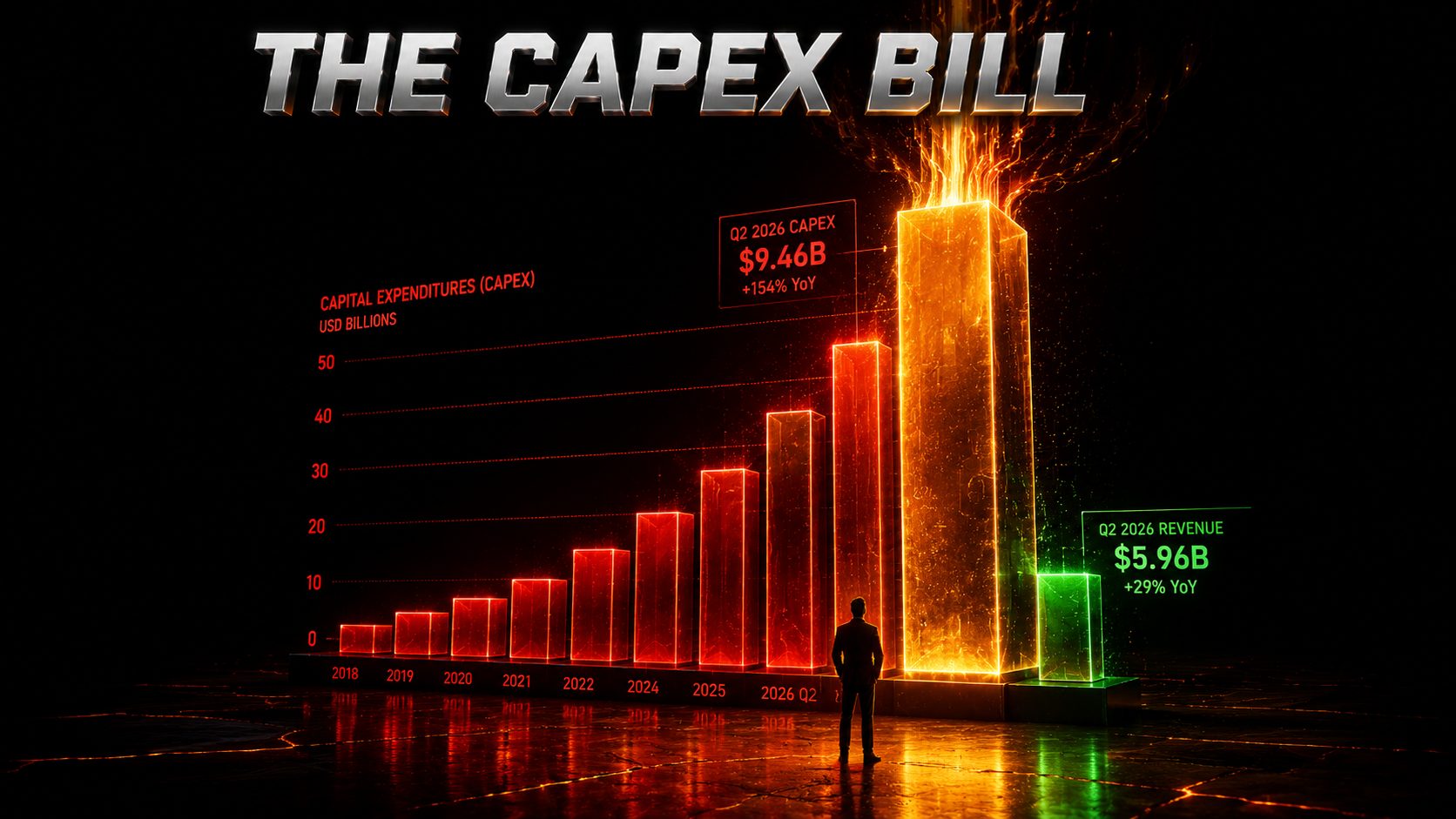
The counter-argument, which management made directly, is that AI compute assets pay back unusually fast and behave more like a cost of goods sold than like conventional infrastructure. If that is right, the spending is a growth investment routed through the balance sheet. If it is wrong, and utilisation disappoints or compute pricing compresses as industry supply arrives, SpaceX has committed tens of billions to assets that depreciate faster than they earn.
One quarter of disclosure is not enough to settle that. It is the central open question in the name, and honest analysis should say so rather than pick a side early.
3. Starlink Is the Engine That Funds Everything
The connectivity segment is where the durable business lives.
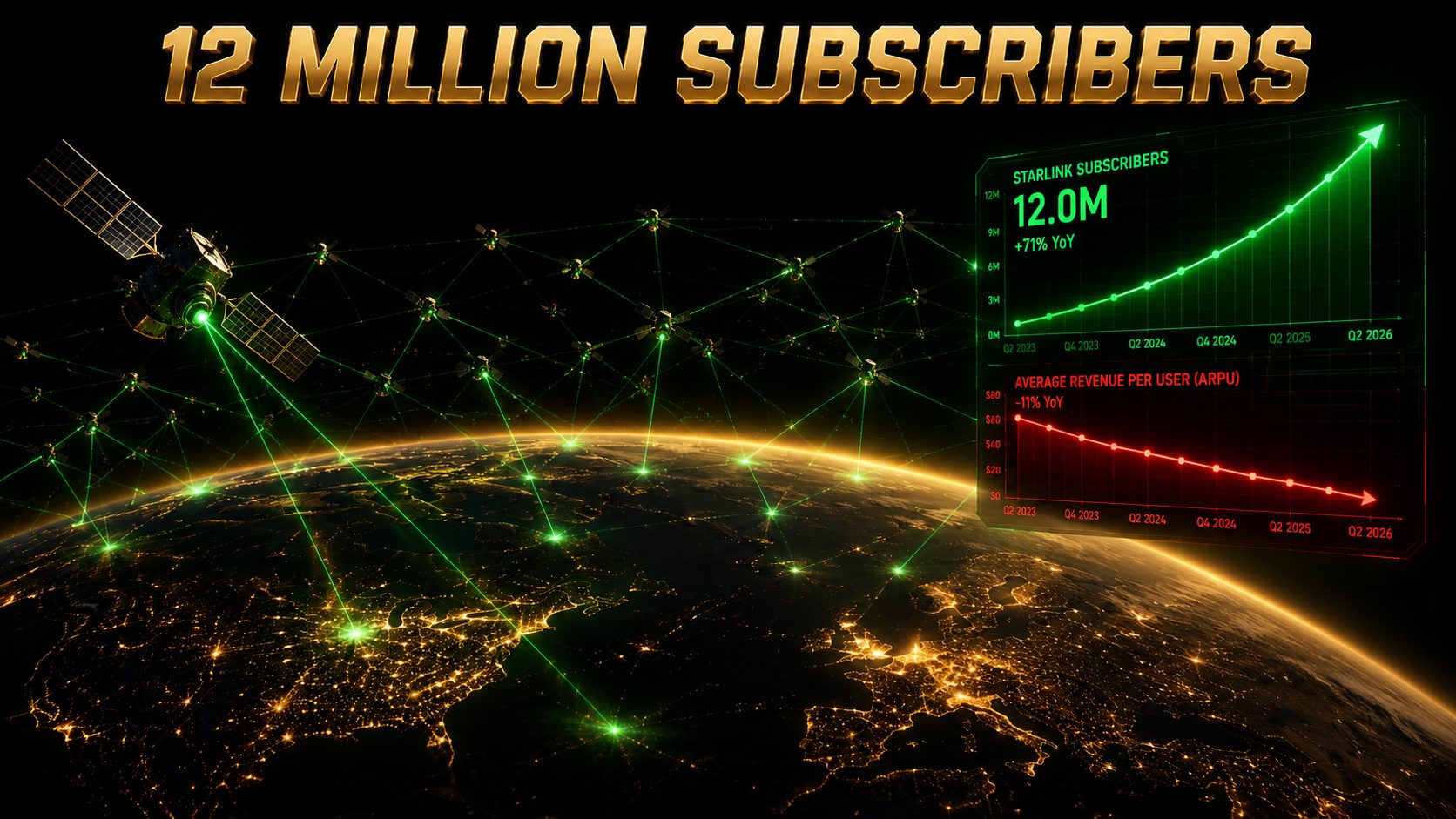
- Subscribers reached 12.0 million, double the year-ago level and up 17% from the first quarter.
- Net additions were 1.7 million in the quarter alone.
- Average revenue per user fell 22% year over year as the mix shifted toward international markets and cheaper tiers.
The ARPU decline sounds alarming and is not, at least not yet. Doubling a subscriber base while pushing into lower-income geographies mechanically drags average pricing down. The question is whether volume growth and falling marginal cost per subscriber more than offset it, and in this quarter they did.
Starlink is also the segment with the clearest competitive moat, which we return to below. For investors, the simplification worth holding onto is this: Starlink currently generates the group’s earnings power, and the AI and Space segments currently consume it.
4. Growth Drivers Beyond Starlink
Three developments carry the forward case, and all three are contractual or committed rather than speculative.
AI compute contracts. SpaceX signed $14.1 billion of new cloud services agreements during the quarter, and total backlog reached $47.5 billion. The anchor deal is with Anthropic, which agreed in May 2026 to pay $1.25 billion per month for access to the Colossus 1 facility near Memphis, running to May 2029 across roughly 300 megawatts and more than 220,000 Nvidia GPUs. That single contract is worth over $40 billion across its term, though either party can exit on 90 days’ notice.
The Cursor acquisition. SpaceX agreed in June 2026 to buy Anysphere, the company behind the AI coding tool Cursor, for $60 billion in stock, with closing expected in the third quarter. Cursor reached roughly $4 billion in annualised revenue in under four years, so the price is about 15 times revenue. It is a full multiple, and it buys a product category where Grok has not competed well.
Terafab. On 6 August, Tesla and SpaceX confirmed a $16.8 billion first phase for a semiconductor plant in Grimes County, Texas, combining logic, memory, packaging and test at one site. It is intended to supply chips for Optimus robots, robotaxis and orbital data centres. Filings suggest total spending across all phases could eventually reach far higher. This announcement, alongside an analyst upgrade, is a large part of why the shares rallied on 7 August.
Readers following the power side of the AI buildout will recognise the pattern from our Vistra analysis, and the chip supply constraint Terafab is meant to address is the same one we examined in our Micron HBM piece.
5. Competitive Advantages
SpaceX’s moat is unusual because it comes from vertical integration rather than from any single product.
- Launch cost control. Owning the rocket means deploying its own satellites at internal cost, which no competing broadband constellation can match.
- Regulatory and orbital position. Spectrum rights and orbital slots are finite, and SpaceX secured them early and at scale.
- Compute scale. The Colossus estate gives it a position in AI infrastructure that very few companies can fund.
- Cross-subsidy capacity. Roughly $100 billion in cash, equivalents and marketable securities lets it absorb losses in two segments while a third compounds.
On the launch side, competition is real but distant in scale. Rocket Lab has built a credible position in the small and medium launch market, as we covered in our Rocket Lab analysis, and lunar-focused operators like Intuitive Machines are carving out adjacent niches. None of them constrains SpaceX today.
Starship remains the long-term cost lever. Flight 13 on 24 July 2026 was the first Starship mission to deploy operational satellites, releasing 20 next-generation Starlink units, and the ship survived a soft splashdown in the Indian Ocean intact. The booster did not: only 10 of its 13 engines relit for the landing burn and it was destroyed on impact. That is genuine progress and a genuine reminder that the programme is not finished.
6. Risks Investors Should Weigh
- Share supply. The 6 August lock-up released 911.5 million shares, lifting the freely tradable float from about 4.9% to 11.8% of shares outstanding. Roughly another 319 million shares became eligible as soon as 12 August, with further tranches after that. Shares held by Elon Musk and a selected group of insiders stay locked until the middle of 2027.
- No capex guidance. Until the company frames its spending, the market will set its own worst case, and every revenue upgrade invites the question of what it cost.
- Supply concentration. The AI data centres are built on Nvidia silicon, which removes optionality at a moment when compute pricing is the swing variable.
- Contract concentration. The Anthropic agreement is large, cancellable on 90 days’ notice, and central to the AI revenue story.
- Governance. Musk retains voting control, and the xAI and Cursor transactions were related-party in character.
7. Valuation: What SpaceX Stock Already Prices In
At roughly $133, SpaceX carries a market capitalisation near $1.75 trillion on a business generating about $7.8 billion of quarterly revenue and a GAAP loss. Conventional multiples do not do useful work at that ratio. The valuation rests on the forward path, not the trailing numbers.
Management has given two anchors. It expects to exit 2026 at roughly a $100 billion annualised revenue run rate, and it has pulled its internal $1 trillion revenue ambition forward to 2030 from 2031. The first is checkable within two quarters. The second is a direction of travel, not a forecast, and should be treated that way.
Wall Street cannot agree. Across roughly 30 analysts the consensus sits at Moderate Buy with an average target near $239. Morgan Stanley carries an Overweight rating at $300. JPMorgan moved to $240 and Bernstein to $248. Argus upgraded to Buy on 7 August with a $160 target, less than half of Morgan Stanley’s number. When targets on a mega-cap span that range, the honest reading is that the AI compute payback question is genuinely unresolved, and position sizing matters more than direction.
🐂 Bull Case
- Starlink doubled subscribers while holding its position as the group’s profit engine.
- $47.5 billion of backlog and $14.1 billion of contracts signed in one quarter give the AI segment real visibility.
- Roughly $100 billion of liquidity funds the current programme without needing the capital markets.
- Terafab and Starship attack the two hardest constraints, chip supply and launch cost, from the inside.
- The lock-up was absorbed without the collapse the market had priced.
🐻 Bear Case
- Capital spending of $18.37 billion in one quarter against $7.81 billion of revenue is unsustainable if payback disappoints.
- Depreciation on the current buildout will suppress reported profit for years.
- No capex guidance leaves the largest variable in the model undisclosed.
- Several hundred million more shares reach the market through the autumn.
- The AI revenue story leans heavily on one cancellable contract.
8. Final Thoughts
SpaceX matters because it has assembled something no other listed company has: a profitable global broadband utility, a launch monopoly in practical terms, and a top-tier AI compute estate, all funded from one balance sheet.
The biggest opportunity is that the AI segment becomes a second Starlink, in which case today’s capital spending will look obvious in hindsight. The biggest risk is that it does not, and the group turns out to be a satellite broadband business carrying an enormous AI capital burden.
Nothing in this quarter resolves that. What it did establish is that Starlink works, that the AI revenue is contracted rather than hypothetical, and that the balance sheet can fund the experiment for a while. The next disclosure worth waiting for is a capital spending envelope, not another revenue upgrade. Investors who want that question answered before committing are being patient, not timid.
If you want to keep following how the AI buildout reshapes these businesses, read our related coverage and subscribe for future updates. You can also find our video analysis on the OneMoreStock YouTube channel.
FAQ
Why did SpaceX stock fall after beating earnings?
The stock fell because capital expenditure of $18.37 billion came in far above expectations while management declined to guide on future spending. Investors were given a stronger revenue outlook without any way to estimate its cost. The reaction was about cash flow, not about the earnings beat itself.
How many Starlink subscribers does SpaceX have?
Starlink reported 12.0 million subscribers at the end of Q2 2026, double the year-ago figure and up 17% from the first quarter. Net additions were 1.7 million in the quarter. Average revenue per user fell 22% year over year as growth shifted toward international and lower-priced tiers.
What happened with the SPCX lock-up expiration?
The first tranche expired on 6 August 2026 and released 911.5 million shares, more than doubling the freely tradable float to about 11.8% of shares outstanding. The shares rose that day rather than falling. Further tranches follow through the autumn, and Musk’s own holdings remain locked until mid-2027.
Is SpaceX profitable?
Not on a GAAP basis. SpaceX reported a net loss of $541 million in Q2 2026, though that was a significant improvement year over year. Adjusted EBITDA was positive at $3.54 billion. The gap between the two is mostly depreciation and stock compensation, and it will widen as the current capital spending enters the depreciation line.
What is Terafab?
Terafab is a semiconductor plant Tesla and SpaceX confirmed in Grimes County, Texas on 6 August 2026, with a $16.8 billion first phase. It is designed to combine logic, memory, packaging and testing at a single site, supplying chips for Optimus robots, robotaxis and orbital data centres.
What would make the investment case clearer?
The single most useful disclosure would be a forward capital expenditure envelope, followed by utilisation data for the Colossus compute estate that supports management’s fast-payback claim. Evidence that Starlink ARPU has stabilised would also help. Until then the range of reasonable outcomes stays unusually wide.
Financial Disclaimer:
This article is for educational and informational purposes only and should not be considered financial or investment advice. Investing involves risk, including the possible loss of capital. Always conduct your own research and consult a qualified financial adviser before making investment decisions.