
Tower Semiconductor (TSEM): Inside the Silicon Photonics Bet
Tower Semiconductor (TSEM): Inside the Silicon Photonics Bet
1. Introduction
For most of its history, Tower Semiconductor was a company investors filed under “specialty analog foundry” and then stopped thinking about. It made image sensors, power management chips, and radio frequency components in older fabs nobody would confuse with a leading-edge logic megafab. In 2022 Intel agreed to buy it for $5.4 billion, and when Chinese regulators let that deal expire in 2023, the consensus view was that Tower had missed its moment.
That view is now badly out of date. The AI build-out has run into a physical constraint that has nothing to do with transistor density: moving data between accelerators fast enough, and cheaply enough in power terms, to keep those accelerators busy. Copper is running out of headroom. The answer the industry has settled on is light, and Tower owns one of the few open foundry silicon photonics platforms qualified for high volume production.
The market has noticed. Tower shares have traded between $43.12 and $319.94 over the past 52 weeks, a range that tells you how violently the narrative repriced. In May 2026 the company disclosed $1.3 billion in signed silicon photonics contracts for 2027 revenue. In July it announced a $3 billion capacity expansion in Japan with a $1 billion grant from the Japanese government.
If Tower executes, a company that did $1.57 billion of revenue in all of 2025 has already contracted more than $1.3 billion of a single product line for 2027. If it does not, investors are paying over 100 times trailing earnings for a mid-tier foundry with structurally older fabs. This article provides a complete, investor-grade deep dive into Tower Semiconductor’s technology, business model, financials, risks, and long-term investment outlook.
2. Company Overview: From TowerJazz to Specialty Foundry Leader
Tower Semiconductor was founded in 1993 in Migdal Haemek, Israel, and listed publicly the following year. Its growth came through acquisition rather than greenfield construction: Jazz Semiconductor in California in 2008, a Micron facility in Japan in 2011, a Panasonic joint venture in 2014 that became TPSCo, and a Maxim Integrated fab in San Antonio in 2016. It rebranded from TowerJazz in 2020.
The result is a footprint that looks nothing like a single-site pure play. Tower operates fabs in Israel, California, Texas, and the Hokuriku region of Japan, and shares a 300mm facility in Agrate, Italy with STMicroelectronics. Russell Ellwanger has been chief executive throughout most of this expansion.
The business itself is deliberately narrow. Tower does not chase leading-edge digital logic, where TSMC’s capital spending makes competition pointless. It sells process platforms customers cannot easily get elsewhere.
- Core process platforms: SiGe and BiCMOS, silicon photonics, RF SOI and RF CMOS, mixed signal CMOS, CMOS image sensors, integrated power management (BCD), non volatile memory, and MEMS
- Ownership structure: Tower holds 51% of TPSCo, with Nuvoton Technology Corporation Japan holding the remaining 49%
- Named customers over the years: Intel, Broadcom, Samsung, ON Semiconductor, Panasonic, Teledyne, Skyworks Solutions, Semtech, Innolight, and Vishay Siliconix
- End markets: AI and data centre optical connectivity, mobile radio frequency front ends, automotive, industrial, aerospace and defence, and medical imaging
- Scale: roughly 5,613 employees, with fiscal 2025 revenue of $1.57 billion
The distinction that matters for investors is between generalised and bespoke capacity. GlobalFoundries competes on large-scale, standardised mature-node manufacturing. Tower runs a high-mix, lower-volume model built around process customisation, where a customer’s design is co-engineered with Tower’s process rather than dropped onto a standard node. That produces stickier customers and slower growth in normal times. It also means that when one of Tower’s niches suddenly becomes strategically critical, the company has very few substitutes standing in front of it.
3. Tower Semiconductor Silicon Photonics: Why Light Is Replacing Copper
Silicon photonics is the practice of building optical components, including waveguides, modulators, and photodetectors, directly onto a silicon wafer using conventional semiconductor manufacturing equipment. Rather than sending data as electrical current down a copper trace, the chip encodes it onto light.
The reason this matters right now is a bandwidth and power problem inside AI clusters. Training and inference workloads split a model across thousands of accelerators that must constantly exchange data. Copper loses signal integrity rapidly as data rates climb, and the circuitry required to compensate consumes a growing share of the power budget. At some point the network, not the accelerator, becomes the bottleneck.
Optical interconnect solves that, but historically the optics lived in a pluggable module at the edge of the switch. The industry’s next step, co-packaged optics, moves the optical engine into the same package as the switch or accelerator silicon, eliminating most of the electrical path. It also requires optical components manufactured with semiconductor-grade yield and volume, which is precisely the capability a photonics foundry sells.
Tower’s technical position rests on a few specific things:
- An open foundry model. Tower manufactures for customers who design their own photonic integrated circuits rather than selling its own finished optical modules, which makes it a supplier to competing module vendors simultaneously.
- Proven volume, not just capability. In June 2026 Tower and Marvell announced they had shipped over five million coherent photonic integrated circuits together, which is a manufacturing track record rather than a technology demonstration.
- A CPO foundry platform. Tower announced co-packaged optics foundry technology available on its silicon photonics and electronic IC platforms in November 2025, positioning it for the packaging transition rather than only the pluggable era.
- Supply chain lock-in upstream. In June 2026 Tower signed a multi-year agreement with IQE for Indium Phosphide epiwafers, securing a material input for optical connectivity products.
- Adjacent optionality. In February 2026 Tower and the Canadian firm Xanadu announced a partnership to manufacture photonic quantum hardware, co-engineering an ultra-low-loss silicon nitride material stack.
That last point mirrors a pattern we covered in our analysis of GlobalFoundries and its silicon photonics and quantum foundry bet. Photonics capability built for AI networking turns out to be transferable to photonic quantum computing. Neither company is being valued on quantum today, and neither should be, but it is a free option attached to capacity being built for a different reason.
The honest caveat is that silicon photonics is not a Tower monopoly. The process steps are difficult but not secret, and every serious foundry has a photonics roadmap. Tower’s advantage is time in market, qualified customer flows, and the fact that a design already qualified on its platform is expensive and slow to move elsewhere.
4. The $1.3 Billion Contract: What It Actually Means
On 13 May 2026, alongside first quarter results, Tower announced it had signed silicon photonics contracts worth $1.3 billion of 2027 revenue with its largest customers, and that it had received $290 million in customer prepayments for capacity reservation.
The prepayment is the part investors should focus on. Customers do not wire nine figures ahead of delivery for a product they might want. They do it when they are more worried about being unable to secure capacity than about the working capital cost. That is a demand signal a purchase order alone does not carry, and it funds a meaningful share of the capital expenditure required to serve the order.
Scale context makes the number easier to hold. Tower’s entire fiscal 2025 revenue was $1.57 billion across every process platform it operates. A single product line contracted at $1.3 billion for 2027 is therefore not an incremental growth driver. It is a restructuring of what the company is.
Management has been explicit about where this leads, stating a financial model target of $2.8 billion in annual revenue and $750 million in net profit for 2028. Against $1.57 billion of 2025 revenue and $220 million of 2025 earnings, that implies roughly a doubling of revenue and more than a tripling of net profit in three years. Management has also said customers committed to larger 2028 orders with additional prepayments due by January 2027, which gives investors a dated checkpoint rather than a vague promise.
Two things are worth keeping in proportion. The $1.3 billion is concentrated among Tower’s largest silicon photonics customers, so the disclosure is a customer concentration risk as much as a growth disclosure. And contracts signed in 2026 for 2027 delivery are not revenue until the wafers ship.
5. The $3 Billion Japan Expansion
On 14 July 2026, Tower announced a dual-track expansion of its 300mm silicon photonics, silicon germanium, and advanced packaging capability in Japan, with support from the Ministry of Economy, Trade and Industry. The company will invest approximately $3 billion net of $1 billion in Japanese government grants.
The structure has two parts. The first repurposes the Arai facility for new 300mm silicon photonics and advanced packaging output, supplementing production at Fab 7 in Uozu, with full readiness targeted for late 2027. The second adds an entirely new 300mm fab adjacent to Fab 7, delivering what the company describes as a multi-fold increase in silicon photonics and silicon germanium capacity.
Three implications follow. The grant materially changes the return profile, because a third of the headline investment is not funded by shareholders or lenders. The late 2027 readiness date lines up with the contracted 2027 revenue and the 2028 model. And the shift to 300mm matters commercially, since larger wafers lower unit cost and are a prerequisite for serving hyperscale volumes at competitive economics.
The risk is equally clear. This is a capital commitment made against a demand forecast, and fabs cannot be resized once the concrete is poured. The prepayments and signed contracts reduce that risk considerably. They do not eliminate it.
6. Business Model and Revenue Engine
Tower earns revenue by manufacturing wafers to customer designs. It does not sell branded end products, does not compete with its customers, and does not carry the demand risk of a finished module business. What it does carry is fixed-cost intensity, which makes utilisation the single most important operating variable in the business.
Management has described an incremental model in which additional revenue converts at roughly a 59% gross margin. When a fab is already running, the marginal wafer is close to pure contribution. This is why Tower’s earnings grow so much faster than its revenue on the way up, and it is also the mechanism that would work brutally in reverse in a downturn.
- Revenue streams: wafer manufacturing across silicon photonics, SiGe and BiCMOS, RF SOI and RF CMOS, power management, image sensors, and MEMS
- Contract structure: increasingly long-dated capacity agreements with prepayments, rather than purely transactional wafer orders
- Named partners: Marvell in coherent photonics, IQE in Indium Phosphide epiwafers, STMicroelectronics in the shared Agrate 300mm facility, Nuvoton in TPSCo, Xanadu in photonic quantum hardware
- Moat: qualified process flows, high switching costs once a design is qualified, geographically diversified capacity across Israel, the United States, Japan, and Italy
- Growth levers: silicon photonics volume, the transition to 300mm, co-packaged optics adoption, and utilisation-driven margin expansion
Geographic diversification deserves separate mention. A foundry with fabs in Israel, California, Texas, Japan, and Italy can offer supply continuity that a single-region manufacturer cannot, and procurement teams currently price that.
Tower’s relationship with Marvell illustrates how this business actually monetises AI. Tower does not sell to hyperscalers. It sells to the companies that sell to hyperscalers, which we examined in our breakdown of Marvell and the AI data centre infrastructure story. That is a lower-beta way to hold the same underlying demand, with the trade-off that Tower captures a smaller share of the economics per unit of AI capital expenditure.
7. Financial Performance
| Metric | Value |
|---|---|
| Price | $219.67 |
| Market Cap | $24.77B |
| 52-Week Range | $43.12 to $319.94 |
| Revenue (TTM) | $1.62B |
| Revenue (FY2025) | $1.57B |
| FY2025 Revenue Growth | +9.1% |
| Net Income (TTM) | $245.4M |
| EPS (TTM) | $2.16 |
| P/E Ratio | 101.7 |
| Forward P/E | 57.9 |
| Shares Outstanding | 112.74M |
| Beta | 0.87 |
| Analyst Rating | Strong Buy |
| Average Price Target | $313.83 |
| Next Earnings Date | 4 August 2026 |
Data as of 1 August 2026, reflecting the 31 July 2026 close. Always verify current figures before investing.
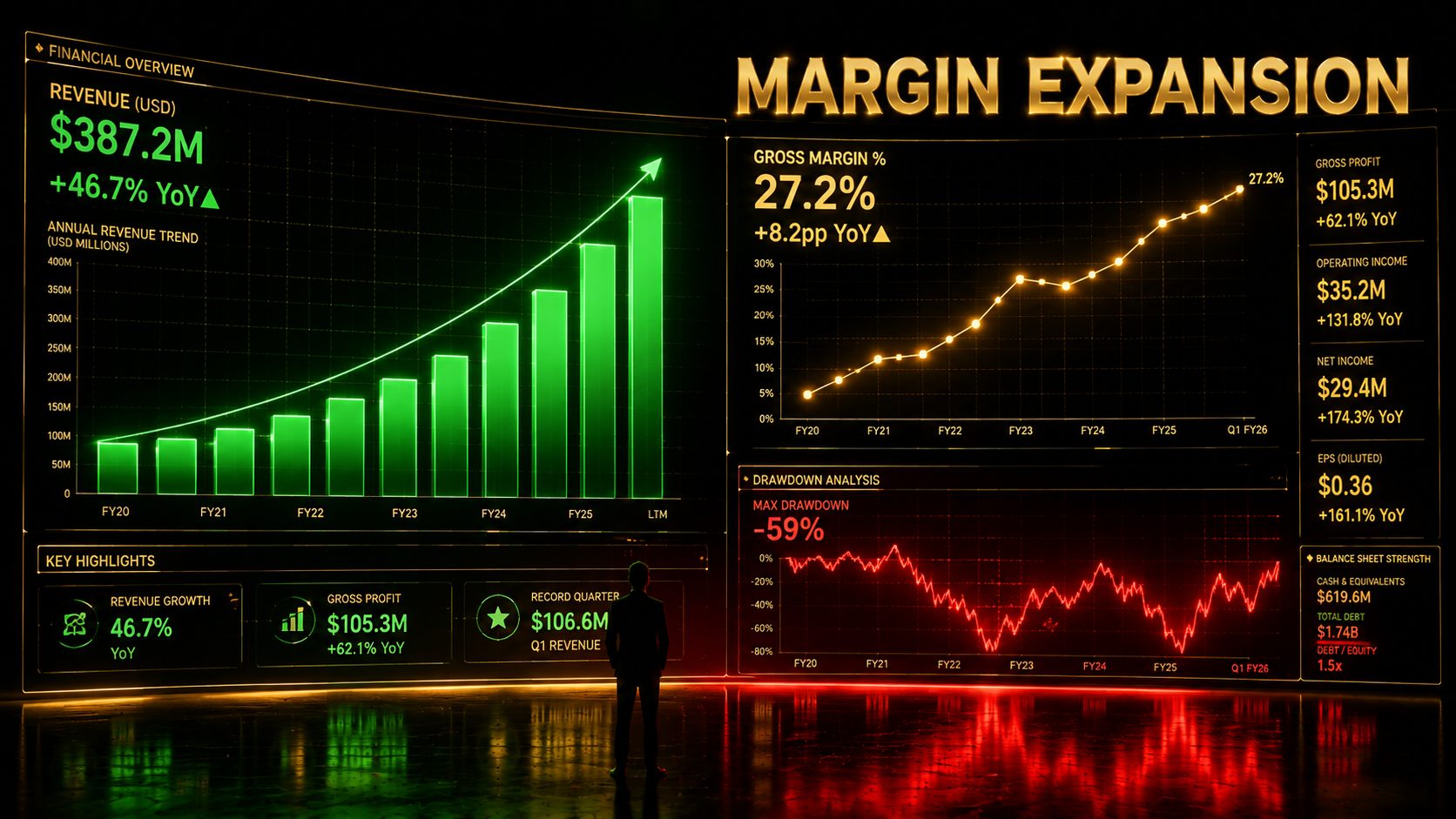
The trend beneath those numbers is what makes the story interesting. First quarter 2026 revenue was $413.6 million, up 15.5% year over year, which is respectable but not remarkable. The margin line is where the operating leverage shows: gross margin reached 26.8%, up 640 basis points from 20.4% a year earlier, and gross profit rose 52% on revenue growth of 15.5%.
Below the gross line the effect compounds. Operating profit was $64.6 million, up 96%. Net profit rose 62% to $65 million, lifting net margin to 16% from 11%. Diluted EPS of $0.57 was up 63%, and adjusted EPS of $0.65 beat the $0.56 consensus.
- Second quarter guidance: $455 million plus or minus 5%, a company record, representing 22% year over year growth and 10% sequential growth at the midpoint against a consensus of $436 million
- Sequential context: first quarter revenue of $413.6 million was down 6% from the record $440.2 million posted in the fourth quarter of 2025, a reminder that foundry revenue is not linear
- Analyst positioning: Benchmark raised its target to $335 from $230 with a Buy rating, Susquehanna to $330 from $180 with a Positive rating, and Wedbush to $300 from $140 while keeping a Neutral rating
- Ownership: institutions hold roughly 75% of the share base, with T. Rowe Price disclosing a 6.6% stake and Phoenix Financial disclosing 5.01% in regulatory filings
- Balance sheet posture: the $290 million of customer prepayments partially self-funds the capacity build, and the Japanese grant covers $1 billion of the Japan programme
The Wedbush position is instructive. A firm can more than double its price target and still rate the stock Neutral, which is what happens when an analyst raises estimates but concludes the multiple has already captured them. That is the central tension in this name. Note also that second quarter results are released on 4 August 2026, so every figure above is pre-print.
8. Competitive Landscape
Tower does not compete across the whole foundry market. It competes for specific design wins, and the competitor varies by platform.
GlobalFoundries is the most direct comparison. It sits third in the pure-play foundry market with roughly 6% to 7% global share, commands over 40% share in RF SOI for 5G front-end modules, runs most of its RF capacity on 300mm wafers, and has silicon photonics and silicon germanium platforms of its own, with SiGe moving from 200mm to 300mm in 2027. The difference is one of model rather than capability: GlobalFoundries is built for large-scale standardised specialty manufacturing, while Tower is built for customisation and high mix.
- TSMC has vastly greater capital and its own advanced packaging and photonics roadmaps, and remains the structural threat to any specialty foundry that becomes large enough to be worth attacking
- Integrated device manufacturers such as Intel have internal silicon photonics capability, meaning some potential customers are also potential competitors
- Module vendors moving upstream could in principle vertically integrate photonics manufacturing, though the capital intensity makes this unattractive for most
- Chinese mature-node capacity exerts persistent price pressure across Tower’s non-photonics platforms, even where it cannot compete on photonics specifically
Tower’s defensible position is narrower than the headlines suggest but real. It is a qualified, multi-region, open silicon photonics foundry with volume production history and signed multi-year contracts, and design qualification cycles are measured in years. The vulnerability is that this is a lead, not a moat, and leads can be closed by competitors with more capital.
9. Market Size and the Long-Term Demand Picture
The silicon photonics market is generally sized at roughly $2.8 billion to $3.1 billion in 2025, with forecasts converging on approximately $9.6 billion to $10.4 billion by 2030, implying a compound annual growth rate in the high twenties. Two independent research houses landing within striking distance of each other is more confidence than most emerging-technology forecasts deserve.
Co-packaged optics is the faster-growing sub-segment and the more contested forecast. Published CPO estimates vary by an order of magnitude depending on how the category is defined, so treat any single CPO number with scepticism. The directional consensus, that large-scale CPO deployment arrives between 2028 and 2030, is more useful than the levels, and it lines up precisely with Tower’s own schedule: capacity ready late 2027, contracted revenue in 2027, financial model targeting 2028.
10. Risk Analysis
Tower is priced for successful execution of a capacity expansion not yet built, serving contracts not yet delivered, into a market whose largest segment has not yet deployed at scale. Each is a separate place the thesis can break.
Valuation Risk
- Trailing P/E above 100 and forward P/E near 58 leave no margin for disappointment
- The stock has traded from $43.12 to $319.94 in 52 weeks, and the current price sits well below the high, which cuts both ways
- Wedbush more than doubled its price target while retaining a Neutral rating, an explicit statement that estimates and valuation have moved together
Execution and Capacity Risk
- The Japan expansion targets late 2027 readiness, and semiconductor construction schedules slip routinely
- Capacity commitments are irreversible once building starts, regardless of what demand does
Customer Concentration Risk
- The $1.3 billion is contracted with Tower’s largest silicon photonics customers, not spread across the 50-plus active silicon photonics accounts management cites
- Loss or reduction from a single major customer would be material
Competitive Risk
- GlobalFoundries, TSMC, and integrated device manufacturers all have credible photonics roadmaps and greater capital
- Process leadership in photonics is a lead measured in years, not a structural monopoly
Geopolitical and Macro Risk
- Headquarters and significant fabs in Israel expose the company to regional instability
- Japanese government support introduces policy dependency, and grant programmes are subject to political change
- AI infrastructure spending is currently the dominant demand driver, and it is cyclical capital expenditure, not recurring revenue
11. Bull vs Bear Case
🐂 Bull Case
- $1.3 billion of signed 2027 silicon photonics contracts against $1.57 billion of total 2025 revenue, with $290 million already prepaid
- Incremental revenue converting at roughly 59% gross margin, producing operating profit growth of 96% on revenue growth of 15.5% in the first quarter of 2026
- A stated 2028 model of $2.8 billion revenue and $750 million net profit, giving investors a specific target to measure management against
- $3 billion of Japan capacity with $1 billion funded by government grant, arriving in time for the 2028 co-packaged optics deployment window
- Verified high-volume production credibility, including more than five million coherent photonic ICs shipped with Marvell
🐻 Bear Case
- Trailing P/E above 100 prices in successful execution that remains three years out
- Revenue is not linear: first quarter 2026 came in 6% below the fourth quarter 2025 record, and foundry demand can reverse quickly
- Concentrated contract exposure to a small number of large silicon photonics customers
- Better-capitalised competitors are moving into the same segment, with GlobalFoundries shifting SiGe to 300mm in 2027
- The entire thesis depends on sustained AI infrastructure capital expenditure, which has no contractual guarantee beyond the signed orders
12. Valuation Perspectives
Three lenses produce three different answers, which is itself the most useful observation available.
On trailing earnings, Tower is expensive by any conventional standard. A P/E above 100 for a foundry with mature-node exposure and single-digit historical revenue growth is not defensible on its own terms.
On forward earnings, a P/E near 58 is demanding but recognisable for a company compounding profit at the current rate. The gap between the trailing and forward multiple reflects consensus expectations that have moved sharply higher.
On management’s 2028 model, the arithmetic changes character entirely. Against $750 million of targeted 2028 net profit, the current $24.77 billion market capitalisation is roughly 33 times those earnings, three years out and undiscounted. For a business growing profit at that rate with contracted visibility, that is not obviously unreasonable. It is also entirely contingent on a target the company has set for itself and not yet delivered.
The analyst consensus sits at Strong Buy with an average target of $313.83, above the last close of $219.67 but below the 52-week high. That spread summarises where the debate stands: the direction is not seriously contested, the multiple is.
13. Investment Outlook
Tower is best understood as a second-derivative position on AI networking. It does not sell to hyperscalers, and its fortunes depend on the module and connectivity vendors that do. That separation dampens some volatility relative to owning the accelerator names directly, and it also caps the share of AI capital expenditure Tower can capture.
The time horizon required is genuinely three years: contracts for 2027 revenue, Japan capacity ready in late 2027, and a financial model targeting 2028. An investor expecting resolution inside twelve months has misread the timeline.
- Bull scenario: the 2028 model is met or exceeded and Tower re-rates as a structural AI infrastructure supplier rather than a specialty foundry
- Bear scenario: AI capital expenditure moderates, capacity arrives into softer demand, and the multiple compresses toward specialty foundry norms before earnings catch up
- Base scenario: contracted 2027 revenue largely converts, the 2028 model is approached with slippage, and returns track earnings growth rather than further multiple expansion
- Catalysts to monitor: second quarter results on 4 August 2026, additional customer prepayments due by January 2027, Japan construction milestones through 2027, and any disclosure widening or narrowing the silicon photonics customer base
This is a growth position, not a core holding, and sizing should reflect a valuation that requires the 2028 outcome to be roughly right.
14. Final Thoughts
Tower Semiconductor spent three decades as a specialty foundry that mattered to its customers and to almost nobody else. The AI build-out changed that by making optical interconnect a bottleneck, and Tower already owned qualified, high-volume silicon photonics manufacturing when the bottleneck appeared.
The biggest opportunity is the gap between what the company earns today and what it has contracted to earn in 2027 and modelled for 2028. The biggest risk is that investors have already paid for that gap in full, at over 100 times trailing earnings, three years before it is scheduled to close. What makes this more than a momentum trade is that the contracts and prepayments are real, dated, and disclosed. Investors are not being asked to believe a story, but to judge whether management can deliver a specific number by a specific year, and whether the price already assumes it will.
For ongoing coverage of the semiconductor and AI infrastructure sector, subscribe to OneMoreStock on YouTube.
FAQ
Is Tower Semiconductor (TSEM) a good buy right now?
That depends entirely on your time horizon and valuation discipline. Tower has $1.3 billion of contracted 2027 silicon photonics revenue and a stated 2028 model of $2.8 billion revenue, but it trades above 100 times trailing earnings, meaning a lot of that future is already in the price. It suits investors with a three-year horizon who can tolerate significant volatility, and it does not suit anyone needing near-term valuation support.
What is Tower Semiconductor’s analyst price target?
The consensus rating is Strong Buy with an average 12-month price target of $313.83 as of 1 August 2026. Recent individual targets include Benchmark at $335 with a Buy rating, Susquehanna at $330 with a Positive rating, and Wedbush at $300 while maintaining a Neutral rating. Targets have risen sharply through 2026 alongside earnings estimates.
What exactly is silicon photonics and why does Tower benefit?
Silicon photonics builds optical components such as waveguides and modulators directly onto silicon wafers, allowing data to travel as light instead of electrical current. AI clusters need this because copper interconnect cannot deliver the required bandwidth within an acceptable power budget. Tower benefits because it operates one of the few open foundry silicon photonics platforms already qualified for high-volume production.
How does Tower Semiconductor compare to GlobalFoundries?
Both operate specialty foundry models with silicon photonics and silicon germanium platforms, but they compete differently. GlobalFoundries is larger, holds roughly 6% to 7% of the pure-play foundry market, and focuses on standardised large-scale manufacturing including over 40% share in RF SOI. Tower runs a higher-mix, customised model with deeper process co-engineering per customer.
Is Tower Semiconductor profitable, and does it pay a dividend?
Tower is profitable and does not pay a dividend. It reported $245.4 million of trailing twelve-month net income and $2.16 of trailing EPS, following $220.5 million in fiscal 2025, with first quarter 2026 net profit up 62% year over year. Capital is being directed toward the $3 billion Japan expansion rather than shareholder distributions.
What is the biggest risk to the Tower Semiconductor thesis?
Valuation combined with timing. The company is priced for a 2028 outcome, so slippage in the Japan schedule, a reduction in contracted volumes, or moderation in AI infrastructure spending would hit both estimates and the multiple simultaneously. Customer concentration within the $1.3 billion contract book adds a second point of fragility.
Financial Disclaimer:
This article is for educational and informational purposes only and should not be considered financial or investment advice. Investing involves risk, including the possible loss of capital. Always conduct your own research and consult a qualified financial adviser before making investment decisions.