
Credo Stock (CRDO): Inside the Post-Earnings Margin Panic
Credo Stock (CRDO): Inside the Post-Earnings Margin Panic
Credo Technology Group reported the best quarter in its history on 1 September 2026, and the market sold it anyway. Revenue grew 114.7% year over year to a record $479.0 million. The stock fell about 20% in a single session.
That gap between what the business did and what the share price did is the whole story. It is also the reason this article exists: a selloff of that size is either a warning the market saw first, or an overreaction that hands patient investors a better entry. Telling the two apart requires reading the actual filing rather than the headline.
This analysis works through what Credo sells, what the Q1 FY2027 numbers really showed, why the widely repeated “margin collapse” framing is mostly a GAAP artefact, where the genuine risks sit, and whether the current valuation reflects any of it.
1. Key Metrics at a Glance
| Metric | Value |
|---|---|
| Share price | $162.95 (11 Sep 2026 close) |
| Market capitalisation | $30.63 billion |
| 52-week range | $86.49 to $308.67 |
| Q1 FY2027 revenue | $479.0 million |
| Revenue growth (YoY) | +114.7% |
| Revenue growth (QoQ) | +9.6% |
| GAAP gross margin | 64.5% |
| Non-GAAP gross margin | 68.0% |
| GAAP diluted EPS | $0.67 |
| Non-GAAP diluted EPS | $1.20 |
| Q2 FY2027 revenue guidance | $525M to $535M |
| Cash and short-term investments | $764.3 million |
| Debt | None reported on the balance sheet |
| Forward P/E | 22.3x |
| Trailing P/E | 57.6x |
| Analyst consensus target | About $281 (range $185 to $350) |
Data as of 11 to 13 September 2026, drawn from Credo’s Q1 FY2027 results release and market data providers. Verify before acting.
2. What Credo Actually Sells
Credo is a fabless semiconductor company built around one narrow, unglamorous problem: moving data between chips, between servers and between racks without losing the signal or burning excessive power.
The core technology is SerDes, short for serialiser and deserialiser. A SerDes takes parallel data inside a chip, squeezes it into a high-speed serial stream that can travel down a wire or a fibre, and reassembles it at the other end. Every generation of faster networking, 400G to 800G to 1.6T, is essentially a harder SerDes problem. Credo’s engineering advantage is that its SerDes designs hit those speeds at lower power than the alternatives.
That capability shows up in the market as several product lines:
- Active Electrical Cables (AECs). Copper cables with Credo silicon built into the connector, which cleans up and retimes the signal. They connect servers within a rack.
- Optical DSPs. The signal-processing chips inside optical transceivers, used where distance exceeds what copper can carry.
- Silicon photonics PICs. Photonic integrated circuits, which put optical functions onto a chip instead of assembling them from discrete parts.
- ZeroFlap Optics. A reliability-focused optical product line aimed at link flaps, the intermittent dropouts that disrupt AI training runs.
- SerDes IP licensing. Selling the underlying designs to other chipmakers.
Revenue arrives mainly as hardware today, with IP licensing as a smaller, higher-margin contributor.
Why this matters now
As AI clusters scale from hundreds of GPUs to tens of thousands, the bottleneck moves. Raw compute stops being the constraint and interconnect becomes one: how fast data moves between accelerators, how much power that movement consumes, and how reliably the links hold up over a training run measured in weeks. A single flapping link can stall a job across an entire cluster.
This is the same structural shift that makes the broader data centre networking layer interesting, and it is why Marvell’s AI data centre franchise has drawn so much investor attention. Credo attacks a narrower slice of it, but attacks it from a power-efficiency angle.
3. Inside Q1 FY2027: The Numbers Behind the Selloff
Credo’s first quarter of fiscal 2027 ended on 1 August 2026. The headline numbers were strong by any reasonable standard.
- Revenue of $479.0 million, up 114.7% year over year and 9.6% sequentially.
- The seventh consecutive quarter of triple-digit year-over-year revenue growth.
- Non-GAAP diluted EPS of $1.20, ahead of consensus.
- GAAP diluted EPS of $0.67.
- Non-GAAP operating income of $230.6 million, a 48.2% non-GAAP operating margin.
- Guidance for Q2 FY2027 revenue of $525 million to $535 million.
That guidance deserves a moment. Credo posted $268.0 million of revenue in the equivalent quarter a year earlier. The $530 million midpoint therefore implies roughly 98% year-over-year growth in the quarter now underway. The company also reiterated its full-year outlook for more than 85% revenue growth and a non-GAAP net margin near 50%.
A company guiding to double its revenue again, at a 50% net margin, does not usually lose a fifth of its market value in a day. So what did the market actually object to?
4. The Margin Story, Read Properly
This is where most of the commentary went wrong, and where the brief this article was built from went wrong too.
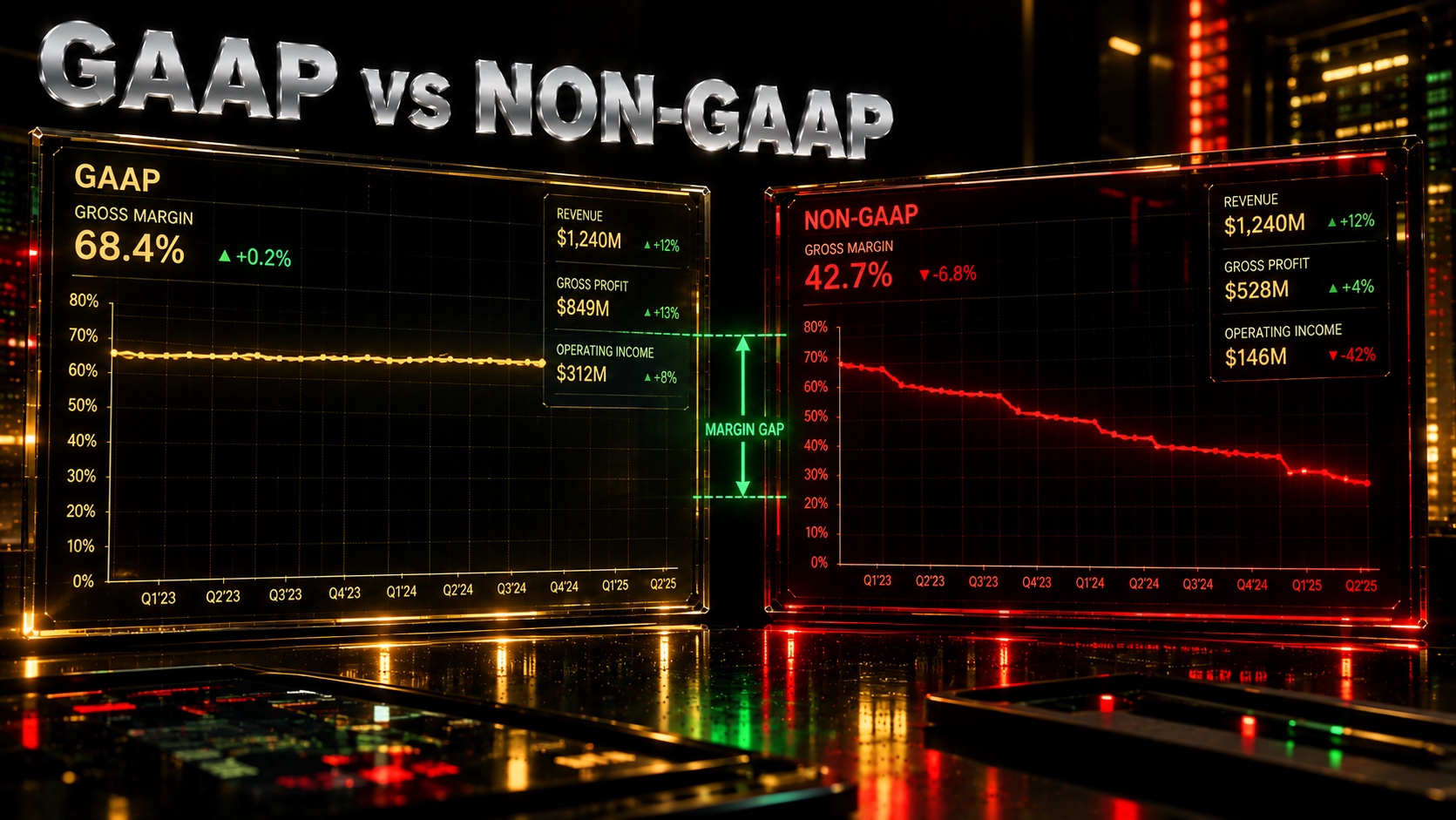
The popular framing was that Credo’s gross margin “collapsed from 68% to 64.5%.” Those two numbers are both real. They are not, however, the same measure, and they are not from the same period.
Here is what the filing actually reports:
| Measure | Q4 FY2026 | Q1 FY2027 | Q2 FY2027 guidance |
|---|---|---|---|
| GAAP gross margin | 68.2% | 64.5% | 62.9% to 64.9% |
| Non-GAAP gross margin | 68.3% | 68.0% | 67.0% to 69.0% |
Read the two rows separately and the picture changes completely.
On a non-GAAP basis, gross margin was essentially flat. It moved from 68.3% to 68.0%, a decline of 30 basis points. Guidance for the current quarter, 67.0% to 69.0%, brackets that level rather than stepping down from it. Management explicitly guided full-year non-GAAP gross margin to come in broadly in line with fiscal 2026.
On a GAAP basis, the compression is real. GAAP gross margin fell 370 basis points, from 68.2% to 64.5%, and GAAP guidance of 62.9% to 64.9% points lower again.
The gap between the two measures is the actual news. In Q4 FY2026 the difference between GAAP and non-GAAP gross margin was 10 basis points. In Q1 FY2027 it was 350 basis points. Something moved into cost of revenue that the non-GAAP presentation excludes, with stock-based compensation and acquisition-related amortisation being the usual occupants of that line.
That distinction matters enormously for the investment case:
- If gross margin were falling because Credo was cutting prices to hold share, that would be structural damage to the thesis.
- If it is falling because non-cash charges inside cost of revenue have grown, that is an accounting and dilution question, not a pricing-power question.
The evidence points firmly at the second explanation. Pricing pressure shows up in both measures at once. This showed up in only one.
The operating expense side
Operating expenses did genuinely rise, and this part of the bear case survives scrutiny:
- Non-GAAP operating expenses grew from $81.7 million to $95.2 million, up about 16% sequentially.
- GAAP operating expenses grew from $142.2 million to $188.4 million, up about 32% sequentially.
Sequential growth of 16% in non-GAAP opex against 9.6% sequential revenue growth means spending outpaced sales in the quarter. For a company ramping three new optical product lines simultaneously, that is expected. For a momentum-driven shareholder base watching for any crack, it was enough.
5. Margin Context: How Credo Compares With Optical Peers
A gross margin only means something next to the alternatives. Credo is expanding into optics, so the relevant comparison is the established optical component suppliers.
| Company | Most recent reported GAAP gross margin |
|---|---|
| Credo (CRDO) | 64.5% |
| Lumentum (LITE) | 47.4% |
| Coherent (COHR) | 38.5% |
Even after the compression that triggered the selloff, Credo’s GAAP gross margin sits roughly 17 percentage points above Lumentum’s and 26 points above Coherent’s. This is the single strongest counterargument to the pricing-power bear case.
It also reflects a genuine structural difference rather than superior execution alone. Coherent and Lumentum are vertically integrated manufacturers carrying fabs, substrate supply and assembly operations. Credo is fabless and silicon-led. Fabless semiconductor businesses structurally earn higher gross margins than companies that own manufacturing, because the capital and the cost of goods sit elsewhere.
The honest reading is therefore narrower than “Credo has better margins than its peers.” It is that Credo has a different business model with a different margin profile, and that model has not shown signs of breaking. Investors should not expect Credo to converge downward toward optical-component margins simply because it now sells optical products, nor should they read its premium as proof of a wider moat than it has.
The physical supply chain underneath all of this remains a genuine constraint, from indium phosphide substrate availability to silicon photonics foundry capacity. Credo’s fabless model outsources those problems. It does not make them disappear.
6. The Core Engine: Active Electrical Cables
Almost everything Credo earns today traces back to AECs, and understanding why they exist explains the company’s competitive position better than any margin table.
Inside a rack, servers need to talk to each other at 400G or 800G over distances of one to three metres. There are two ways to do that:
- Passive copper. Cheap and power-free, but signal integrity degrades badly at high speeds and short reach limits become severe.
- Optical modules. Excellent reach and signal quality, but each module consumes meaningful power, costs considerably more, and adds components that can fail.
AECs sit between the two. A copper cable with Credo’s retimer silicon in the connector recovers the signal electrically, which extends usable reach and holds integrity at high data rates while consuming far less power than an optical module over the same distance.
In a rack containing dozens of accelerators, and a data centre containing thousands of racks, the power difference compounds into a real operating cost. That is the moat: not that copper is exotic, but that Credo’s low-power SerDes makes copper viable at speeds where it otherwise would not be.
Where that leaves the business today:
- AECs drive the large majority of Credo’s revenue.
- Deployment is concentrated among a small number of very large cloud operators.
- The company added a new customer crossing the 10% revenue threshold during the quarter.
The obvious limitation is physics. Copper reach does not extend indefinitely, and as clusters grow beyond a single rack the interconnect must go optical. A company whose revenue depends almost entirely on intra-rack copper has a ceiling written into its addressable market. Which is precisely the problem the next section is about.
7. From Millimetres to Kilometres
Credo’s strategic answer is to cover every distance in the data centre with the same underlying SerDes and DSP competence, rather than defending copper alone.
- Millimetres. Chiplet and die-to-die connectivity inside a package, where custom accelerators need low-power links between compute and memory dies.
- Metres. Intra-rack copper AECs, the current revenue base.
- Tens to hundreds of metres. Optical DSPs inside transceivers, connecting racks across a data hall.
- Kilometres. Silicon photonics PICs and longer-reach optical products spanning campus-scale deployments.
The strategic logic is coherent. The same signal-integrity and power-efficiency engineering that made AECs competitive is the engineering that optical DSPs require. Credo is not entering an unrelated market; it is applying an existing capability at a longer reach.
The competitive reality is harder. At the optical end, the incumbents are Broadcom and Marvell, both far larger, both with entrenched positions in optical DSPs and deep customer relationships. Credo is the challenger there, not the leader, and it is challenging on the incumbents’ home ground rather than in a niche they ignored.
8. The $600 Million Optical Catalyst
On the earnings call, management reiterated a specific and checkable target: more than $600 million of optical revenue in fiscal 2027, with three product lines each contributing more than $100 million.
- Optical DSPs
- Silicon photonics PICs
- ZeroFlap Optics
Management also indicated that initial 1.6T DSP revenue arrives later in fiscal 2027.
The significance is not the dollar figure by itself. It is that the figure is large relative to the current business and specific enough to be graded. Credo generated roughly $1.34 billion of revenue in all of fiscal 2026. A $600 million optical contribution in fiscal 2027 would mean optics alone approaching half of the prior full year’s total revenue, from a product set that barely registered before.
If it lands, the “AEC cable company with a copper ceiling” characterisation stops being accurate, and Credo becomes a multi-product interconnect platform with a second growth curve. If it slips, the bear case gets its evidence and the elevated operating expenses look like spending without return.
This is the single most important thing to track over the next four quarters, and it is why investors should read each quarter’s optical revenue disclosure rather than the headline growth rate.
One caution on how to weigh it: this is company guidance, not a reported result. It belongs in the analysis as a stated management target with an execution record attached to it, not as a number to model as though it were already banked.
9. Customer Concentration: The Risk That Is Actually Real
If an investor takes one bear-case item seriously, it should be this one.
In Q1 FY2027, Credo’s four largest customers accounted for 33%, 28%, 13% and 10% of revenue. That is roughly 84% of the business in four accounts, with the top two alone representing 61%.
The consequences are structural rather than hypothetical:
- A single large customer pausing or digesting inventory for one quarter can move total company revenue by double digits.
- Credo’s revenue follows hyperscaler capital expenditure cycles, which it does not control and cannot forecast independently.
- An architectural decision at one customer, moving to a different interconnect approach or bringing a function in-house, could remove a quarter of the business.
- Negotiating leverage sits with the buyer when the buyer is a third of your revenue.
There is genuine progress against this. The company added a new customer above the 10% threshold during the quarter, and management expects three to four customers to remain above 10% going forward. Adding a fifth meaningful account dilutes the risk somewhat.
But concentration of this degree does not unwind quickly. It is the structural reason Credo’s revenue is more volatile than its growth rate suggests, and it is a legitimate reason for the stock to carry a discount to a more diversified semiconductor business. Investors who buy the valuation argument without pricing this in are only reading half the page.

10. The Balance Sheet
Credo ended the quarter with $764.3 million in cash and short-term investments and no debt reported on the balance sheet. For a company funding three simultaneous product ramps, that is a genuinely useful position: research and development can be financed from the balance sheet without raising debt or issuing equity into a falling share price.
One item deserves attention rather than assumption. At the end of the prior quarter, Credo reported approximately $1.4 billion in cash and short-term investments. The balance at the end of Q1 FY2027 was $764.3 million. Both figures come from the company’s own results releases. The reason for the change is not something this article will guess at, and investors who care about it should read the cash flow statement in the quarterly filing directly rather than accept any commentator’s explanation, including this one.
What can be said without speculation is that a debt-free balance sheet with more than $750 million of liquidity does not constrain the optical ramp, and that the direction of the cash balance is worth checking again next quarter.
11. Valuation
Credo trades at roughly 22.3 times forward earnings and about 57.6 times trailing earnings, at a market capitalisation near $30.6 billion.
The forward multiple is the striking number. A company guiding to more than 85% revenue growth for the full year, at a non-GAAP net margin near 50%, is trading at a forward multiple in the low twenties. For comparison, Coherent trades at a forward P/E in the high forties, and Applied Optoelectronics is not profitable on a trailing basis, which makes an earnings multiple meaningless for it.
Analyst sentiment has not followed the share price down. The consensus twelve-month target sits at roughly $281, against a $162.95 close, with individual targets ranging from $185 to $350 and no sell ratings among the covering analysts.
Three cautions belong alongside those numbers.
First, the forward multiple embeds the guidance. A forward P/E of 22x is only 22x if Credo delivers the earnings it has guided to. Miss the optical ramp and the multiple recalculates upward immediately. The cheapness is conditional, not observed.
Second, consensus targets are not analysis. A $281 average target against a $163 price mostly tells you that analysts have not yet revised models after a one-day move. It is a data point about analyst behaviour, not about intrinsic value.
Third, concentration justifies some discount. Part of the gap between Credo’s multiple and its peers’ is not mispricing. It is the market correctly charging for the risk that 84% of revenue sits in four accounts. The question is not whether a discount is warranted, but whether the current one overshoots.
On balance, the valuation looks more attractive than it did a month ago, and the reason it got cheaper is weaker than the price move implied. That is a reasonable starting point for research. It is not, by itself, a thesis.
12. Bull Case, Bear Case, Base Case
🐂 Bull Case
- Non-GAAP gross margin held at 68.0%, meaning the pricing-power fear that drove the selloff is not supported by the filing.
- Q2 guidance of $525M to $535M implies roughly 98% year-over-year growth, with full-year guidance above 85%.
- The $600 million optical target, if delivered, converts Credo from a single-product story into a multi-line interconnect platform.
- A fabless model produces GAAP gross margins far above vertically integrated optical peers at 47.4% and 38.5%.
- A debt-free balance sheet with $764.3 million funds the ramp without dilution or financing risk.
- Forward P/E near 22x against guided growth above 85% is a genuine disconnect if execution holds.
🐻 Bear Case
- Four customers represent 84% of revenue, so one capex pause materially damages a quarter.
- GAAP gross margin genuinely fell 370 basis points and is guided lower again, and GAAP is what most screens and index funds see.
- Non-GAAP operating expenses grew 16% sequentially against 9.6% revenue growth, and the payoff is a guided target rather than a delivered result.
- The optical expansion puts Credo head to head with Broadcom and Marvell, both larger and entrenched.
- Cash and short-term investments fell from roughly $1.4 billion to $764.3 million in one quarter, a movement investors should understand before assuming balance sheet strength.
- The widening gap between GAAP and non-GAAP results raises a dilution question that a non-GAAP-only reading hides.
Base Case
The most probable path is that Credo continues to grow rapidly on AEC strength while the optical ramp progresses unevenly, with some product lines landing near target and others slipping a quarter or two. GAAP margins stay compressed while non-cash charges remain elevated, non-GAAP margins hold near current levels, and the share price stays volatile around each quarterly customer-concentration disclosure. In that scenario the business compounds materially while the multiple stays contested, which rewards patience rather than timing.
13. Final Thoughts
Credo matters because the AI buildout has moved past the point where compute alone determines cluster performance. Interconnect power, reach and reliability now shape what a data centre can physically run, and Credo sits directly on that constraint with a genuine low-power engineering advantage.
The biggest opportunity is the optical expansion. If the $600 million fiscal 2027 target lands, the copper ceiling argument disappears and the addressable market expands by an order of magnitude.
The biggest risk is not the margin line that caused the selloff. It is customer concentration. Eighty-four percent of revenue in four accounts means the business is exposed to decisions made in four boardrooms, and no amount of engineering advantage changes that in the near term.
The long-term view is that this is a real business with a defensible technical position, sold off for a reason that the filing does not fully support, carrying a risk that the filing supports completely. Those are not the same thing, and the difference between them is where the work is.
If you want to keep following how the AI interconnect layer develops, read our related coverage above, and subscribe to the OneMoreStock YouTube channel for future analysis.
FAQ
Why did CRDO stock fall if earnings beat expectations?
The market reacted to margin and spending trends rather than the top line. GAAP gross margin fell from 68.2% to 64.5% with guidance pointing lower, non-GAAP operating expenses rose about 16% sequentially, and the quarterly filing showed four customers accounting for 84% of revenue. In a stock that had run to a 52-week high of $308.67, those were enough to trigger heavy selling despite 114.7% revenue growth.
Did Credo’s gross margin actually collapse?
Not on the measure management guides to. Non-GAAP gross margin was 68.0% in Q1 FY2027 against 68.3% the prior quarter, a 30 basis point move, and Q2 guidance of 67.0% to 69.0% brackets that level. GAAP gross margin did fall meaningfully, from 68.2% to 64.5%, because non-cash charges inside cost of revenue grew. Both facts are true, and conflating them produced the “margin collapse” narrative.
What is an Active Electrical Cable and why does it matter?
An AEC is a copper cable with signal-processing silicon built into the connector, which retimes and cleans the signal so copper stays viable at 400G and 800G speeds. It matters because it delivers the reach a rack needs at far lower power than an optical module. Across thousands of racks that power saving becomes a material operating cost advantage, and AECs drive the large majority of Credo’s current revenue.
How risky is Credo’s customer concentration?
It is the most significant risk in the investment case. Four customers represented 33%, 28%, 13% and 10% of revenue in the quarter, roughly 84% of the total, with the top two at 61%. A single customer pausing deployment can move company revenue by double digits in a quarter. Credo added a new customer above the 10% threshold during the period, which helps at the margin but does not resolve the structure.
Is the $600 million optical revenue target reliable?
It is management guidance, not a reported result, and should be weighed accordingly. Management reiterated the target of more than $600 million of optical revenue in fiscal 2027, with optical DSPs, silicon photonics PICs and ZeroFlap Optics each expected to exceed $100 million, and initial 1.6T DSP revenue arriving later in the fiscal year. The useful discipline is to check optical revenue disclosure each quarter against that path rather than treating the figure as already earned.
Is CRDO cheap at a forward P/E in the low twenties?
It is cheap relative to its guided growth, which is the point of the bull case, but the multiple is conditional on that guidance being met. A forward P/E near 22x against more than 85% guided revenue growth is unusual, and it sits well below Coherent’s forward multiple in the high forties. If the optical ramp underperforms, forward earnings fall and the multiple is no longer what it appeared to be.
Financial Disclaimer:
This article is for educational and informational purposes only and should not be considered financial or investment advice. Investing involves risk, including the possible loss of capital. Always conduct your own research and consult a qualified financial adviser before making investment decisions.