Stock Tokenization: What the SEC’s Five-Year Exemption Means
Stock Tokenization: What the SEC’s Five-Year Exemption Means
1. Introduction: What Changed, and When
On 17 September 2026 the US Securities and Exchange Commission issued an order it calls the Innovation Exemption, granting temporary, conditional relief that lets a new category of venue trade certain tokenized US stocks on a blockchain. The relief runs five years, to 17 September 2031, with a public comment period alongside it.
This is a real market-structure development, and it is also widely misdescribed. The SEC has not announced a five-year plan to tokenize the US stock market. It has granted a five-year exemption from two specific legal definitions, under conditions, so qualifying venues can run a supervised experiment while regulators watch.
The distinction matters because the headline version, “the SEC approved tokenized stocks”, skips every condition that makes the order workable. Stock tokenization under this framework is narrow, permissioned, capped by symbol and volume, and reversible. This article explains what changed, how the venues work, who gains and loses, what could go wrong, and what a long-term investor should actually do.
2. Key Facts
| Item | Detail |
|---|---|
| What is changing | Qualifying venues may trade certain tokenized NMS stocks onchain via permissioned AMM liquidity pools |
| Decided by | US Securities and Exchange Commission, order 34-106402 |
| Current status | Live. An exemptive order effective on issuance, not a proposal |
| Effective date | 17 September 2026, expiring 17 September 2031 |
| Who it applies to | Tokenized Securities Venues meeting the conditions, plus qualifying liquidity providers |
| Relief granted | Exemption from the “exchange” definition under the Securities Exchange Act of 1934, and the “dealer” definition for qualifying liquidity providers |
| Explicitly excluded | Synthetic tokens tracking a share price without conferring the underlying rights |
| Next step | Public comment, then a decision on durable rulemaking |
Status as of 24 September 2026. Rule changes can be delayed or amended, verify before acting.
3. What the SEC Actually Approved
The order is narrower than most coverage suggests. It grants two pieces of relief.
The first exempts a Tokenized Securities Venue, or TSV, from the definition of an “exchange” under the Securities Exchange Act of 1934. Without it, any venue matching buyers and sellers of NMS stock would have to register as a national securities exchange or operate as an alternative trading system. The second exempts qualifying liquidity providers from the “dealer” definition when they supply tokenized NMS stock to these pools with their own capital.
Those two exemptions are the entire legal mechanism. Everything else is a condition attached to them, and the conditions are substantial:
- Tokenized NMS stock must give holders the same rights and privileges as traditional stock of an equivalent class, including voting and dividends
- For a third-party tokenization, the TSV must give the issuer written notice and an opportunity to object before listing it
- Smart contracts must be auditable, public, and deployed on a public, permissionless ledger
- Trading must halt whenever the underlying stock halts
- Limits apply to the number of symbols and the volume traded, and leverage is prohibited
- Access standards, transparency and recordkeeping obligations all apply
What this order does not mean
- Not all US stocks are tokenized, and no company is required to tokenize
- Not every investor can trade tokenized stocks, access is permissioned
- The US stock market has not become decentralized or 24/7
- Not all tokenized stocks are equivalent to traditional shares
- The SEC has not permanently approved onchain stock exchanges
- Nothing here guarantees faster settlement, better pricing, or better returns
4. Tokenized Stock Versus Synthetic Token
Retail investors are most likely to lose money on this distinction, so it is worth being blunt.
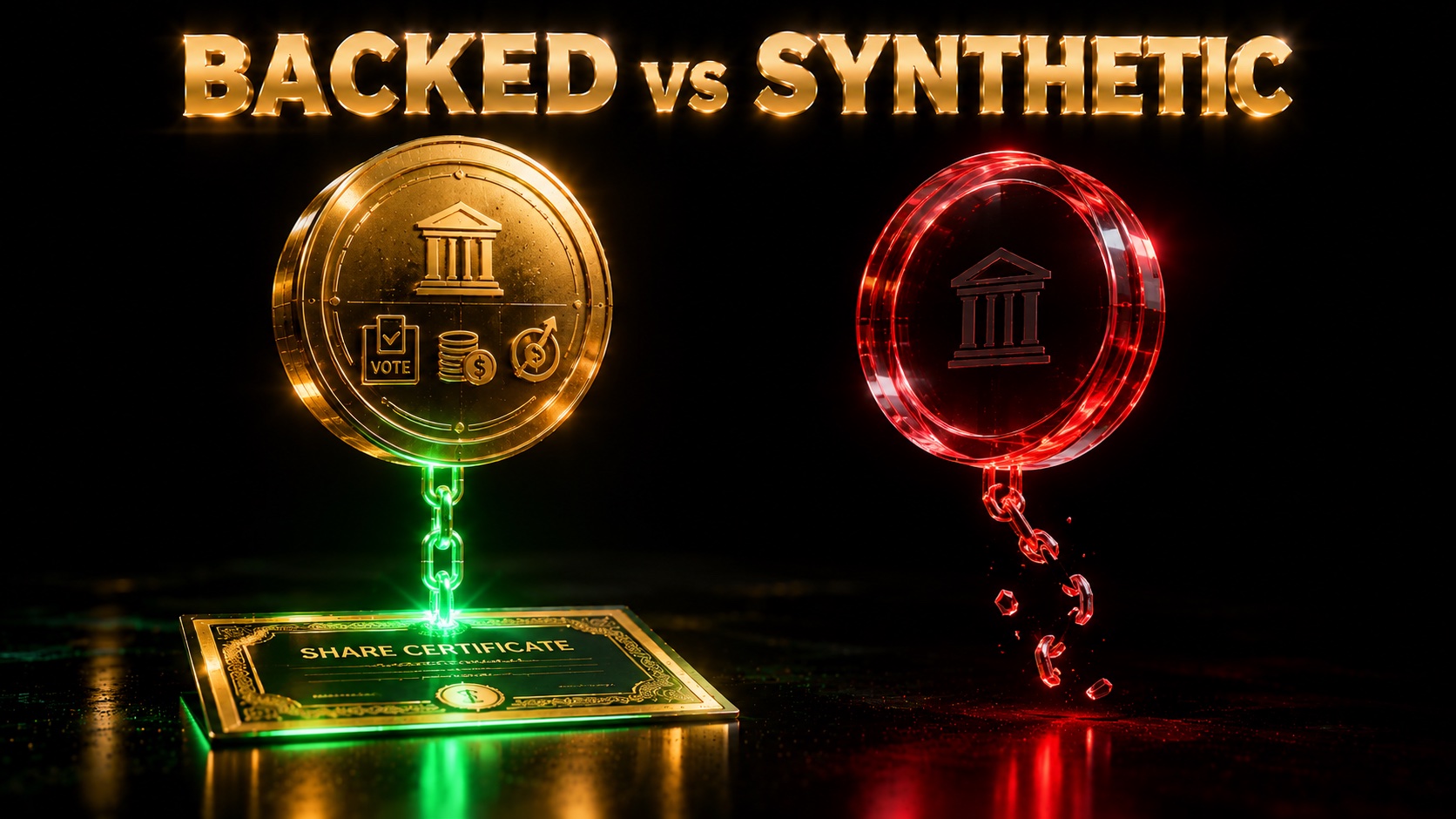
A tokenized share is a blockchain representation of an actual qualifying security, linked to the underlying equity and structured to carry its rights. A synthetic token tracks the price or economic exposure of a stock without necessarily representing ownership.
A token that follows Apple’s share price is not the same as owning Apple stock. Whether you own anything depends on the legal structure behind the token, not the ticker in the app.
The SEC drew this line deliberately. The exemption covers rights-backed tokenized NMS stock and excludes synthetic representations. That has commercial consequences: products retail investors already recognise, including Robinhood’s stock tokens and Kraken’s xStocks, sit outside the framework in their current form. We covered the issuer-side tension in Robinhood’s stock tokens and the AMC clash.
5. How Tokenized Securities Venues and AMMs Work
A TSV is defined by function, not technology. It brings together buyers and sellers of tokenized NMS stock by providing automated market maker liquidity pools, letting permissioned participants agree trade terms, and setting standards for who may access the system.
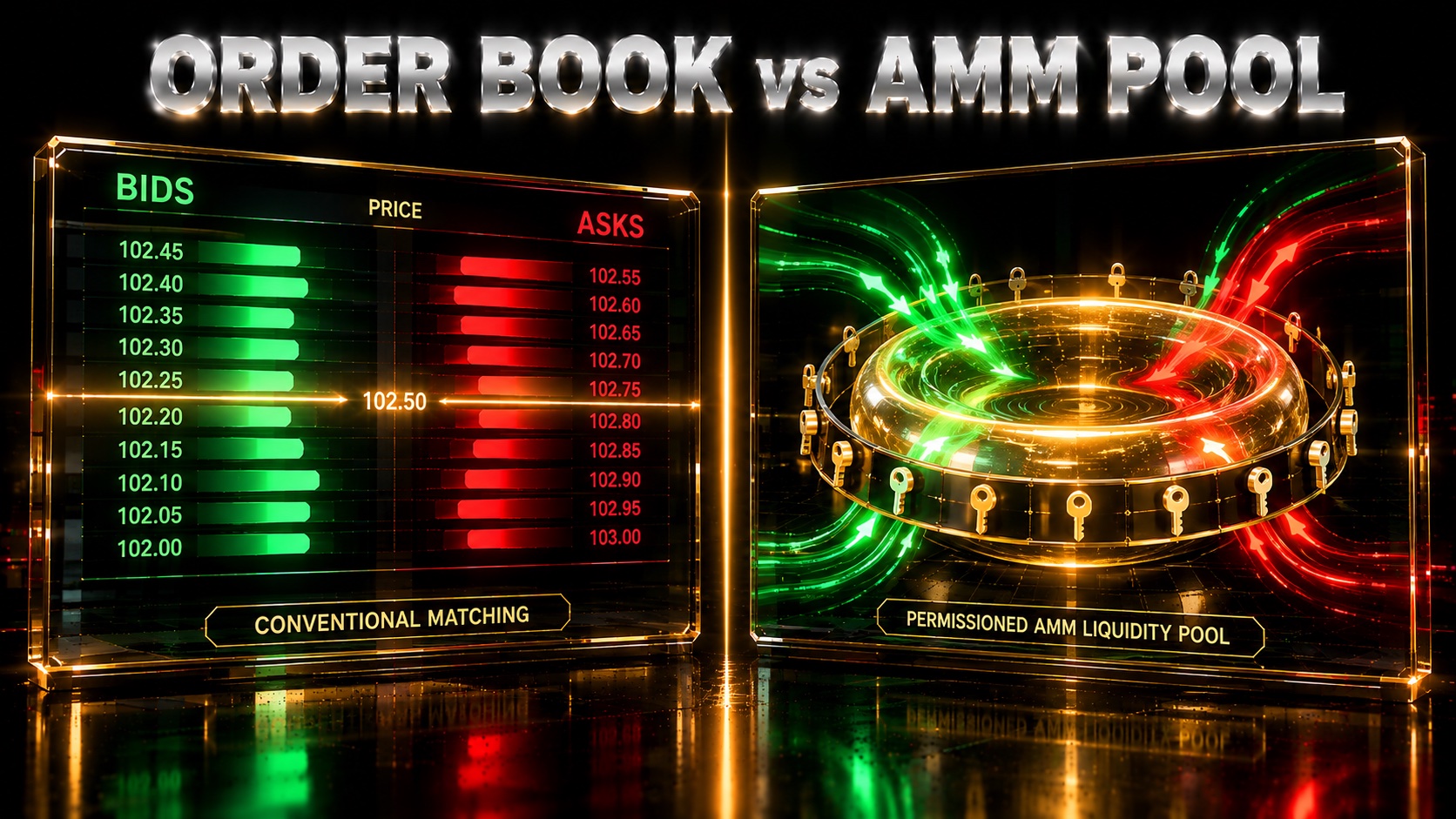
The structural change is in how a trade matches:
- Traditional exchange: buyer, then a central order book, then seller
- TSV model: buyer, then a permissioned AMM liquidity pool, then seller
An automated market maker is a smart contract mechanism that facilitates trading through pooled liquidity rather than a centralised order book. Prices come from the pool’s formula and inventory, not from resting bids and offers. Our Uniswap deep dive covers AMM mechanics in detail.
One point is easy to get wrong. Onchain does not mean permissionless. The contracts sit on a public chain, but who may trade through them is gated. This is blockchain infrastructure operating inside securities rules, not outside them.
6. How It Works Today Versus Onchain
| Aspect | Today | Under the exemption |
|---|---|---|
| Where you trade | Registered exchange or ATS | Qualifying TSV, permissioned access |
| How trades match | Central limit order book | AMM liquidity pool |
| Settlement | T+1 through central infrastructure | Potentially near-instantaneous onchain |
| Custody | Broker or custodian holds the position | Potential self-custody in a digital wallet |
| Trading hours | Exchange hours plus extended sessions | Potentially longer, subject to halts |
| Leverage | Available through margin | Prohibited |
| Your rights | Voting, dividends, economic rights | Same rights required by the order |
The last row matters most. The order’s design is that tokenization changes how a security is represented and transferred without stripping what it entitles you to.
7. Why Stock Tokenization Is Happening Now
Three pressures converged, none suddenly. Crypto markets trade continuously and settle in minutes, and offshore venues have offered synthetic exposure to US equities for years, capturing demand US-regulated venues could not serve. Tokenized money market funds and Treasuries moved from pilot to production across 2025 and 2026, making equity tokenization a smaller technical leap than it once was.
The regulatory groundwork was also laid:
- January 2026: SEC staff clarified that recording ownership on a distributed ledger does not change whether securities laws apply
- March 2026: the SEC approved a Nasdaq rule change enabling tokenized trading, covering Russell 1000 stocks and index ETFs
- September 2026: the SEC proposed transfer agent rules expressly permitting distributed ledger technology as part or all of the master securityholder file
That last item is the quiet one, and arguably the most consequential. Tokenization is not only about where trades happen. It reaches the recordkeeping layer that determines who owns what.
8. Who Benefits, and Who Is Worse Off
Rights-backed platforms are the clearest beneficiaries. Firms already holding the underlying shares in custody and representing the entitlement onchain start inside the framework. Ondo Finance and Coinbase are frequently named here. Our piece on Ondo and stock tokenization covers that model.
Synthetic issuers are the clearest losers for now. Products tracking a price without conferring rights do not qualify and need restructuring to come inside the perimeter.
Traditional exchanges are better placed than the disruption framing suggests. Nasdaq already has approval to trade securities in tokenized form, making it a participant rather than a bystander.
Retail investors get a mixed outcome. Self-custody, fractional ownership and faster settlement are real potential gains. Against that, access is permissioned, so most will not use a TSV soon, and the products they can already reach are the excluded synthetic ones.
Issuers gain a right they lacked: notice and an opportunity to object before a third party lists a tokenized version of their stock. That answers a live argument about who controls the tokenization of a company’s shares.
9. Tokenization and the 23-Hour Market
These are two separate developments pointing the same way. Extended hours address when you can trade, a shift we covered in Nasdaq’s 23-hour trading session. Tokenization addresses how a security is represented, transferred and settled. Neither causes the other.
They are complementary because the constraint on longer windows was never the matching engine. It was everything behind it: clearing, settlement, custody, corporate actions and surveillance, all built around fixed operating hours. Blockchain infrastructure can in principle support continuous processing and programmable settlement, making longer windows more feasible.
What it does not do is remove the need for regulation, settlement controls, custody, sanctions compliance or surveillance.
10. What Could Go Wrong
The likeliest failures are structural rather than technological.
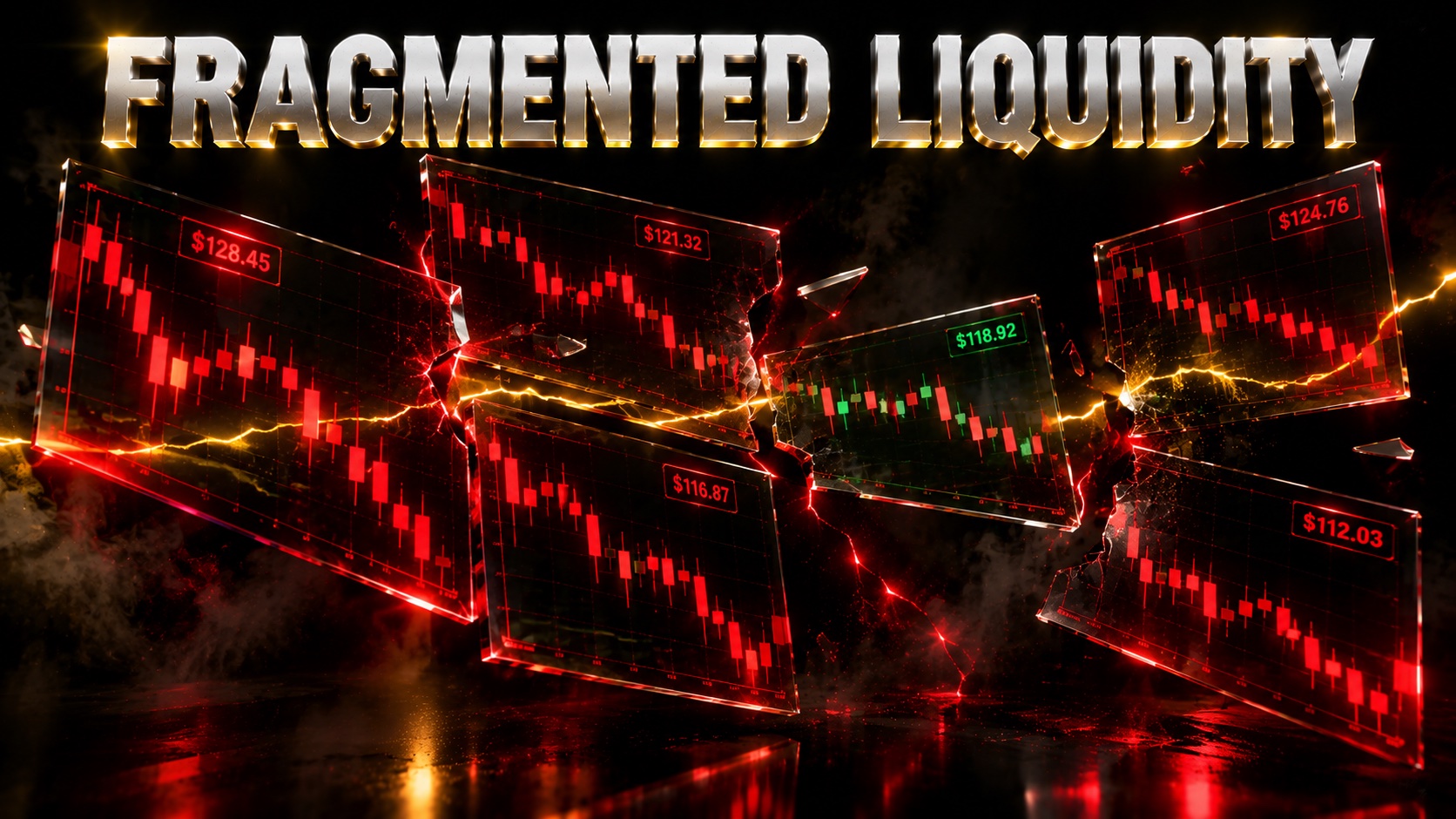
- Liquidity fragmentation. The same security trading in parallel venues under different rules can split liquidity and produce inconsistent pricing. Industry groups raised exactly this objection, warning of parallel but unequal ecosystems for substantively identical assets.
- Price discovery. AMM pricing is formula-driven, and in thin conditions a pool can drift from the underlying price. This is why the order ties halts to the underlying stock.
- Smart contract risk. Auditable, public contracts reduce this risk without eliminating code vulnerabilities.
- Custody risk. Self-custody moves responsibility to the investor. A lost key has no broker to call.
- Corporate actions. Dividends, splits, mergers and voting must work correctly in tokenized form, which is operationally harder than trading.
- Behavioural risk. My own read rather than a sourced finding: near-continuous access tends to encourage more trading, and more trading rarely improves retail returns.
11. Historical Precedent
The closest analogy is the arrival of alternative trading systems and electronic communication networks in the late 1990s, when regulators let new venue types operate alongside incumbent exchanges under a tailored framework. Costs fell and spreads narrowed over two decades. It also fragmented US equity trading across dozens of venues, producing best-execution and market-data complexities the industry still argues about.
Where the analogy breaks down is scope. ECNs changed where orders met. Tokenization changes the ownership record itself, reaching into custody, transfer agency and corporate actions. That is a deeper layer, and the five-year window exists precisely because nobody yet knows how it behaves at scale.
12. What This Means for Your Portfolio
For most long-term investors the honest answer is nothing, for now. That is a statement about timing, not a dismissal.
- You do not need to act. Access is permissioned and capped. Ordinary brokerage accounts are unaffected.
- Check what you hold. A synthetic stock token on a crypto platform may confer no ownership rights and sits outside this framework.
- Watch the recordkeeping layer. The transfer agent proposal, comments due 3 November 2026, may matter more than the venues do.
- Do not assume 24/7 equity trading is imminent. The exemption enables experiments, it does not schedule outcomes.
For someone holding through earnings or investing in index funds for a decade, nothing changes today.
13. Bull and Bear Framing
🐂 The Case That This Is Genuinely Good
- Tokenized shares must carry the same voting and dividend rights as the underlying
- Issuers get notice and a right to object, resolving a real dispute
- The leverage ban and halt linkage remove two obvious retail harms
- Public, auditable smart contracts set a transparency standard above most private market infrastructure
🐻 The Case That This Is Oversold or Harmful
- Liquidity fragmentation across parallel venues drew formal industry objections
- Permissioned access excludes most interested retail investors at the start
- AMM price discovery in thin, capped markets is unproven for equities
- The most widely held retail products are synthetic and excluded, so confusion may increase first
14. Final Verdict
Stock tokenization took a real step forward on 17 September 2026, but not the step most headlines described. The SEC granted a narrow, conditional, five-year exemption from two legal definitions so permissioned venues can test onchain equity trading under supervision. It did not legalise tokenized stock trading generally, and it did not start a countdown to a tokenized market.
What most coverage gets wrong is the word “plan”. This is an exemption with an expiry date, not a roadmap with a destination. The next dates to watch are the comment period on the exemption, and 3 November 2026 for the transfer agent proposal, which reaches the ownership record rather than the trading venue. For a detailed legal reading of the order’s terms, see Dechert’s analysis.
For ongoing coverage of market structure changes, subscribe to OneMoreStock on YouTube at www.youtube.com/@onemorestock.
FAQ
What is stock tokenization? Stock tokenization records or transfers a share using blockchain or distributed ledger technology. A tokenized share is a digital representation of an actual security, structured so the holder keeps the rights attached to it.
What did the SEC announce on 17 September 2026? The Innovation Exemption, a temporary conditional order granting Tokenized Securities Venues relief from the “exchange” definition and qualifying liquidity providers relief from the “dealer” definition, so they can trade certain tokenized NMS stocks onchain through permissioned AMM pools.
Do tokenized shares have voting and dividend rights? Under this exemption they must. The order requires tokenized NMS stock to provide the same rights and privileges as traditional stock of an equivalent class. Synthetic tokens that only track a price do not qualify and do not carry those rights.
Can tokenized stocks be traded 24 hours a day? Not automatically. The SEC identifies around-the-clock trading as a potential benefit of the technology, but the exemption mandates no schedule, and venues must halt whenever the underlying stock halts.
What happens after the five years expire? That is undecided. The SEC describes the exemption as an interim step toward more durable rulemaking and has requested comment. There is no commitment that permanent rules will exist by September 2031.
Financial Disclaimer:
This article is for educational and informational purposes only and should not be considered financial or investment advice. Investing involves risk, including the possible loss of capital. Always conduct your own research and consult a qualified financial adviser before making investment decisions.