
Claudeforce: Salesforce, Anthropic and the CRM Stock Case
Claudeforce: Salesforce, Anthropic and the CRM Stock Case
For most of 2026, the bear case on enterprise software had a name. Investors called it the SaaSpocalypse: the fear that once AI agents could read a database, reason over it and act on it, nobody would need to pay for the software layer sitting on top. Salesforce, as the largest and most visible system of record in the world, became the trade everyone used to express that fear.
On 26 August 2026, Salesforce answered it in the most direct way available. Alongside its second quarter fiscal 2027 results, the company announced Claudeforce, an expanded partnership with Anthropic that puts Claude inside Salesforce as a reasoning model and puts Salesforce inside Claude as a plugin. The market reaction was immediate. Shares rose roughly 18% to 21% the following session, ending a slump that had dominated the stock for months.
This article works through what was actually announced, what the numbers underneath it say, and whether the investment case has genuinely changed or merely been given a better story. That distinction matters, because one of the most striking things in this quarter is that the headline earnings figure is not what it first appears to be.
1. Key Financial Metrics
| Metric | Value |
|---|---|
| Ticker | CRM (NYSE) |
| Q2 FY2027 revenue | $11.35 billion, up 11% YoY |
| Subscription and support revenue | $10.82 billion, up 12% YoY |
| Adjusted EPS (reported) | $5.90 |
| Adjusted EPS excluding investment gains | Approximately $3.37 |
| Non-GAAP operating margin | 34.1% |
| GAAP operating margin | 20.5% |
| Current remaining performance obligation | $33.5 billion, up 14% in constant currency |
| Free cash flow | $1.1 billion, up 81% YoY |
| Agentforce ARR | Above $1.5 billion, up over 240% YoY |
| AI and Data ARR | Approaching $4 billion |
| FY2027 revenue guidance | $46.1 billion to $46.4 billion (raised) |
| Q3 FY2027 revenue guidance | $11.42 billion to $11.50 billion |
| Share price after the print | Approximately $248 to $256 |
| Approximate market capitalisation | Around $210 billion |
| 52-week range | Roughly $146 to $268 |
Data as of late August 2026, drawn from the Q2 FY2027 results and subsequent market reporting. Verify before publishing or acting.
2. What Claudeforce Actually Is
Claudeforce is not a single product. It is an umbrella name covering three distinct integrations, and conflating them is the fastest way to misread the announcement.
- Claude in Salesforce. Claude becomes the reasoning model behind the Atlas Reasoning Engine, and the default model in Agentforce Vibes and Agentforce Coworker. It is a selectable option inside Agent Builder.
- Salesforce in Claude. A plugin that brings Salesforce data, workflows and actions directly into Claude, shipping with 37 prebuilt sales skills. Named examples include meeting preparation, deal health reviews and pipeline reviews. It can also generate live dashboards as HTML files from Salesforce data.
- Claude in Slack. Claude powers Slackbot across the workforce, along with a Claude Tag feature and a new Slack Code product.
The second of these is the one that unsettles people, and rightly so. It means a seller can work a pipeline from inside Claude without opening a Salesforce screen. Marc Benioff framed the shift bluntly, describing a world in which “the UI is the AI.”
Availability is deliberately narrow for now. Salesforce in Claude is with select pilot customers, with open beta expected in September 2026. Prebuilt skills beyond sales are slated for late 2026. Anyone modelling near term revenue from this should assume very little lands inside FY2027.
3. Inside the Architecture: Headless 360, AIforce and MCP
The interesting engineering here predates the announcement. Claudeforce is built on Headless 360, a set of capabilities Salesforce released in March 2026 that exposes data, workflows, business logic and actions through APIs, MCP servers and command line tools, with no user interface required. Patrick Stokes, president of applications and marketing at Salesforce, has said the company “really kind of surprised the world a little bit with our headless approach.”
Sitting across that is AIforce, which Salesforce describes as its enterprise harness: the layer that brings business data and workflows to any agent through MCP servers, APIs and CLI tools. The hosted MCP server has been in beta since July 2026 and exposes a small, deliberate tool surface, including discovery, description and dispatch operations, with a read-only dispatch variant. It requires Salesforce API version 67.0 or later and uses per-user OAuth through an External Client App.

Why permission inheritance is the whole point
For an investor, the technical detail that matters most is not the model. It is the permission model. Every request through the MCP server runs under the individual user’s existing Salesforce permissions, sharing rules and business logic. Stokes put it plainly: “If you don’t own that record, if you don’t have permission to see that record, the MCP server doesn’t either.”
That single sentence is the commercial argument. A general purpose agent pointed at a raw corporate database has no concept of who is allowed to see what, which records are authoritative, or which write operations are legal under a company’s own business rules. Salesforce has spent two decades encoding exactly that. Claudeforce also offers zero data retention across Anthropic’s Sonnet, Opus and Haiku models, which removes one of the standard objections from enterprise security teams.
The reason this deserves attention is that it reframes the disruption question. If a probabilistic model needs a deterministic, permissioned system of record to act safely inside a regulated enterprise, then the system of record is not the thing being disrupted. It is the thing being called.
4. Decoding the Q2 FY2027 Numbers
Revenue came in at $11.35 billion, up 11% year over year and slightly ahead of the roughly $11.32 billion analysts expected. Subscription and support revenue, the part that matters most for durability, grew 12% to $10.82 billion.
The forward indicators were the better part of the print:
- Current remaining performance obligation reached $33.5 billion, up 14% in constant currency, and accelerated sequentially.
- Free cash flow was $1.1 billion, up 81% year over year.
- Non-GAAP operating margin held at 34.1%, marginally below the 34.3% of a year earlier.
- Full-year revenue guidance rose to $46.1 billion to $46.4 billion, from $45.9 billion to $46.2 billion, absorbing a roughly $100 million currency headwind along the way.
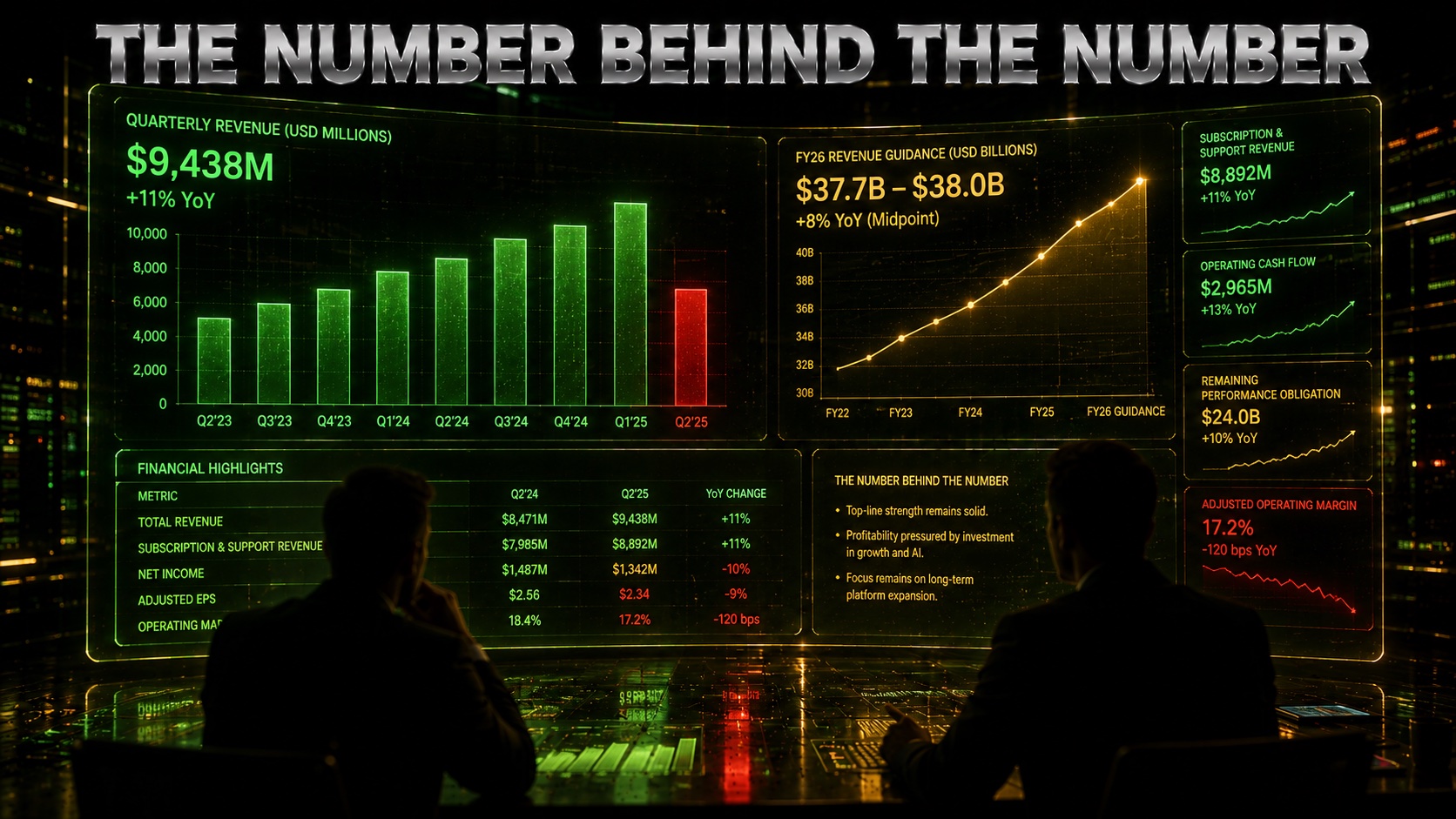
The earnings figure that needs unpacking
Adjusted earnings per share came in at $5.90 against a consensus near $3.27. On the surface that is an enormous beat. It is not, in the way that phrase usually implies.
Salesforce booked roughly $2.6 billion in investment gains during the quarter, driven overwhelmingly by an unrealised markup on its stake in Anthropic. That contributed about $2.53 of the $5.90. Strip it out and operating earnings were approximately $3.37 per share, against $2.91 a year earlier. That is roughly 16% growth in the underlying business: genuinely good, and completely different from the number in the headline.
This is worth stating clearly because it cuts against the narrative the stock rallied on. Salesforce owns a large, appreciating position in the very company it just partnered with. That position is now a meaningful swing factor in reported profit, and it works in both directions. A private company markup is not recurring software profit, and investors should not capitalise it as though it were.
5. The AI Engine: Agentforce, Data and Real Traction
The commercial question is whether any of the agent strategy converts into money. On this quarter’s evidence, it is starting to.
- Agentforce ARR passed $1.5 billion, up more than 240% year over year.
- Combined AI and Data ARR is approaching $4 billion.
- Agent work units consumed reached 3.2 billion in the quarter, up 97% sequentially.
- Roughly 2,000 production customers were added, a 70% sequential increase.
- Slackbot passed one million active users, up around 150% year over year.
Two cautions belong alongside those figures. First, $1.5 billion of Agentforce ARR sits against a business guided to more than $46 billion of annual revenue. It is a real business and a fast-growing one, but it is not yet large enough to set the direction of the whole company. Second, work-unit growth of 97% in a quarter is the kind of number that comes off a small base and from customers still in an experimentation phase. Sustained growth at that rate is not the reasonable planning assumption.
The honest read is that AI is now a genuine revenue line at Salesforce rather than a slide in a keynote, and that it is still too small to rescue or sink the investment case on its own.
6. How Salesforce Gets Paid in an Agent World
This is where the strategy becomes financially consequential. Salesforce has moved to headless consumption pricing, where API call access scales with the customer’s user licence edition. Customers contract separately with Anthropic for Claude inference, which creates a two-invoice arrangement.
That structure is revealing in two ways. It means Salesforce is not taking on the gross margin risk of reselling frontier model inference, which is a genuine positive given how volatile that cost line has been across the industry. It also means Salesforce does not capture the inference spend, so the upside from heavy agent usage accrues to it as platform consumption rather than as a margin on the model.
Company commentary acknowledged that the monetisation strategy for headless configurations is still evolving. For investors, that is the correct level of candour, and it is also the crux: the shift from selling seats to selling consumption changes the unit being billed, and a business metered on API consumption cannot be valued on the same seat-growth assumptions as one billed per licence.
7. The Moat Question
The broader theme, which we examined when Anthropic first triggered the SaaSpocalypse debate, is whether autonomous agents make application software redundant. Claudeforce is Salesforce’s structural answer, and it is a coherent one.
The moat, on this argument, was never the user interface. Screens are the most replaceable part of enterprise software, which is precisely why an AI interface can absorb them. What is hard to replicate is the accumulated layer underneath: identity, sharing rules, field-level security, audit trails, approval workflows, validation logic and the data model those depend on. An agent that bypasses all of that is not cheaper. It is a compliance incident waiting to happen.
Seen that way, Salesforce has chosen to let its interface be commoditised in order to defend the layer that actually holds the switching costs. It is a genuinely aggressive decision and the more credible strategy than pretending the interface was defensible.
The counter-argument deserves equal weight. If the interface is where seats were justified, then conceding the interface may concede the pricing model with it. The ecosystem is also moving quickly and not always in incumbents’ favour, as the dispute over third-party agent access to Claude demonstrated. Governance is a real moat, but it is a narrower one than owning the customer’s entire daily workflow.
8. Competitive Landscape
Salesforce is not alone in making this argument. Microsoft is making a near identical one with Copilot and Dynamics 365, with the advantage of owning the productivity surface where work already happens. ServiceNow has arguably the strongest workflow governance story in enterprise software. Oracle and SAP hold the systems of record for finance and operations and are pursuing the same logic from the ERP side. HubSpot competes hard in the mid-market, where governance complexity is lower and switching costs are thinner.
The distinguishing feature of Salesforce’s approach is that it partnered with a frontier lab rather than trying to out-build one. That avoids an unwinnable capital race against Anthropic, OpenAI and Google, and it is the same discipline that separates durable infrastructure businesses from narrative ones, a distinction we applied when assessing whether Marvell’s AI data centre business was real or a story. The trade-off is dependence: the reasoning layer of Salesforce’s flagship AI experience now belongs to somebody else.
9. Risks

- Seat compression. If agents do the clicking, enterprises need fewer licensed clickers. Seat-based revenue is the core of the business, and consumption revenue has to grow faster than seats shrink. The timing of that crossover is unknown.
- Execution risk on an unproven product. Salesforce in Claude is in restricted pilot. Open beta was expected in September 2026, and non-sales skills are not due until late 2026. Latency, hallucinated deal analysis or integration friction at scale would all be visible failures.
- Dependence on Anthropic. Salesforce’s flagship reasoning layer is a partner’s model. Pricing, capacity, roadmap and availability are outside its control.
- Investment gain volatility. The Anthropic stake, valued in the billions, now moves reported earnings materially. Markups reverse.
- Monetisation still being designed. Management itself described headless monetisation as evolving. Unsettled pricing on a strategically central product is a real uncertainty.
- Adoption depth. Only about 5% of knowledge workers have upgraded to premium editions. That is upside, but it is also evidence that adoption is early rather than proven.
- Currency and macro. Guidance already absorbs a roughly $100 million foreign exchange headwind.
10. Valuation
Following the print the shares traded in the region of $248 to $256, against a 52-week range of roughly $146 to $268, giving a market capitalisation in the area of $210 billion and a forward earnings multiple in the mid-teens.
That multiple is the heart of the case. A business growing revenue 11%, expanding cRPO 14% and holding a 34% non-GAAP operating margin does not obviously belong at a mid-teens forward multiple, which is a discount to the broader software group. The market has been pricing in structural decline rather than cyclical slowness.
Analyst opinion after the quarter reflected exactly that split. Several houses, including JPMorgan, Mizuho, BMO, Truist and Monness Crespi, raised targets into a $260 to $300 range. UBS, Citi, Morgan Stanley and Wells Fargo kept neutral or equivalent ratings, with targets clustered nearer $230 to $240. Morgan Stanley’s own published scenario work spans an unusually wide $90 to $350, with the bear case built on AI-native competitors grinding growth down toward mid-single digits over three years. A spread that wide is itself the message: this is a genuine disagreement about the business model, not a debate about next quarter.
Bull Case
- The discounted multiple already embeds a disruption thesis that this quarter’s cRPO acceleration and raised guidance actively contradict.
- Agentforce ARR above $1.5 billion, growing over 240%, proves customers will pay for agentic capability rather than merely trial it.
- Permission inheritance and zero data retention make Salesforce the default safe host for enterprise agents, which is a defensible position rather than a feature.
- Consumption pricing raises the revenue ceiling per customer beyond what a seat count allows.
- Free cash flow up 81% year over year funds buybacks and investment without stressing the balance sheet.
Bear Case
- Roughly 43% of reported adjusted profit came from investment gains, not software. The underlying beat was modest.
- Conceding the interface may concede the seat-based pricing model along with it, and consumption revenue is currently a fraction of licence revenue.
- Claudeforce is in pilot. Essentially none of the thesis is proven at enterprise scale yet.
- Reliance on Anthropic surrenders control of the reasoning layer and the economics attached to it.
- Every major platform vendor is making the same governance argument, so the differentiation may prove narrower than it looks today.
- Eleven percent revenue growth is respectable, not transformative, and it is what the multiple ultimately has to be justified against.
Base Case
The most reasonable central expectation is that Salesforce remains a high-margin, low-double-digit growth business through FY2027, with AI revenue growing quickly from a base too small to change the aggregate growth rate. The rerating already delivered reflects relief that the disruption thesis was overstated. Further rerating likely requires evidence over several quarters that consumption revenue is growing faster than seat revenue is eroding. The September 2026 open beta and the late 2026 skill expansion are the checkpoints that will start to answer that.
11. Final Thoughts
Salesforce matters because it holds the governed data layer that enterprise AI has to pass through to be useful and legal. Its biggest opportunity is converting that position into consumption revenue that scales with agent activity instead of headcount. Its biggest risk is that the same shift dissolves the seat-based pricing that produces almost all of its revenue today, faster than the replacement arrives.
The quarter was good, and the strategy is more coherent than the market had been giving it credit for. But the headline earnings number flattered the result considerably, and Claudeforce is a pilot rather than a proven business. This is an early and encouraging data point in a transition that will take years to resolve, not the resolution itself. The distinction between a company adapting well and a company having already adapted is worth holding onto, particularly given how quickly AI is reshaping the work these tools were built to support.
FAQ
What is Claudeforce?
Claudeforce is the expanded partnership between Salesforce and Anthropic announced on 26 August 2026. It covers three integrations: Claude as the reasoning model inside Salesforce products, a Salesforce plugin inside Claude with 37 prebuilt sales skills, and Claude powering Slack experiences including Slackbot.
When will Claudeforce be generally available?
Salesforce in Claude was with select pilot customers at launch, with open beta expected in September 2026. Prebuilt skills covering functions beyond sales were slated to begin arriving in late 2026, so meaningful revenue contribution is unlikely before fiscal 2028.
Did Salesforce really beat earnings estimates by that much?
Not in operating terms. Adjusted EPS of $5.90 compared with consensus near $3.27, but roughly $2.53 of it came from investment gains, mainly an unrealised markup on the company’s Anthropic stake. Excluding those gains, adjusted EPS was approximately $3.37 against $2.91 a year earlier.
Will AI agents cannibalise Salesforce’s seat-based revenue?
That is the central bear case and it is unresolved. If agents replace manual work, customers may need fewer licences. Salesforce’s answer is consumption pricing tied to API access, but consumption revenue is currently far smaller than licence revenue, so the crossover timing is the risk.
Why does the Model Context Protocol matter to investors?
MCP is the open standard through which agents call Salesforce data and actions. It matters commercially because Salesforce’s MCP server enforces the individual user’s existing permissions and sharing rules, which is what makes agent access safe enough for regulated enterprises to authorise.
Is Salesforce stock cheap after the Claudeforce rally?
Even after a rise of roughly 18% to 21%, the shares traded at a forward earnings multiple in the mid-teens, a discount to the software sector. Whether that is cheap depends entirely on whether you believe revenue growth stabilises in the low double digits or erodes as seat demand falls.
Stay With the Analysis
If this breakdown was useful, read our related coverage on AI and enterprise software, subscribe for future updates, and visit the One More Stock YouTube channel for video versions of these deep dives.
Financial Disclaimer:
This article is for educational and informational purposes only and should not be considered financial or investment advice. Investing involves risk, including the possible loss of capital. Always conduct your own research and consult a qualified financial adviser before making investment decisions.