
Why Workers Are Training AI to Replace Themselves?
Let’s talk about Colleague.Skill today, which went viral within China companies.
The global workforce is entering a phase that feels almost paradoxical: employees are now being asked to train the very systems that may eventually replace them. What once sounded like a distant automation narrative is now unfolding in real time, particularly in China’s rapidly evolving AI-driven economy.
Recent reports highlighted by institutions such as MIT Technology Review describe a growing trend where Chinese companies require employees to meticulously document their workflows. These records are then fed into AI systems capable of replicating decision-making processes, operational steps, and even nuanced workplace behaviors.
At the center of this conversation is a viral concept known as “Colleague.Skill.” This tool demonstrates how employee-generated data can be transformed into structured AI instructions, effectively turning human expertise into machine-executable workflows. Combined with emerging systems like OpenClaw, the implications are clear: the boundary between human labor and machine intelligence is collapsing.
This is not just automation. It is the systematic conversion of human work into reusable digital assets owned by companies.
From Task Execution to Knowledge Extraction
Traditionally, automation replaced repetitive, manual labor. What makes the current wave different is its focus on knowledge work, the domain once believed to be safe from disruption.
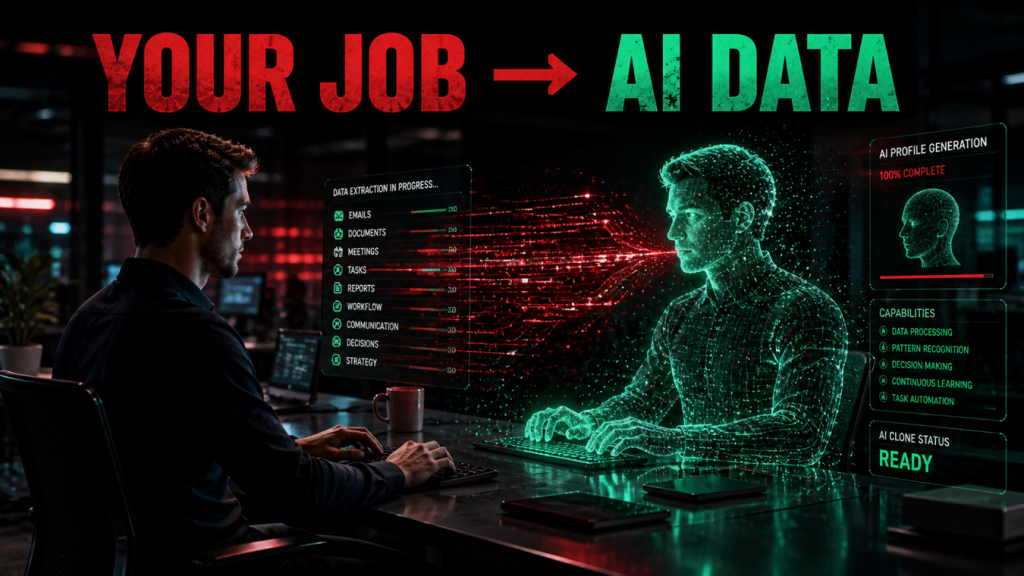
With tools like Colleague.Skill, companies are no longer just automating tasks; they are extracting entire workflows. Employees are asked to describe how they solve problems, how they communicate with stakeholders, and how they make decisions. This information becomes training data for AI agents.
The result is a new economic model, distill your colleagues:
- Employees perform tasks
- Their processes are captured and structured
- AI systems learn and replicate those processes
- Human roles are gradually reduced or eliminated
This model is already being implemented across industries such as tech, finance, customer service, and operations.
For workers, this creates a deeply uncomfortable reality: your job security may depend on how well you train your replacement.
The Global Context: AI Replacing Jobs Faster Than Expected
The developments in China are not isolated. Across the world, major corporations are accelerating their transition toward AI-driven operations.
Companies like Meta, Microsoft, and Amazon have already begun restructuring their workforce, citing efficiency gains from AI systems. In many cases, layoffs are not due to declining demand but due to increased productivity per employee enabled by AI.
This marks a fundamental shift. In previous economic cycles, layoffs were temporary corrections. Today, they are part of a long-term transition toward AI-first business models.
The key difference is that AI does not just replace jobs, it compresses them. Work that once required multiple employees can now be handled by a single AI-augmented operator or fully autonomous system.
Will AI Destroy Jobs or Create New Ones?
This question dominates public discourse, but the answer is more nuanced than most headlines suggest.
AI will undoubtedly create new roles. However, these roles tend to be highly specialized, AI engineers, data scientists, automation architects, and are significantly fewer in number compared to the jobs being displaced.
At the same time, a large portion of existing roles will not disappear entirely but will be radically transformed. Employees will be expected to manage AI tools, oversee automated systems, and deliver significantly higher output.

This leads to a two-tiered workforce:
- AI-augmented workers, who remain employed but face increasing productivity pressure
- Displaced workers, whose roles are fully automated
In both cases, income stability becomes less certain. Salaries may stagnate or decline as supply increases and demand shifts toward fewer, more specialized roles.
The Income Problem: Why Full-Time Jobs Are No Longer Enough
For decades, the traditional career model offered a clear path: education, employment, promotion, and financial stability. That model is now under pressure.
AI-driven automation introduces three key risks to income:
- Job volatility – roles can be restructured or eliminated quickly
- Wage compression – increased productivity reduces the need for large teams
- Skill obsolescence – existing expertise can become outdated faster than everd
This creates a fundamental challenge: relying solely on a single salary is becoming increasingly risky.
The emergence of tools like Colleague.Skill highlights this reality. If your knowledge can be digitized and automated, then your income must evolve beyond traditional employment.
The Passive Income Shift: From Labor to Systems
This is where the conversation shifts from risk to opportunity.
The same technologies that are replacing jobs are also enabling individuals to build scalable, AI-powered income systems. Passive income is no longer limited to traditional investments, it now includes digital assets powered by automation.
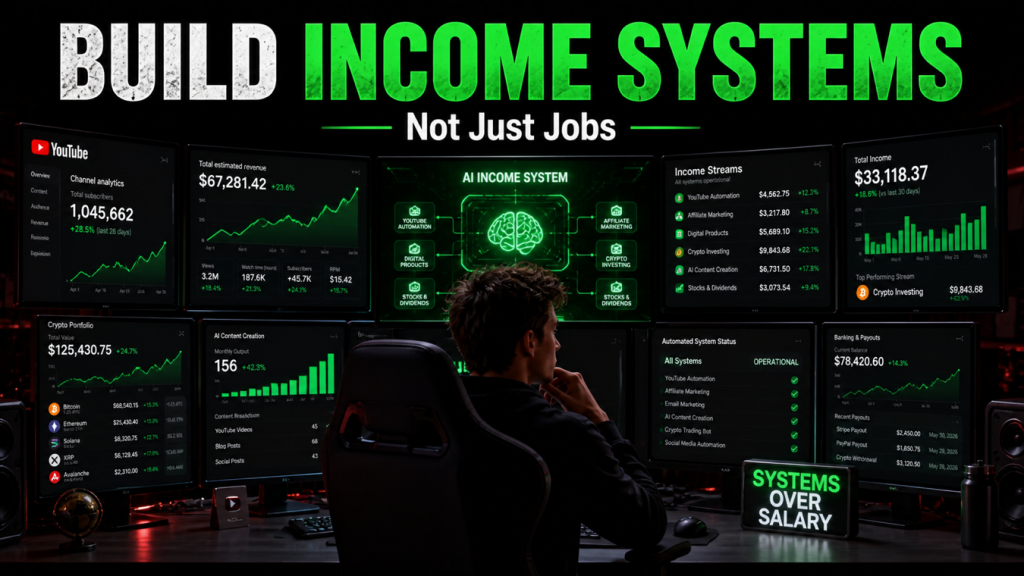
In the AI era, passive income is best understood as system-generated income rather than effort-based income.
Examples include:
- AI-generated content platforms (YouTube, blogs, newsletters)
- AI-powered affiliate marketing systems
- Algorithmic trading strategies
- Blockchain-based yield generation
These systems operate continuously, leveraging AI to produce output without constant human input.
For workers facing job uncertainty, this represents a critical shift:
from being a provider of labor → to becoming an owner of systems.
Why AI Displacement Accelerates the Side Hustle Economy
As job security declines, individuals are increasingly turning to side hustles, not as optional income, but as essential financial protection.
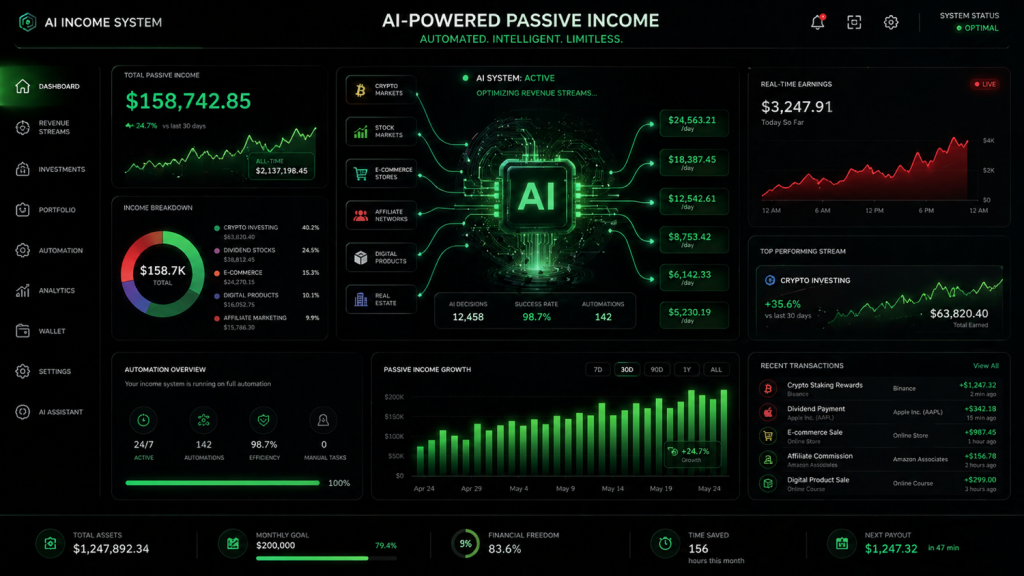
AI dramatically lowers the barrier to entry. Tasks that once required technical expertise can now be executed using user-friendly tools. This allows individuals to launch income streams faster and at lower cost.
However, not all side hustles are equal. The most effective ones share three characteristics:
- Scalability – the ability to grow without proportional effort
- Automation – minimal ongoing manual input
- Leverage – the ability to generate income repeatedly
AI-powered systems meet all three criteria.
This is why the rise of tools like Colleague.Skill is not just a warning – it is a signal. It indicates that the future of work will favor those who build systems rather than perform tasks.
The Psychological Shift: Competing With AI vs Using AI
Perhaps the most important decision individuals face today is whether to compete with AI or to use it.
Competing with AI often leads to diminishing returns. Machines excel at speed, consistency, and scalability, areas where humans struggle to match.

Using AI, on the other hand, allows individuals to amplify their capabilities. A single person equipped with the right tools can achieve output levels that previously required entire teams.
This shift requires a change in mindset. Instead of asking, “How can I protect my job?” the more effective question is:
“How can I use AI to build income streams that do not depend on my job?”
Final Thoughts: The Future Belongs to System Builders
The rise of Colleague.Skill and similar tools marks a turning point in the relationship between humans and technology. Work is no longer just being automated, it is being digitized, replicated, and scaled.

For workers, this creates uncertainty. For those who adapt, it creates opportunity.
The future of income will not be defined by job titles, but by systems ownership. Those who build and control AI-driven systems will generate income continuously, while those who rely solely on employment may face increasing instability.
The transition is already underway. The only question is how quickly you respond.
FAQ Section
Q1: What is Colleague.Skill?
It is a concept/tool that converts employee workflows into structured data used to train AI systems capable of automating those roles.
Q2: Are workers really training their replacements?
In some cases, yes. Companies are using employee-generated data to build AI systems that replicate job functions.
Q3: Will AI eliminate most jobs?
Not entirely, but many roles will be transformed or reduced, especially repetitive and process-driven jobs.
Q4: How can I protect my income from AI disruption?
By building multiple income streams, especially AI-powered passive income systems.
Q5: Is passive income necessary in the AI era?
Increasingly yes, as reliance on a single job becomes more risky.
Sources
- World Economic Forum, The Future of Jobs Report 2025
- IMF Blog, AI Will Transform the Global Economy. Let’s Make Sure It Benefits Humanity.
- Stanford HAI, The 2025 AI Index Report
Disclaimer: This article is for educational and informational purposes only and does not constitute financial or business advice. Results from any online business vary widely, and there is no guarantee of any income. Do your own research before investing time or money.