

The Great AI Layoffs: Why Tech Giants Retrenchment Is Forcing a New Passive Income Era
The global technology sector is undergoing one of the most significant structural transformations in modern economic history. What began as post-pandemic “cost optimization” has now evolved into a full-scale AI-driven workforce restructuring. Across Silicon Valley and beyond, major technology companies are aggressively reducing headcount, not due to declining demand, but because artificial intelligence is replacing large portions of human labor. The Big Tech Layoffs is in the central of the storm now!

In 2025 alone, more than 120,000 tech workers were laid off globally, and the trend has continued into 2026 with renewed intensity. Unlike previous cycles, this wave of retrenchment is fundamentally different. It is not temporary. It is structural. And most importantly, it is being driven by the rapid deployment of AI systems capable of performing tasks that once required entire teams.

For professionals, investors, and passive income seekers, this shift is not just a warning; it is a signal.
The Scale of Retrenchment: Silicon Valley and Beyond
The magnitude of layoffs across major tech firms highlights the seriousness of this transition. Companies that once symbolized stability are now leading the charge in workforce reduction.

Amazon has cut tens of thousands of roles across corporate, logistics, and cloud divisions, citing efficiency gains from AI-driven automation and internal tooling. Microsoft has restructured aggressively, reallocating capital from human resources to AI infrastructure, particularly in its cloud and enterprise segments. Meanwhile, Intel has slashed tens of thousands of jobs as it pivots toward AI chip manufacturing to compete in a market increasingly dominated by GPU-centric workloads.
Perhaps the most controversial case comes from Meta. Through its internal “Model Capability Initiative,” the company has reportedly deployed tracking systems that capture employee workflows, every click, keystroke, and process decision. This data is then used to train AI agents capable of replicating those workflows. This is similar to the Colleague.md Skill hype happening in China corporates now.
This is not simply automation. It is what many analysts now call “industrialized behavior harvesting”; a system where human labor is systematically converted into machine intelligence, effectively training AI systems to replace the workforce itself.
At a macro level, this represents a shift from labor-based productivity to compute-based productivity.
From Employment to Automation: What’s Really Changing
The key question is not whether jobs are disappearing, but how they are being transformed.
AI is not eliminating all work, it is compressing it. Tasks that once required multiple employees can now be handled by a single AI-augmented operator or fully autonomous system. This leads to a bifurcation of the workforce.
On one side are “AI-augmented professionals” who leverage tools to increase productivity. These individuals remain employed but face increasing pressure to deliver more output with fewer resources. On the other side are roles that are becoming fully automated, customer support, basic coding, data analysis, and administrative functions.
The result is a gradual erosion of traditional full-time job security. Even high-paying tech roles are no longer immune.
This raises a critical reality: relying on a single income stream, especially a salary, is becoming increasingly risky.
The Meta Case: When Employees Train Their Replacements
The situation at Meta illustrates the future direction of AI-driven corporations.
By capturing real-time employee behavior and converting it into machine-executable processes, Meta is effectively building AI agents that can replicate entire job functions. This creates a closed-loop system:
Human Work → Data Capture → AI Training → Automation → Reduced Workforce
If successful, this model allows companies to scale without proportional increases in headcount. In fact, it incentivizes the opposite, continuous workforce reduction.
From a business perspective, this is highly efficient. From a workforce perspective, it is deeply disruptive.
And from an investor’s perspective, it signals where capital is flowing: away from labor and toward AI infrastructure.
Will AI Destroy Jobs or Create Them?
The debate around AI and employment is often framed in extremes. The reality is more nuanced.
AI will undoubtedly create new roles, AI engineers, prompt specialists, automation architects, but these roles require specialized skills and are far fewer in number compared to the jobs being displaced.
Most estimates suggest that while 10–20% of roles may disappear entirely, more than 50% will be significantly transformed. This means workers will need to adapt continuously, often without the stability that traditional employment once provided.

In practical terms, this leads to a world where:
- Jobs are less stable
- Income is less predictable
- Career paths are less linear
For many, this environment necessitates a shift in mindset: from employee to income architect.
Why This Pushes the Rise of Passive Income
As job security declines, the importance of multiple income streams becomes increasingly clear. Passive income is no longer a luxury, it is a financial necessity.
In the AI era, passive income opportunities have expanded dramatically. Unlike traditional side hustles, modern systems can be automated, scaled, and optimized using AI.
Key advantages include:
- Scalability: AI-driven systems operate 24/7 without additional labor
- Leverage: One system can generate income repeatedly
- Diversification: Multiple streams reduce reliance on a single employer
This is precisely where the OneMoreMoney philosophy becomes relevant, building systems that generate “one more” stream of income, repeatedly.
The New Passive Income Playbook (AI Era)
To adapt to this new economic reality, individuals must focus on building AI-powered income systems rather than relying solely on employment.
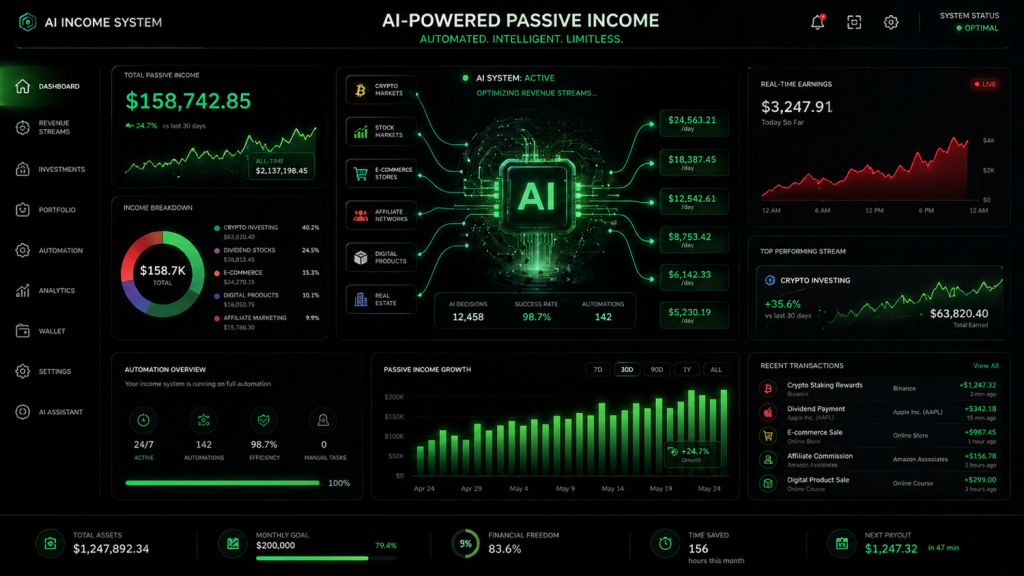
The most effective models today include:
AI Content Engines
Faceless YouTube channels, automated blogs, and newsletters can generate traffic and monetize through ads and affiliate marketing. AI handles content creation, allowing for rapid scaling.
AI Affiliate Marketing
Using AI Affiliate Marketing tools, individuals can automate product recommendations, optimize funnels, and generate commissions from digital traffic.
Algorithmic Trading
AI trading bots in stocks, forex, and crypto markets can execute strategies continuously, generating returns independent of active involvement.
Blockchain Yield Systems
DeFi platforms offer yield opportunities through staking, lending, and real world tokenized assets, providing an alternative to traditional financial systems.
Each of these models shifts income generation from time-based effort to system-based output.
The Psychological Shift: From Worker to Operator
Perhaps the most important change is not technological, but psychological.
For decades, financial stability was tied to employment. In 2026, stability comes from ownership of systems and assets.
This requires a new mindset:
- Instead of asking “How do I get a better job?”
- Ask “What system can I build that generates income without me?”
This shift is subtle but powerful. It moves you from dependence to control.
Final Thoughts: Turning Big Tech Layoffs Disruption into Opportunity
The wave of AI-driven retrenchment is not slowing down. If anything, it is accelerating as companies race to adopt automation and reduce costs.
For many, this is a period of uncertainty. But for those who understand the shift, it is also a period of opportunity.

The same AI technologies that are replacing jobs are also enabling individuals to build scalable income systems. The difference lies in how you use them.
You can either compete with AI, or you can deploy it.
The choice will define your financial future.
FAQ Section
Q1: Why are tech companies laying off employees in 2026?
Companies are replacing repetitive and scalable tasks with AI systems to improve efficiency and reduce costs.
Q2: Is AI the main reason for job losses?
AI is a major factor, especially in roles involving data processing, customer service, and routine operations.
Q3: Will AI create new job opportunities?
Yes, but fewer in number and requiring advanced or specialized skills.
Q4: How can I protect my income from AI disruption?
By building multiple income streams such as AI-driven content, affiliate marketing, and automated investments.
Q5: Is passive income necessary in the AI era?
Increasingly yes, as relying on a single job becomes more risky in an automated economy.