
Bloom Energy (BE): The AI Data Center Power Bottleneck Play
Bloom Energy (BE): The AI Data Center Power Bottleneck Play
For three years the constraint on artificial intelligence was silicon. If you could secure accelerators, you could build. That constraint has quietly moved.
The binding limit on AI capacity today is electricity, and more precisely the ability to get electricity to a specific site on a specific date. A data centre campus with signed leases, delivered racks and no interconnection agreement is a stranded asset. That is the problem Bloom Energy (NYSE: BE) sells into, and in 2026 the market repriced the company accordingly.
This article works through what Bloom actually does, what its record second quarter proved and did not prove, why a widely circulated congressional disclosure is a weaker signal than headlines suggest, and where the genuine risks sit. Our aim is the usual one at OneMoreStock: understand the business first, then decide whether the price makes sense.
Key Financial Metrics
| Metric | Value |
|---|---|
| Ticker | NYSE: BE |
| Share price | $252.87 (close, 4 Sep 2026) |
| Market capitalisation | ~$74.5 billion |
| 52-week range | $52.00 to $351.28 |
| Revenue (TTM) | $3.11 billion, up 91% |
| Q2 2026 revenue | $1,065.4 million, up 165.5% YoY |
| Q2 2026 operating income | $182.2 million (GAAP) |
| Q2 2026 non-GAAP gross margin | 34.3%, up 604 bps YoY |
| FY2026 revenue guidance | $3.9 billion to $4.2 billion |
| FY2026 non-GAAP operating income guidance | $800 million to $900 million |
| FY2026 non-GAAP EPS guidance | $2.55 to $2.85 |
| Trailing P/E | ~285 |
| Forward P/E | ~72 |
| Analyst consensus | Buy, mean target ~$275 (range $97 to $390, 29 analysts) |
Data as of 4 September 2026. Verify before acting on any figure.
1. Why Electricity Became the New Silicon
The economics of an AI buildout are unforgiving about time. Accelerators depreciate whether or not they are drawing load, and a campus that cannot energise is burning capital while producing nothing.
Grid connection is where that time disappears. Lawrence Berkeley National Laboratory, which tracks United States interconnection queues, found that the typical wait from connection request to commercial operation rose from under two years for projects built between 2000 and 2007 to a median of roughly five years for projects completed in 2023. The queue itself held about 2.6 terawatts of proposed capacity at the end of 2023, roughly twice the country’s entire installed generating base.
Those numbers describe generation projects rather than data centre loads, but the underlying congestion is the same, and it is the reason large-load customers now treat utility timelines as a planning risk rather than a given. Two responses follow:
- Wait for the utility, and accept that the site energises on the utility’s schedule rather than the customer’s.
- Generate on site, and treat grid power as an eventual supplement rather than the precondition.
The second option used to be a diesel-backed compromise. Bloom’s argument is that it no longer has to be.
2. What Bloom Energy Actually Does
Bloom Energy manufactures solid oxide fuel cell systems, sold as Bloom Energy Servers. A fuel cell is not a generator in the combustion sense. It converts fuel into electricity through an electrochemical reaction, which means no burning, no rotating machinery and far fewer moving parts than a turbine or a reciprocating engine.
Bloom’s cells are solid oxide, meaning the electrolyte is a ceramic that operates at high temperature. That design choice is what allows the system to run on natural gas, biogas or hydrogen without a separate reformer, and it is also the reason scandium matters to this company, a point we return to in the risk section.
The commercial model has three legs:
- Hardware. Sale of the fuel cell systems themselves, which is where the bulk of revenue and the operating leverage sit.
- Service. Long-term operations and maintenance agreements attached to the installed base.
- Power purchase agreements. Bloom or a financing partner owns the asset and sells the electricity, which converts a capital sale into a recurring stream.
The product relevant to this thesis is the modular on-site power block sized for compute workloads. It is scalable in increments, it sits behind the meter, and it can be commissioned in months rather than years. Bloom delivered power to an Oracle data centre within 55 days of first engagement, a figure management has used repeatedly because it is the clearest possible statement of the value proposition.
3. Recent Developments: A Record Quarter and an Index Seat
Two things happened in quick succession that changed how the market classifies this company.
On 28 July 2026, Bloom reported second quarter revenue of $1,065.4 million, up 165.5% from $401.2 million a year earlier, and raised full year guidance. On 4 September 2026, S&P Dow Jones Indices announced that Bloom Energy would join the S&P 500 in the quarterly rebalance, replacing Molson Coors before the open on 21 September. The stock closed that session at $252.87, up 7.35%, and traded higher again after hours.
Index inclusion is not a fundamental event. It does not change a single unit of demand. What it does change is the shareholder register: passive funds tracking the index must buy, and a company that spent most of its life as a speculative clean-technology name is now a mandatory holding for a large pool of capital. That is a real, if one-off, change in the cost of capital and the volatility profile.
The fundamental event is the quarter itself.
4. Financial Performance: What the Quarter Proved
The headline number is large, but the composition is what matters.
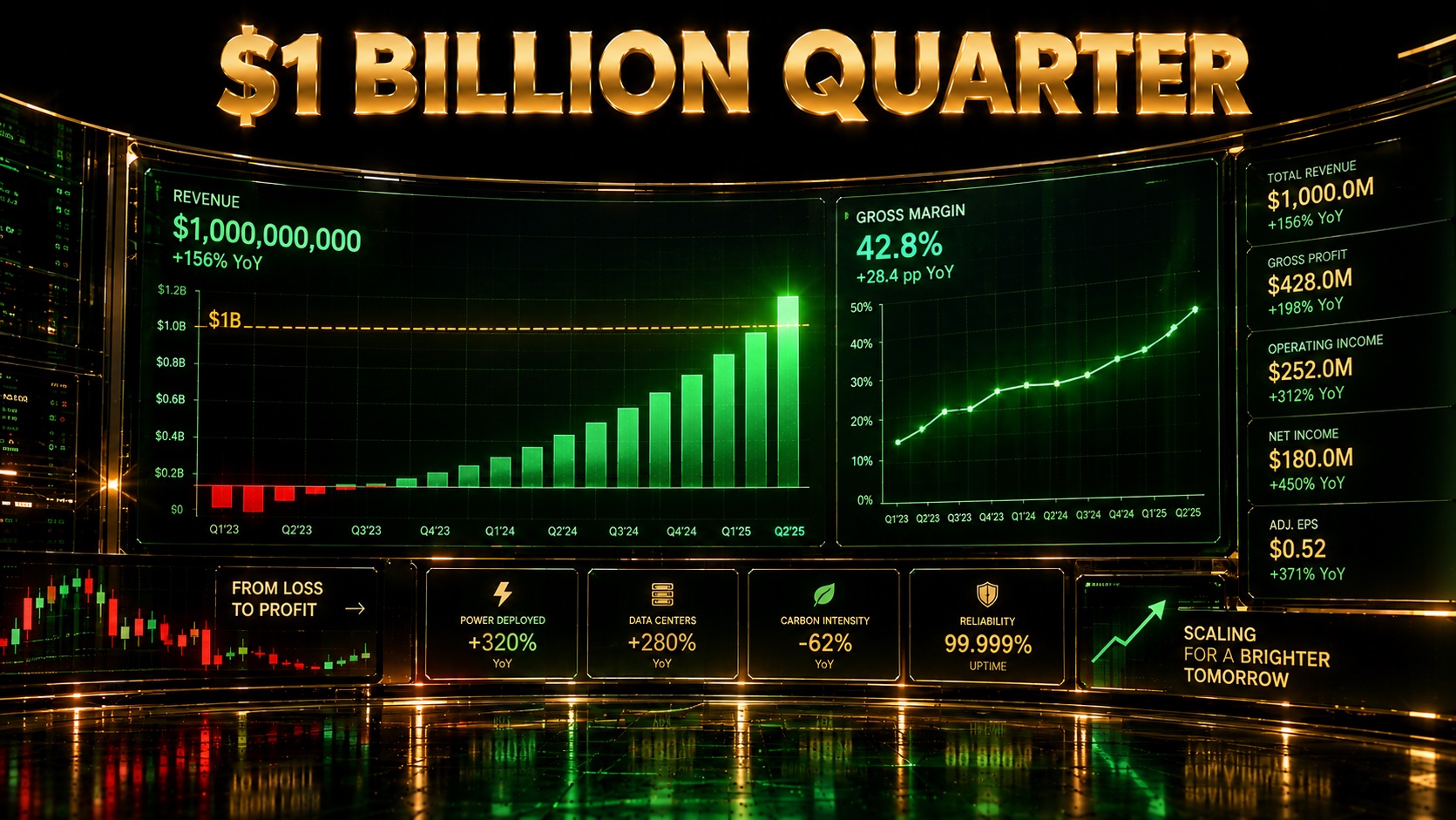
- Revenue of $1,065.4 million, up 165.5% year on year and up 42% sequentially.
- Product revenue of $935.4 million, up 215.4% from $296.6 million. Growth is concentrated in hardware, not in service or financing.
- GAAP operating income of $182.2 million, against a $3.5 million operating loss in the prior year period. Non-GAAP operating income was $239.6 million.
- Non-GAAP gross margin of 34.3%, an improvement of 604 basis points from 28.2%.
- Raised full year guidance: revenue of $3.9 billion to $4.2 billion, non-GAAP operating income of $800 million to $900 million, and non-GAAP EPS of $2.55 to $2.85.
Read together, those figures describe operating leverage rather than a one-quarter demand spike. Gross margin expanding by six percentage points while revenue nearly triples is the signature of a manufacturer moving up its own cost curve: fixed factory overhead spread across far more units, better purchasing terms, and fewer first-of-a-kind installation costs.
The honest caveat is that a single quarter of operating profit does not establish a durable margin. Bloom has guided to roughly 34% non-GAAP gross margin for the year, which implies the second half does not deteriorate. Whether that holds through a period of rapid capacity expansion is the central open question on the long side.
5. Growth Drivers: Hyperscalers, Neoclouds and Capacity
Demand for Bloom’s product is no longer speculative, and the customer list is the evidence.
- Oracle. In April 2026 the two companies announced an expanded partnership covering up to 2.8 gigawatts of fuel cell capacity for AI and cloud data centres.
- Brookfield. A $5 billion strategic AI infrastructure partnership announced in October 2025, under which Brookfield funds deployment of Bloom’s systems at data centre sites internationally.
- Utilities and colocation. Agreements with AEP, which supplies power to Amazon Web Services, and with Equinix, alongside neocloud operators including CoreWeave.
On the second quarter call, management said Bloom has validation from the major United States hyperscalers plus more than a dozen neoclouds, AI labs and colocation operators, and that backlog is growing faster than revenue as customers place longer-dated orders. Founder and chief executive KR Sridhar framed it as Bloom becoming “a standard for AI onsite power.”
Capacity is the other half of the equation. Bloom has said it remains on track to double annual production capacity to 2 gigawatts by the end of 2026. Backlog only converts into revenue if the factory can build, so manufacturing execution is now as important to the thesis as demand generation.
This is the same structural story that runs through the rest of the AI infrastructure stack, where the constraint keeps migrating to whichever component is hardest to add capacity in. We have traced the equivalent squeeze in networking silicon in our Marvell AI data centre infrastructure analysis, and in the optical layer in our work on indium phosphide and AI optical components.
6. Competitive Position
Bloom competes less against other fuel cell companies than against every other way of getting electrons to a site quickly.
- Grid interconnection. The default, and the slowest. Bloom’s entire pitch is speed relative to this baseline.
- Gas turbines (GE Vernova and peers). Proven, efficient at large scale, and currently subject to multi-year order backlogs of their own. Turbines also require permitting for combustion emissions that fuel cells largely avoid.
- Other fuel cell makers (FuelCell Energy, Plug Power). Direct technology competitors, but neither is currently shipping at Bloom’s revenue scale.
- Reciprocating engines and gensets (Caterpillar and similar). Cheap and fast to deploy, but built for backup duty rather than continuous prime power, and worse on emissions.
Bloom’s advantage is narrow but real: continuous on-site prime power, at 10 to 100+ megawatt scale, deployable in months, with an emissions profile that clears permitting in jurisdictions where combustion would not. The moat is manufacturing scale and a qualified customer base rather than a patent thicket, which means it is defensible for as long as Bloom keeps its lead in deployed megawatts and loses value if a larger industrial competitor decides to build the same thing.
7. The Pelosi Disclosure: What It Is and What It Is Not
Much of the retail attention on BE in late August came from a congressional disclosure, and it is worth handling precisely rather than dramatically.
Nancy Pelosi signed a periodic transaction report on 21 August 2026 disclosing purchases made by Paul Pelosi. The report covers:
- 10,000 shares purchased on 24 July, in the $1 million to $5 million disclosure band, plus 100 call options in the same band.
- 5,000 shares purchased on 28 July, in the $500,000 to $1 million band, plus a further 100 call options in the $1 million to $5 million band.
- The 200 call options carry a $100 strike price and expire on 17 June 2027.
That totals 15,000 shares and 200 call contracts, with a combined disclosed value somewhere between $3 million and $12 million. Congressional disclosure uses value bands rather than exact amounts, which is why every report of this trade quotes a wide range.
Three points of interpretation matter more than the headline:
- The purchases were made on 24 and 28 July, immediately before and around the 28 July earnings release, and were disclosed roughly a month later. Anyone reacting to the news in late August was reacting to information already reflected in the price.
- Deep in-the-money LEAPS with a $100 strike against a stock trading near $250 behave much like leveraged stock exposure with a defined expiry. They are a directional position with a time limit, not a hedge.
- A disclosed trade is a data point about one household’s allocation. It is not research, it carries no information about Bloom’s backlog or margins, and building a position around it means owning a business you have not underwritten.
We include it because it is a genuine driver of the stock’s visibility and trading volume. It is not part of the investment case.
8. Risks
This is where the balance of the thesis is decided, and the risks here are unusually concrete.
Scandium sourcing and the short report
On 8 July 2026, Hunterbrook Media published a report alleging that Bloom remains reliant on Chinese scandium, the rare earth metal used to stabilise the ceramic electrolyte in its cells. Hunterbrook said it traced four China-linked routes into the supply chain, including direct shipments of scandium oxide to Bloom’s Delaware plant and scandium-bearing ceramics and powders routed through intermediaries in Thailand, Japan and South Korea, and that its work drew on trade data, Chinese corporate records, satellite imagery and correspondence with suppliers.
Bloom rejected the report as false and misleading. In an SEC filing the company stated: “We have sufficient supply of scandium oxide to meet our current fuel cell demand and backlog, and our supply is not dependent on China.” The shares fell 5.7%, or $15.28, to close at $254.29 on the day of publication. A second critical report from Crossroads Capital followed in August, which Bloom also denied.
We are not in a position to adjudicate the sourcing question, and we are not going to pretend otherwise. What an investor can reasonably conclude is narrower: a critical input to the product is a rare earth metal with a concentrated global supply base, and the company’s own supply chain disclosures are now contested in public.
Litigation
On 30 July 2026 a securities class action was filed in the Northern District of California on behalf of purchasers of Bloom securities between 27 February and 8 July 2026, alleging the company understated the extent of its reliance on Chinese scandium. The lead plaintiff deadline is 28 September 2026. Securities class actions are slow and frequently resolve for far less than the headlines imply, but they consume management attention and create a disclosure overhang.
Fuel and policy
Most deployed Bloom capacity runs on natural gas. That exposes customers to commodity price volatility, and it means the environmental case rests on efficiency and the absence of combustion rather than on zero emissions. A tightening of carbon rules, or a corporate customer’s own emissions commitments, could constrain where these systems are acceptable.
Valuation and execution
At roughly 285 times trailing earnings and 72 times forward earnings, the market is not asking whether Bloom grows. It is assuming that it does, at high margins, without stumbling. Installation delays, a cancelled pilot, or gross margin slipping a few points below the 34% guide would each be enough to compress the multiple sharply. The 52-week range, from $52.00 to $351.28, is a fair warning about how this stock behaves when expectations move.

9. Valuation
Bloom trades at roughly $74.5 billion in market capitalisation against $3.11 billion of trailing revenue and a guided $3.9 billion to $4.2 billion for the full year. On the midpoint of guidance that is around 18 times current-year sales.
The forward earnings multiple of roughly 72 is the more useful anchor, because it prices the operating income guidance of $800 million to $900 million rather than the trailing GAAP figure distorted by a recent turn to profit. Seventy-two times forward earnings for a business growing revenue near 100% with expanding gross margins is defensible arithmetic. It is also entirely dependent on that growth rate persisting well beyond 2026.
Sell-side opinion reflects the tension. Across 29 analysts the consensus rating is Buy with a mean twelve-month target near $275, roughly 9% above the recent close, but the individual targets run from $97 to $390. A four-fold spread between the low and high estimate is not analytical sloppiness. It is an accurate description of a company whose value depends on how long a demand cycle lasts, and reasonable people disagree about that by a factor of four.
Bull case
- AI capacity is power-constrained rather than chip-constrained, and Bloom sells the fastest route around a five-year interconnection queue.
- Q2 demonstrated genuine operating leverage: 604 basis points of gross margin expansion alongside near-tripled revenue.
- Contracted demand is visible rather than hypothetical, spanning Oracle at up to 2.8 GW, a $5 billion Brookfield partnership, and validation across the major hyperscalers and a dozen-plus neoclouds.
- Backlog is growing faster than revenue, and capacity is on track to double to 2 GW by year end.
- S&P 500 inclusion broadens the shareholder base and lowers the cost of capital.
Bear case
- The scandium dispute puts a critical input, and the credibility of the company’s own supply chain disclosure, into open question.
- A securities class action covering February to July 2026 is live, with a September lead plaintiff deadline.
- Natural gas dependence exposes customers to fuel price volatility and to tightening emissions policy.
- At roughly 72 times forward earnings there is no room for an installation delay, a cancelled project or a margin miss.
- Demand is concentrated in a small number of very large customers whose own capital spending plans can change quickly.
Base case
Bloom delivers close to guidance, gross margin holds near 34%, and the stock trades on execution against a large, visible backlog rather than on narrative. In that scenario the shares are neither cheap nor absurd, and the return comes from growth compounding into the multiple rather than from further multiple expansion.
10. Final Thoughts
Bloom Energy matters because it sells the scarce input to the most capital-intensive buildout in the technology sector, and because it has now proved it can do so profitably at scale. The second quarter was not a narrative quarter. Revenue above $1 billion with 34.3% non-GAAP gross margin and $182.2 million of GAAP operating income is a manufacturing business working.
The biggest opportunity is that the grid does not catch up. Interconnection queues are structural, and every quarter they remain congested is a quarter in which on-site generation is not a workaround but the plan.
The biggest risk is that the valuation already assumes exactly that. At these multiples the market has priced several years of flawless execution, and the scandium dispute is a live reminder that this is a physical manufacturer with a concentrated input, not a software company. Anyone buying here is underwriting both the demand cycle and the supply chain, and should size the position accordingly.
For readers building a broader picture of where AI infrastructure spending is actually landing, our analysis of silicon photonics and advanced packaging at GlobalFoundries covers the compute side of the same buildout.
If this kind of breakdown is useful, keep reading the rest of our AI infrastructure coverage and subscribe to the One More Stock YouTube channel for the video versions.
FAQ
Why is Bloom Energy stock up so much in 2026?
Bloom’s second quarter 2026 revenue reached $1,065.4 million, up 165.5% year on year, with $182.2 million of GAAP operating income and raised full year guidance. The company also announced major AI data centre partnerships with Oracle and Brookfield, and on 4 September 2026 was named for inclusion in the S&P 500. The combination of a profit inflection and index inclusion drove the re-rating.
What does Bloom Energy actually sell?
It manufactures solid oxide fuel cell systems called Bloom Energy Servers that generate electricity on site from natural gas, biogas or hydrogen through an electrochemical reaction rather than combustion. Revenue comes from hardware sales, long-term service agreements and power purchase agreements.
Why do AI data centres buy fuel cells instead of connecting to the grid?
Because of time. Berkeley Lab data shows the typical wait from interconnection request to commercial operation has stretched to a median of about five years for projects completed in 2023. Bloom can commission on-site capacity in months, and delivered power to an Oracle data centre within 55 days of first engagement.
What is the scandium controversy about?
Scandium is a rare earth metal used to stabilise the ceramic electrolyte in Bloom’s fuel cells. On 8 July 2026 Hunterbrook Media alleged Bloom relies on Chinese scandium supplied through intermediaries. Bloom called the report false and misleading and stated in an SEC filing that its supply is sufficient and not dependent on China. A securities class action covering the period from 27 February to 8 July 2026 was filed on 30 July.
Did Nancy Pelosi buy Bloom Energy stock?
A periodic transaction report signed on 21 August 2026 disclosed that Paul Pelosi purchased 15,000 shares across 24 and 28 July plus 200 call options with a $100 strike expiring 17 June 2027, with a combined disclosed value between $3 million and $12 million. The trades were disclosed roughly a month after they occurred, so the information was already in the price by the time it became public.
Is BE stock expensive?
At roughly $252.87 per share and $74.5 billion market capitalisation, Bloom trades near 285 times trailing earnings and 72 times forward earnings, or about 18 times the midpoint of full year revenue guidance. Analyst targets span $97 to $390 with a mean near $275, which is a fair reflection of how much the valuation depends on the demand cycle persisting.
What would break the investment thesis?
Gross margin falling materially below the roughly 34% guided level, a slip in the capacity ramp toward 2 GW, cancellation or deferral by one of the large hyperscaler customers, or a supply chain disruption in scandium sourcing. Any of these would undermine the operating leverage argument that supports the current multiple.
Financial Disclaimer:
This article is for educational and informational purposes only and should not be considered financial or investment advice. Investing involves risk, including the possible loss of capital. Always conduct your own research and consult a qualified financial adviser before making investment decisions.