
AXT (AXTI): The Indium Phosphide Bottleneck Behind AI Optics
AXT (AXTI): The Indium Phosphide Bottleneck Behind AI Optics
Every few quarters the AI buildout finds a new component it cannot get enough of. In 2024 it was high bandwidth memory. In 2025 it was advanced packaging. In 2026 the constraint moved somewhere far less visible: the crystal wafer that high speed laser chips are grown on.
That wafer is indium phosphide, and AXT, Inc. (Nasdaq: AXTI) is one of only three companies in the world that makes it at scale. The result has been one of the more violent repricings in the semiconductor sector. AXT shares traded near $2 in early 2025, touched an all time high of $143.16 in late May 2026, fell back into the $30s over the summer, and changed hands around $81 in mid August 2026.
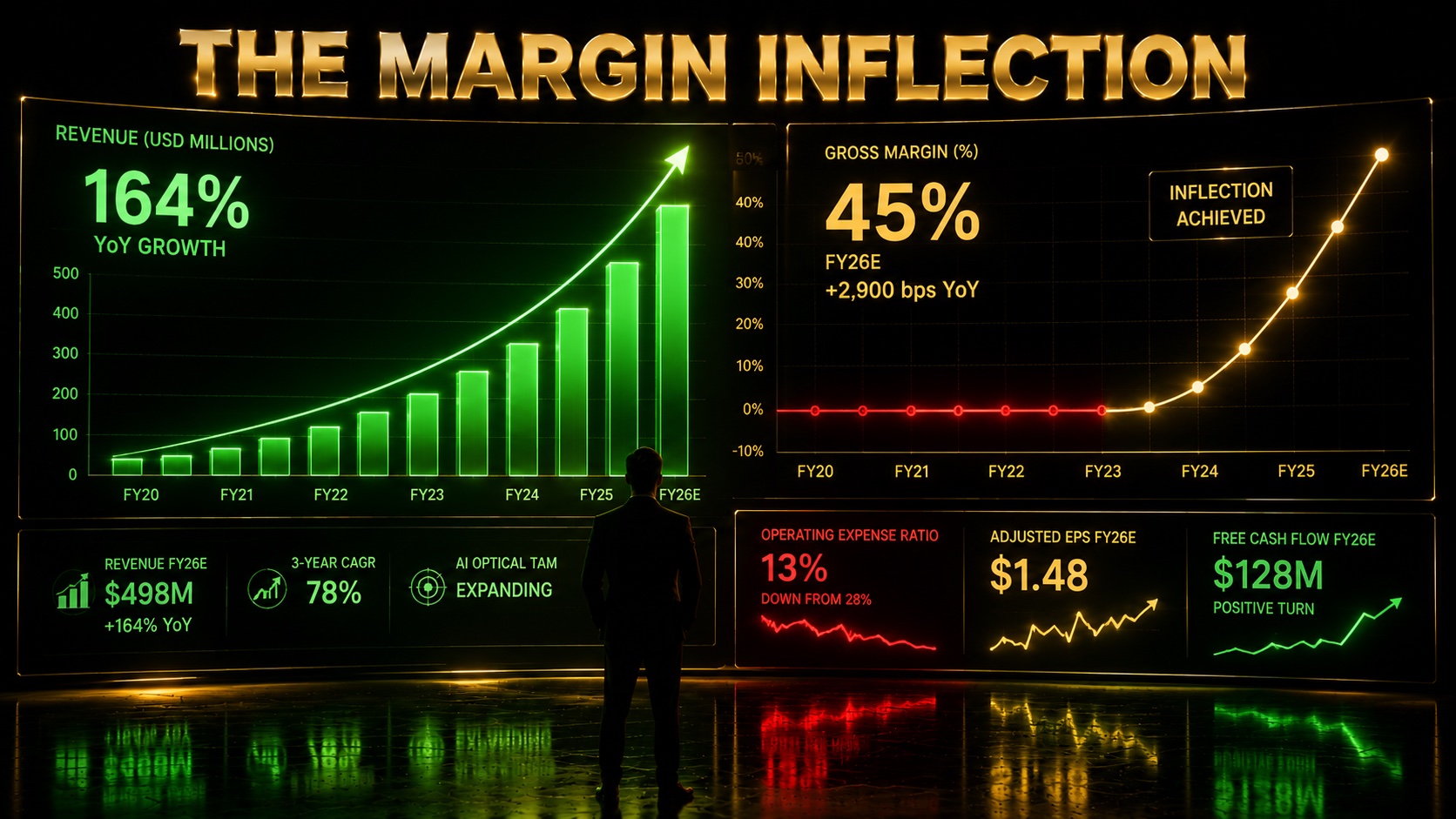
Underneath that volatility sits a genuine business inflection. In the June quarter AXT reported revenue of $47.6 million, up 164% year over year, with non GAAP gross margin of 45.0% and its first meaningful profit in years. Three customers signed capacity reservation agreements in the space of seven weeks, two of them with cash upfront.
This article works through what AXT actually sells, why indium phosphide became scarce, what the Q2 2026 numbers really show, where the moat is genuine and where it is thinner than the narrative suggests, and what the current share price is already assuming.
Key Metrics at a Glance
| Metric | Value |
|---|---|
| Share price | ~$81.64 |
| Market capitalisation | ~$5.34 billion |
| Shares outstanding | ~65.6 million |
| 52 week range | $2.05 to $143.16 |
| Q2 2026 revenue | $47.6 million (+164% YoY, +77% QoQ) |
| Q2 2026 InP revenue | $30.7 million (company record) |
| Q2 2026 non GAAP gross margin | 45.0% |
| Q2 2026 non GAAP EPS | $0.19 (consensus $0.07) |
| Q3 2026 revenue guidance | ~$66 million |
| Q3 2026 non GAAP EPS guidance | $0.30 to $0.32 |
| Cash and investments | ~$749 million |
| Backlog | Above $100 million, extending into 2027 |
| Analyst consensus | Buy, average target roughly $84 to $92 |
Data as of 14 August 2026. Verify before acting on any figure.
1. What AXT Actually Sells
AXT is a compound semiconductor substrate company. It does not design chips and it does not sell modules. It grows single crystal ingots, slices them into wafers, polishes them, and ships them to companies that build devices on top.
Three product families carry the business:
- Indium phosphide (InP) substrates, the base material for high speed lasers and photodetectors used in optical communications.
- Gallium arsenide (GaAs) substrates, used in radio frequency devices, lasers, LEDs and some sensing applications.
- Germanium substrates, a small legacy line used mainly in space solar cells.
AXT also consolidates several raw material joint ventures in China that supply and refine the feedstock chemistry the substrate business depends on. Those ventures are a real business in their own right, contributing $10.0 million of record revenue in Q2 2026.
The manufacturing itself sits with Beijing Tongmei Xtal Technology, AXT’s operating subsidiary in China. This is the single most important structural fact about the company, and it cuts both ways. It gives AXT a durable cost advantage over Japanese competitors. It also puts every export shipment under Chinese licensing control, which is where the company’s worst quarters have come from.
The revenue mix in Q2 2026 shows how completely InP now dominates the story:
- Indium phosphide: $30.7 million
- Gallium arsenide: $6.6 million
- Germanium: $272,000
- Raw material joint ventures: $10.0 million
A year earlier the whole company did $18.0 million. InP alone is now larger than that.
2. Why Indium Phosphide Became the Bottleneck
To understand why a sleepy substrate supplier suddenly matters, follow the light through an AI data centre.
2a. The physics silicon cannot do
Silicon is an indirect bandgap material. It is superb at switching electrons and hopeless at emitting light. Any system that moves data as photons still needs a compound semiconductor somewhere to generate the light in the first place.
Indium phosphide is the material of choice for that job at telecom and datacom wavelengths. It emits efficiently at 1310nm and 1550nm, it supports the high modulation speeds that short reach data centre links require, and it can integrate lasers, modulators and detectors on a single chip. Gallium arsenide covers shorter wavelengths and lower speeds. For 200 gigabits per lane, InP is effectively the only commercial answer.
This matters for silicon photonics too. A silicon photonics engine can route, split and modulate light beautifully, but it still needs an external InP laser feeding it. Silicon photonics does not remove indium phosphide from the supply chain. It usually increases how much of it a system needs. Our analysis of Tower Semiconductor’s silicon photonics platform walks through how those two technologies fit together rather than compete.
2b. The demand curve underneath
AI training and inference clusters are network bound. Scaling to tens of thousands of accelerators means every generation of GPU forces a matching generation of optical interconnect, and the industry is in the middle of two upgrades at once.
The data points are unambiguous:
- The AI focused optical transceiver market is projected to grow from roughly $16.5 billion in 2025 to about $26 billion in 2026, according to TrendForce.
- More than 24 million 800G and faster transceiver units shipped in 2025, with roughly 63 million projected for 2026, an increase of about 2.6 times.
- Transceivers running at 800G and above are expected to move from 19.5% of total shipments in 2024 to more than 60% in 2026.
- 2026 is the first year of volume 1.6T production, with Cignal AI projecting over 5 million 1.6T units.
The enabling component for 1.6T is the 200G per lane electro absorption modulated laser, which doubles the lane rate used in 800G modules. Every one of those lasers is grown on an indium phosphide wafer. TrendForce has explicitly flagged lasers and optical components, not module assembly, as the capacity bottleneck for the whole category.
That is the entire AXT thesis in one sentence. The transceiver makers can add assembly lines quickly. Nobody can add InP crystal growth quickly.
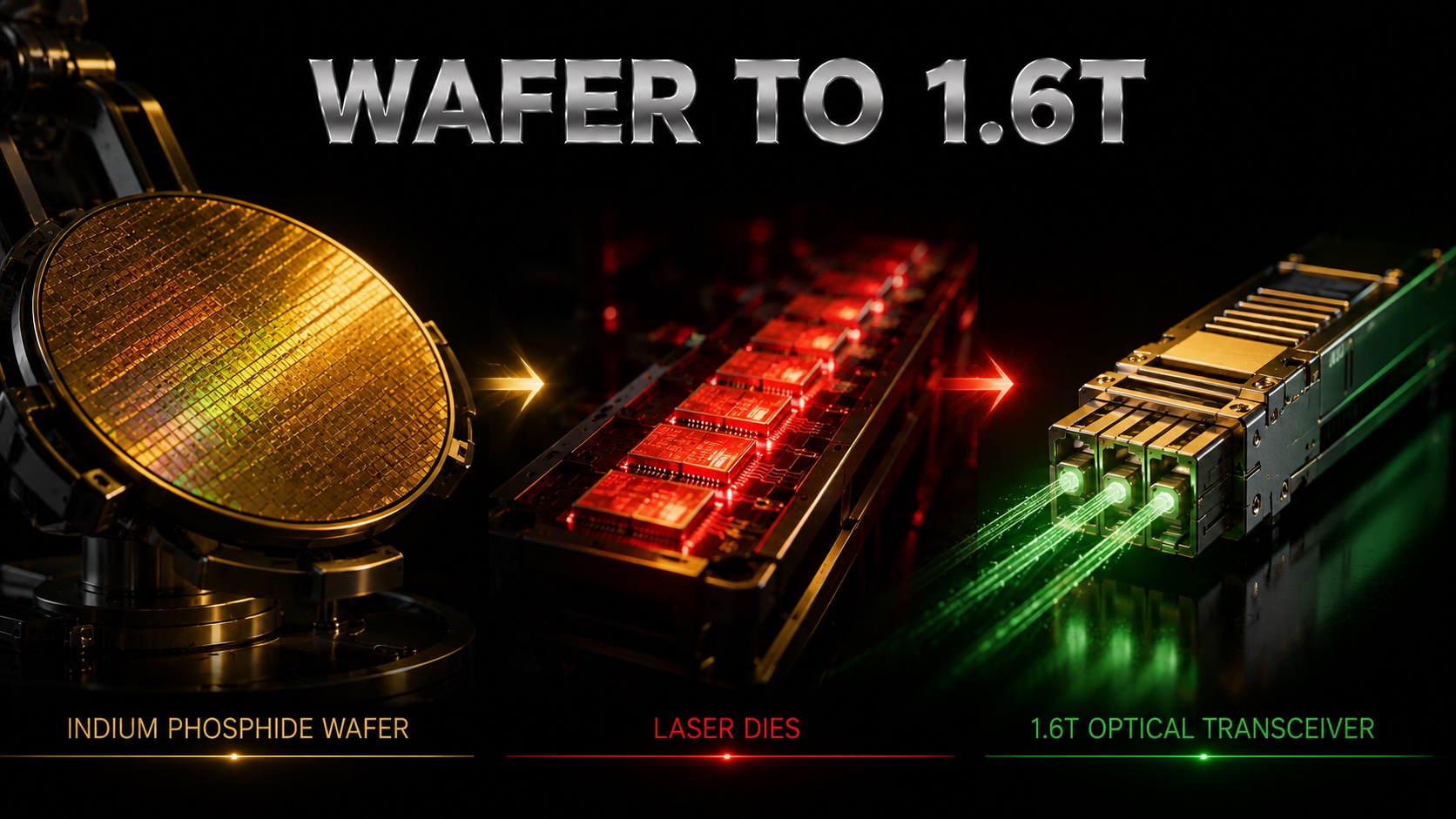
2c. Why supply cannot respond quickly
Growing an InP boule is slow, capital intensive chemistry. Indium is scarce, phosphorus is volatile and dangerous to handle at temperature, and yield depends on accumulated process knowledge rather than purchased equipment. On top of that, qualification cycles at optical component customers run for quarters, because a laser die failing in the field is a data centre outage.
The practical consequence is that customers do not switch substrate vendors opportunistically, and new entrants cannot buy their way in. When demand steps up by a factor of three, price and lead time absorb it long before capacity does.
3. Recent Developments: Three Agreements in Seven Weeks
The clearest evidence that this shortage is real is that AXT’s customers stopped placing quarterly orders and started reserving capacity years in advance, with cash.
Nanjing Casela Technologies, 11 June 2026. Tongmei signed a long term supply agreement to provide InP substrates throughout 2027. Tongmei reserves production capacity and raw materials and grants Casela supply priority; Casela is obligated to purchase a fixed quantity of substrates for RMB 173 million.
Coherent, 25 June 2026. Tongmei entered a three year Master Development and Supply Agreement with Coherent to develop and mass supply 6 inch indium phosphide substrates, supported by a prepayment of $22.29 million. Coherent is one of the two largest optical component makers in the world, and we covered its own AI photonics position in our Coherent (COHR) analysis.
Lumentum, 29 July 2026. The largest of the three. AXT agreed to reserve a minimum annual InP commitment for Lumentum running through 31 December 2031, and to support additional capacity beyond that. Lumentum pays an initial deposit of $43.5 million within thirty business days and a second $43.5 million deposit on terms to be set during 2028, for $87 million in total, applied as shipment credits against future purchases. Our Lumentum (LITE) analysis covers the demand side of that same agreement.
Two things are worth separating here. Prepayments are not revenue, and a capacity reservation is not a purchase order. But a customer wiring $43.5 million to secure supply through 2031 is making a statement about scarcity that no management commentary can match. AXT received $47.7 million in prepayments from the Casela and Coherent agreements during the quarter alone.
By the end of Q2 the company reported backlog above $100 million extending into 2027. Management described that figure as deliberately conservative, noting on the earnings call that it is not accepting all available orders because production capacity is already full.
4. Financial Performance: The Q2 2026 Inflection
Reported on 3 August 2026, the June quarter was the moment the operating model changed.
| Metric | Q2 2025 | Q1 2026 | Q2 2026 |
|---|---|---|---|
| Revenue | $18.0M | $26.9M | $47.6M |
| Non GAAP gross margin | 8.2% | 29.9% | 45.0% |
| Non GAAP EPS | Loss | $(0.01) | $0.19 |
Three observations matter more than the headline growth rate.
Operating leverage is real, not rhetorical. Gross margin moved from 8.2% to 45.0% in four quarters. Substrate manufacturing carries heavy fixed costs in crystal growth furnaces, cleanrooms and skilled labour. Below a utilisation threshold those costs swamp the business. Above it, incremental revenue converts to gross profit at a very high rate. AXT has crossed that threshold.
The profit is not an accounting artefact. GAAP gross margin came in at 44.9%, essentially identical to the non GAAP figure, and GAAP net income was $11.1 million, or $0.17 per share, against non GAAP net income of $11.9 million, or $0.19 per share. When the GAAP and non GAAP numbers sit that close together, the adjustments are not doing the work. Non GAAP operating profit was $11.2 million.
The beat was large, and so is the guide. Consensus had been $34.1 million in revenue and $0.07 in EPS. AXT delivered $47.6 million and $0.19. It then guided Q3 revenue to roughly $66 million with non GAAP EPS of $0.30 to $0.32, against a street estimate near $0.10, with operating expenses of about $10.5 million. Guidance of that shape, more than 70% above consensus, is rare outside of genuine supply shocks.
For context on where the company came from: full year 2025 revenue was $88.3 million, down 11% from $99.4 million in 2024, because China issued fewer InP export permits than expected. Q3 2026 guidance alone is three quarters of what the entire 2025 year delivered.
The balance sheet was transformed alongside the income statement. AXT closed an underwritten public offering in April 2026 of 8,560,311 shares at $64.25, raising roughly $550 million in gross proceeds, with underwriters exercising an over allotment for a further 1,284,046 shares. Total gross proceeds came to about $632.5 million. Cash and investments stood at roughly $749 million at quarter end.
That raise diluted existing holders by roughly 15%. It also removed financing risk from a capacity expansion that would otherwise have been impossible to fund from $88 million of annual revenue. For a company whose binding constraint is physical capacity, that is a defensible trade.
5. Growth Drivers: What Has to Happen Next
The investment case from here rests on execution against three specific targets, all of which management has put on record.
- Capacity to roughly $60 million of InP per quarter by end of 2026. Against $30.7 million in Q2 2026, this is close to a doubling within two quarters.
- Capacity to roughly $130 million of InP per quarter by end of 2027. Another doubling on top.
- 6 inch indium phosphide in mass production. Larger diameter wafers yield more die per wafer at lower cost per die, which supports margin as volume scales. The Coherent agreement is specifically a development and supply deal for 6 inch material.
There is a fourth item that is easy to miss. Tongmei has shifted its planned subsidiary listing from Shanghai’s STAR Market to the Hong Kong Exchange, a process management expects to take about a year. A successful listing would give the subsidiary an independent funding channel and would create a market price for an asset currently buried inside AXT’s consolidated accounts. It would also add another layer of structural complexity to an already complicated corporate arrangement.
The demand side of these targets looks well underwritten. The Lumentum reservation runs to 2031, the Coherent agreement runs three years, and the Casela agreement covers 2027. That is unusually good visibility for a components supplier. The supply side is the part that is not yet proven, and capacity plans in crystal growth have a long history of slipping.
6. Competitive Landscape and the Real Moat
The InP substrate market is an oligopoly, and an unusually tight one.
- Sumitomo Electric (Japan) is the largest supplier, with roughly 60% share, built on mature 4 inch semi insulating substrate processes and a long reputation for yield stability.
- AXT, through Tongmei, holds roughly 35%, with a cost advantage from its China manufacturing base and mass production capability on 6 inch wafers using the vertical gradient freeze method.
- JX Metals (Japan) holds most of the remainder.
Together these three control between 80% and 90% of the market. Chinese suppliers including Yunnan Germanium, Guangdong Xiandao and Dingtai hold less than 10% combined, with production volumes an order of magnitude below the leaders.
The moat is therefore genuine but not permanent, and the reason is straightforward: high prices attract capacity. JX Advanced Metals has announced capital spending of up to JPY 120 billion over several years to expand its InP substrate capacity by seven to ten times versus fiscal 2025. If that lands on schedule, the supply picture in 2028 looks very different from 2026.
AXT also has a structural advantage that is easy to underrate. Because it already runs gallium arsenide capacity, it can convert existing crystal growth infrastructure to InP faster than a competitor building new lines. That is why AXT has been able to respond to this demand surge at all, and it is a genuine, if temporary, edge.
The comparison worth holding in mind is high bandwidth memory. Our Micron HBM analysis traced how a bottleneck component earns extraordinary margins for exactly as long as it stays a bottleneck. Substrates are a smaller, less differentiated layer of the stack than HBM, which argues for a shorter window rather than a longer one. The same dynamic runs through the broader AI networking layer we examined in our Marvell analysis.
7. Risks
This is where the story requires the most honesty, because the risks here are not generic.
China export licensing is the dominant risk. China restricted gallium arsenide exports in August 2023 and indium phosphide exports in February 2025. Every customer order requires its own export permit from China’s Ministry of Commerce. AXT has already lived through the consequence: Q4 2025 revenue came in below guidance and full year 2025 revenue fell 11%, specifically because fewer permits were issued than expected. Management stated plainly on the Q2 2026 call that it cannot predict the timing of future permits or its success in obtaining them. Note that the entire Q3 guidance is built only on existing permits and non restricted products, which is prudent, but it does not remove the risk from later quarters.
Customer concentration. The three named agreements represent a large share of forward visibility. A single large customer qualifying a second source, or cutting orders in a digestion phase, would be felt immediately.
Competitive capacity additions. The JX Advanced Metals expansion is the clearest example. Substrate pricing is currently reflecting scarcity, not a durable differentiation. When capacity arrives, both price and margin are exposed.
Environmental regulation in China. Management specifically flagged tightening environmental rules at its manufacturing sites as a risk factor. Compound semiconductor production involves hazardous chemistry, and compliance costs or production interruptions are plausible.
Execution risk on the capacity ramp. Doubling crystal growth output twice in eighteen months is an operational undertaking with real yield risk. Slipping the schedule would not just delay revenue, it would invite competitors into the gap.
Valuation and volatility. This is not a theoretical concern for AXTI. The stock has moved from roughly $2 to $143.16 and back below $40 within about fifteen months, and it fell 16.67% in a single session on 10 August 2026 with no company specific news. Heavy insider selling by the chief executive and several directors during the run has been noted publicly. Position sizing matters more than usual here.
8. Valuation: What the Price Already Assumes
At roughly $81.64 per share and about 65.6 million shares outstanding, AXT carries a market capitalisation near $5.34 billion. Against trailing twelve month revenue that is a price to sales ratio of roughly 34 times.
Trailing multiples are misleading for a company whose revenue is nearly doubling sequentially, so it is more useful to work forward from guidance.
- Q3 2026 guided revenue of $66 million annualises to about $264 million, putting the shares at roughly 20 times an annualised revenue run rate.
- Q3 2026 guided non GAAP EPS of $0.30 to $0.32 annualises to roughly $1.24, putting the shares near 66 times an annualised earnings run rate.
Both of those numbers describe a business already priced for the capacity expansion to succeed. Take management’s own end of 2027 target of $130 million of InP capacity per quarter, add the other product lines, and a roughly $600 million annual revenue business is conceivable. On that basis the current market capitalisation is about 9 times a 2028 revenue figure that has not been earned yet and depends on export permits nobody controls.
That is not automatically too expensive for a genuine bottleneck asset in a market growing at this rate. It does mean there is essentially no valuation cushion. Any permit delay, any capacity slip, any sign that JX or Sumitomo is closing the gap, and the multiple compresses against a much smaller earnings base.
Wall Street is broadly constructive but not uniform. The consensus rating is Buy, with average price targets clustering between roughly $84 and $92, a low near $55 and a high near $125. Needham upgraded to Buy with a $90 target and Wedbush reiterated Outperform at $93 following the Q2 results. A target range that spans more than two to one tells you how much disagreement remains about the durability of this cycle.
9. Bull, Base and Bear
🐂 Bull Case
- Indium phosphide is a hard physical bottleneck in AI optics, and 1.6T adoption is only starting.
- Three customers have reserved capacity into 2027 and beyond, two with cash prepayments totalling $47.7 million received in the quarter.
- Gross margin went from 8.2% to 45.0% in four quarters, demonstrating extreme operating leverage above the utilisation threshold.
- $749 million in cash and investments fully funds the capacity expansion without further dilution.
- 6 inch InP production, if it scales, lowers cost per die and widens the gap against 4 inch competitors.
🐻 Bear Case
- Manufacturing sits in China and every export order needs an individual permit; this has already broken guidance twice.
- JX Advanced Metals is spending up to JPY 120 billion to expand InP capacity by seven to ten times, targeting exactly this shortage.
- Roughly 66 times an annualised earnings run rate leaves no margin for error on a single missed quarter.
- Insider selling during the run and a 16.67% single day decline on no news signal a shareholder base with weak conviction.
- Substrates are a commodity layer historically; scarcity pricing has never been permanent in this industry.
Base Case
The most probable path is that AXT executes most, but not all, of its capacity plan; permit friction costs it at least one quarter over the next two years; margins hold in the 40s while the shortage persists and then compress as Japanese capacity arrives in 2028; and the shares remain extremely volatile around a rising but decelerating earnings base. That is a real business with a real inflection, valued as though execution is close to guaranteed.
10. Final Thoughts
AXT matters because it sits at a genuine chokepoint. The AI buildout cannot move data between accelerators without lasers, and lasers cannot be built without indium phosphide, and only three companies make indium phosphide at scale. That is a stronger structural position than most companies caught up in the AI trade can claim.
The biggest opportunity is that the bottleneck lasts longer than the market expects, and AXT converts its cost advantage and 6 inch capability into durable share against a Japanese incumbent that has historically prioritised stability over aggression.
The biggest risk is not competitive at all. It is that AXT’s factories are in China and its customers are not, and that a government permit desk sits between the two. No amount of demand fixes that, and it has already cost shareholders a full year of growth once.
For long term investors, the questions worth answering before acting are whether you believe the capacity targets, and whether you are comfortable owning manufacturing assets exposed to export licensing you cannot forecast. Those are judgements about risk tolerance, not about whether the AI optical cycle is real. The cycle is real. The question is what you are paying for it, and what could interrupt it.
If you found this useful, our archive covers the rest of the AI optical stack, from transceiver makers to silicon photonics foundries. Subscribe for future updates, and visit the OneMoreStock channel on YouTube at www.youtube.com/@onemorestock for the video versions of these analyses.
FAQ
What does AXT, Inc. actually make?
AXT makes compound semiconductor substrates, which are the polished crystal wafers that other companies build chips on. Its three product lines are indium phosphide, gallium arsenide and germanium, and it also consolidates raw material joint ventures in China. Indium phosphide generated $30.7 million of the company’s $47.6 million in Q2 2026 revenue.
Why is indium phosphide important for AI data centres?
Indium phosphide is the material used to make the high speed lasers inside optical transceivers, and AI clusters need enormous numbers of them to connect accelerators together. Silicon cannot emit light efficiently, so it cannot replace InP for this function. The 200G per lane lasers that enable 1.6T transceivers are all built on indium phosphide.
How strong were AXT’s Q2 2026 results?
Very strong relative to expectations. Revenue was $47.6 million against a consensus of $34.1 million, up 164% year over year, and non GAAP EPS of $0.19 came in well above the $0.07 expected. Non GAAP gross margin reached 45.0%, up from 8.2% a year earlier, and the company guided Q3 revenue to roughly $66 million.
What is the biggest risk in owning AXTI?
China export licensing. AXT manufactures through its Beijing Tongmei subsidiary, and China has required export permits for gallium arsenide since August 2023 and for indium phosphide since February 2025. Permit delays already caused AXT to miss guidance in Q4 2025 and pushed full year 2025 revenue down 11%. Management has said it cannot predict future permit timing.
Does AXT have real competition?
Yes. Sumitomo Electric holds roughly 60% of the InP substrate market and JX Metals holds much of the remainder, with AXT at roughly 35% through Tongmei. More importantly, JX Advanced Metals has announced capital spending of up to JPY 120 billion to expand InP capacity by seven to ten times versus fiscal 2025, which directly targets the current shortage.
Is AXTI expensive at current levels?
By any conventional measure, yes. At roughly $81.64 the shares trade around 20 times an annualised revenue run rate based on Q3 guidance, and near 66 times an annualised earnings run rate. That valuation assumes the capacity expansion succeeds largely on schedule. Analyst price targets average roughly $84 to $92 with a range from $55 to $125.
What should investors watch next?
Three things: whether InP capacity reaches the stated $60 million per quarter target by the end of 2026, whether China continues issuing export permits at a workable pace, and whether 6 inch indium phosphide reaches volume production. Progress on the Tongmei listing in Hong Kong is a secondary item worth tracking.
Financial Disclaimer:
This article is for educational and informational purposes only and should not be considered financial or investment advice. Investing involves risk, including the possible loss of capital. Always conduct your own research and consult a qualified financial adviser before making investment decisions.