
Zscaler Stock Analysis: Zero Trust Security in the AI Era
Zscaler Stock Analysis: Zero Trust Security in the AI Era
1. Introduction: Why Zscaler Matters Now
Zscaler sits at the centre of one of the biggest shifts in enterprise security. For decades, companies protected a network perimeter with firewalls and VPNs. Today employees work from anywhere, applications live in the cloud, and a fast-growing share of traffic comes from software agents rather than people. Zscaler was built on the idea that the corporate network should stop being the thing you trust.
The business is performing. Revenue grew 25% in fiscal 2026 (the year to 31 July 2026) to $3.35 billion, and annual recurring revenue (ARR) reached $3.77 billion. Yet the stock tells a different story. On 27 May 2026 the shares fell more than 30% in a single session, their worst day ever, after management guided to slower growth, and on 13 November 2026 ZS closed at $192.47, about 36% below where it traded a year earlier.
That gap between a growing business and a falling stock is the subject of this Zscaler stock analysis. The central question is whether Zscaler can build a durable position in cloud-delivered Zero Trust security as AI agents and machine identities multiply, and whether its financials can justify the valuation. If it succeeds, it becomes the default checkpoint for how enterprises connect anything to anything. If it fails, it risks becoming one feature inside larger platforms sold by Microsoft and Palo Alto Networks.
This article provides a complete, investor-grade deep dive into Zscaler’s technology, business model, financials, risks, and long-term investment outlook.
Key Financial Metrics
| Metric | Value |
|---|---|
| Ticker / Exchange | ZS / Nasdaq |
| Share Price (close, 13 Nov 2026) | $192.47 |
| Shares Outstanding (27 Aug 2026) | 163.1 million |
| Market Cap (approx.) | $31.4 billion |
| 52-Week Low (10 Apr 2026, intraday) | $114.63 |
| FY2026 Revenue | $3,352.5 million (+25%) |
| FY2026 Revenue ex Red Canary | $3,209 million (+20%) |
| ARR (31 Jul 2026) | $3,771 million (+25%) |
| GAAP Gross Margin / Non-GAAP | 77% / 80% |
| GAAP Operating Loss | $133.3 million (-4% margin) |
| Non-GAAP Operating Income | $767.1 million (23% margin) |
| Free Cash Flow | $779.1 million (23% margin) |
| Stock-Based Compensation Expense | $821.9 million |
| Cash and Short-Term Investments | $3.47 billion |
| Convertible Notes (carrying value) | $1.70 billion |
| FY2027 Revenue Guidance | $3.908 to $3.938 billion (+16.6% to 17.5%) |
Data as of 13 November 2026, from Zscaler’s FY2026 Form 10-K, its Q4 FY2026 results release and Nasdaq closing prices. Market cap is calculated from the share count above. Verify before publishing.
2. Company Overview: The Zero Trust Pioneer
Zscaler was incorporated in Delaware in September 2007 as SafeChannel and took the Zscaler name in August 2008. It is led by founder Jay Chaudhry, who remains Chairman and CEO, and is headquartered in San Jose, California. Its founding bet was that the internet would become the new corporate network and the cloud the new data centre, so perimeter security would stop working.
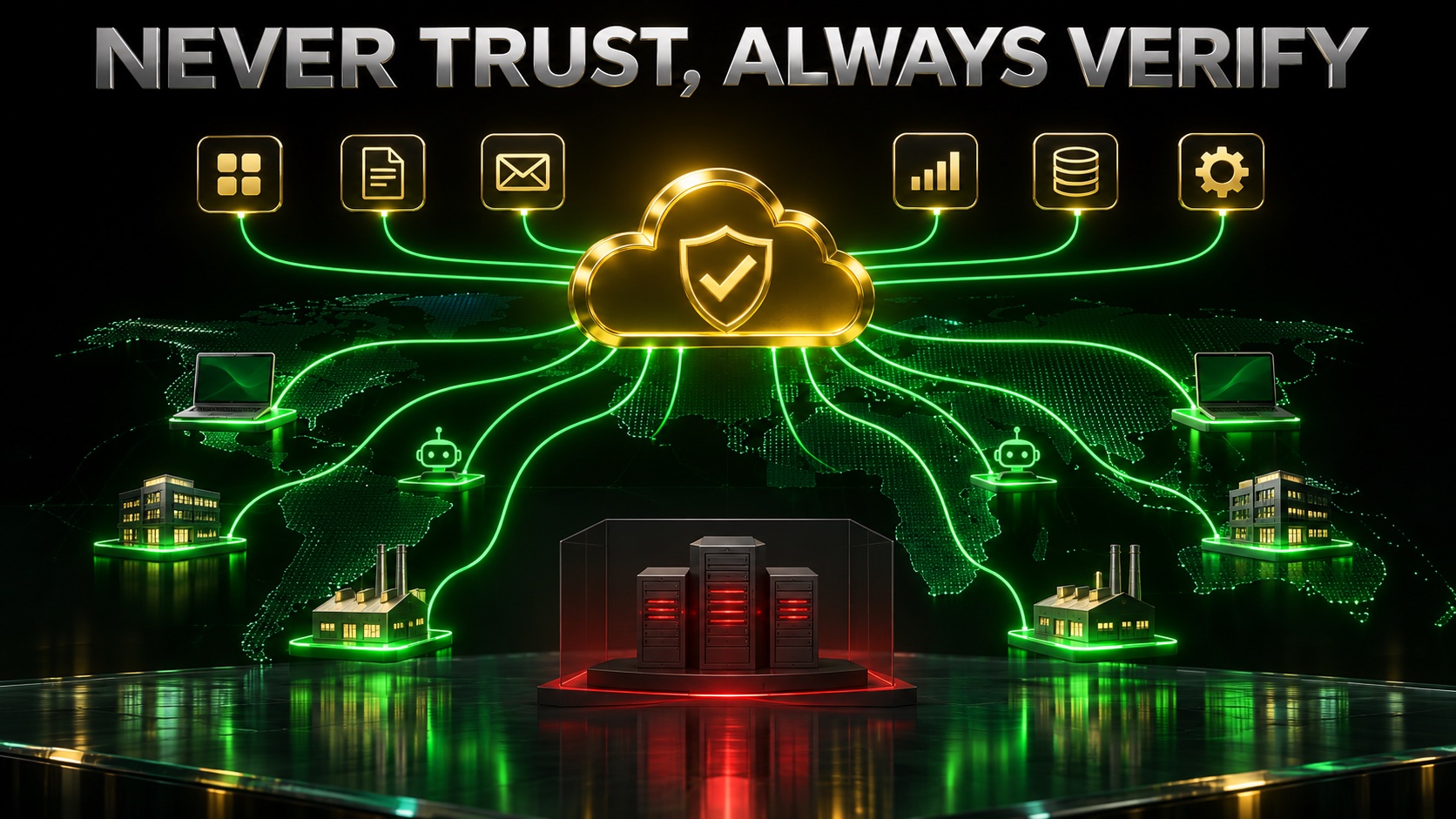
The company sells one cloud platform, the Zero Trust Exchange. Instead of letting a user onto the network and then guarding the network, Zscaler sits in the middle of every connection. A user, device, workload or AI agent asks to reach an application, Zscaler checks identity and policy, inspects the traffic, and connects it directly to that one application and nothing else.
- Scale (company-reported): more than 750 billion transactions processed per day, with enforcement in over 185 countries.
- Customers: about 11,000, up from about 9,400 a year earlier, including over 40% of the Forbes Global 2000 and over 50% of the Fortune 500.
- Headroom: Zscaler says it serves over 4,600 of an estimated 20,000 organisations with more than 1,500 employees.
- Revenue model: almost entirely subscriptions plus support, with an immaterial amount of professional services.
3. Technology: How Zero Trust Works, and Where AI Fits
The Core Idea in Plain English
A traditional network works like an office building with a guarded front door. Once you are inside, you can walk down most corridors. Attackers exploit exactly that: break in once through a phishing email or a weak VPN, then move sideways to valuable systems. Security teams call this lateral movement.
Zero Trust removes the corridors. Nobody is “inside”. Every request is treated as untrusted until it is verified, and a verified user is connected to one application, not to the network that hosts it. Zscaler argues that applications hidden behind its cloud cannot be scanned or attacked from the open internet, which shrinks what it calls the attack surface.
The Product Portfolio
Zscaler’s FY2026 10-K organises the platform into four pillars: Zero Trust SASE, Security for AI, Data Security, and Agentic Security Operations. The main named products and solutions are:
- Zscaler Internet Access (ZIA): a cloud secure web gateway that protects connections to the internet, SaaS and AI applications.
- Zscaler Private Access (ZPA): Zero Trust access to internal applications in data centres or clouds, replacing VPNs.
- Zero Trust Branch: connects branches, factories and campuses over broadband, 5G or satellite without traditional SD-WAN or MPLS.
- Zero Trust Cloud: secures workload-to-workload traffic across hybrid and public clouds.
- Data Security: data loss prevention across email, endpoints, SaaS apps, and prompts sent to AI tools.
- Agentic Security Operations: security analytics, the Data Fabric for Security, deception, and Red Canary’s managed detection and response.
SASE (secure access service edge) is the industry term for combining networking and security in one cloud service. SSE (security service edge) is the security half of that, and it is the market where Zscaler is strongest.
Two Different AI Stories
It is important to separate two ideas that are often blended together in marketing.
AI as a new attack surface. AI agents log into systems, call APIs and move data at machine speed, often with broad permissions. Zscaler’s 10-K says its platform can now govern connections for AI agents and models the same way it governs people, and its Security for AI solution discovers and controls the AI apps, models and agents in use across a company. This is a genuine new demand driver, because every agent is another identity that needs a policy.
AI as a defensive tool. Zscaler also uses AI internally to detect threats and prioritise alerts, trained on signals from its transaction volume. Every serious security vendor claims this, so it is a requirement to compete rather than a differentiator on its own.
What is commercially available versus vision matters here:
- Available and generating bookings: Security for AI, data protection for AI prompts, and Zero Trust access for AI applications. Management did not disclose a separate ARR figure for these products.
- Bought rather than built: In fiscal 2026 Zscaler acquired Red Canary (August 2025), SPLX (October 2025), SquareX (February 2026) and Symmetry Systems (May 2026), largely to add AI security, browser security, data security and security operations capabilities.
- Vision: management’s goal, set out at its October 2026 Investor Day, is to become “the cybersecurity platform for the AI era” and reach $10 billion of ARR. That is a target, not a result, and the company has not committed to a date for it in the materials reviewed here.
Independent Evidence
Most of Zscaler’s claims about scale and simplicity come from Zscaler itself. The clearest independent signal is Gartner’s 2025 Magic Quadrant for Security Service Edge, which named Zscaler, Netskope and Palo Alto Networks as Leaders, with Zscaler ranked first on Ability to Execute. Fortinet was placed as a Challenger and Cloudflare as a Niche Player. That supports Zscaler’s leadership in its core market, but it says nothing about whether the company can win in newer categories such as security operations.
4. Business Model and Moat
Zscaler sells subscriptions of generally one to five years, priced mainly per user and by metered usage. Growth comes from three levers: new customers, more users at existing customers, and more products per customer. The newer Z-Flex program lets customers commit to a spend level and then switch on products within it, which lowers the friction of adopting additional modules.
The company is also deliberately moving beyond seat-based pricing. As AI agents do more work, a model that charges per human employee could shrink. Charging for workloads, branches, data and agents is how Zscaler tries to turn that threat into growth.
Revenue Streams
- Subscriptions and support: almost all revenue, recognised evenly over the contract term.
- Professional services: implementation and training, immaterial to results.
- Contracted backlog: remaining performance obligations (RPO) of $7.37 billion at 31 July 2026, of which Zscaler expects to recognise 45% over the next 12 months.
Where the Moat Comes From
- Inline position: once traffic flows through Zscaler, replacing it means rerouting how an entire workforce reaches the internet and its apps. That creates real switching costs.
- Scale data: hundreds of billions of daily transactions feed threat detection that a smaller vendor cannot easily replicate.
- Purpose-built cloud: Zscaler says it runs its platform across more than 200 data centres of its own, which it argues improves performance and cost control.
The Limits of the Moat
- Bundling: Microsoft sells Entra Internet Access and Entra Private Access as part of its own identity suite, so some customers get “good enough” Zero Trust access with licences they already own.
- Platform rivals: Palo Alto Networks offers a full SASE stack plus firewalls, security operations and identity, and can discount one product to win the whole platform.
- Acquired growth: a meaningful part of FY2026 growth was bought, so the moat in newer areas is still being proven.
5. Financial Performance: Strong Growth, With Asterisks
Three-Year Revenue Trend
| Fiscal Year (ends 31 Jul) | Revenue | Growth |
|---|---|---|
| FY2024 | $2,167.8 million | n/a |
| FY2025 | $2,673.1 million | +23% |
| FY2026 | $3,352.5 million | +25% |
| FY2026 ex Red Canary | $3,209 million | +20% |
Headline growth accelerated in FY2026, but the acceleration came from the Red Canary acquisition. Excluding it, revenue grew 20%, slower than the 23% of the prior year. The same pattern shows in ARR: reported ARR grew 25% to $3,771 million, but excluding the $141 million that Red Canary contributed, ARR grew 20% to $3,630 million.
Revenue, ARR, RPO and Free Cash Flow: What Each Tells You
These four numbers measure different things, and confusing them is a common mistake.
- Revenue is what was earned in the period under accounting rules. It lags sales because subscriptions are recognised month by month.
- ARR is the annualised value of subscriptions in force at a point in time. It is a forward-looking run rate, but it is a company-defined metric, not an audited one.
- RPO is the total contracted value not yet recognised as revenue, including multi-year commitments. At $7.37 billion it is more than double FY2026 revenue, which signals long contracts.
- Free cash flow is operating cash flow minus capital spending. Subscription companies often bill upfront, so cash can arrive well before revenue is recognised.
GAAP Versus Non-GAAP
Zscaler is profitable on an adjusted basis and loss-making under GAAP. The gap is almost entirely stock-based compensation.
- GAAP operating loss: $133.3 million in FY2026, or -4% of revenue (FY2025: -$128.5 million, -5%).
- Non-GAAP operating income: $767.1 million, or 23% of revenue (FY2025: $580.1 million, 22%).
- GAAP net loss: $63.2 million, or $0.39 per share.
- Non-GAAP net income: $704.2 million, or $4.21 per diluted share.
- Q4 FY2026 non-GAAP operating margin: a record 24%, while the quarter’s GAAP operating loss was $15.5 million.
Cash Flow, Stock Compensation and Dilution
Zscaler generated $1,130 million of operating cash flow in FY2026 (34% of revenue) and $779.1 million of free cash flow (23% of revenue), down from a 27% free cash flow margin a year earlier. The decline was driven by heavier investment: purchases of property and equipment rose to $277.3 million from $164.3 million. In Q4 alone, capex and internal-use software reached $218.5 million, which pushed that quarter’s free cash flow margin down to 7%.
Stock-based compensation is the issue long-term investors should weigh most carefully.
- SBC expense: $821.9 million in FY2026, about 24.5% of revenue, up from $661.4 million.
- SBC versus free cash flow: SBC exceeded free cash flow by roughly $43 million. In other words, after paying employees partly in stock, the business did not generate surplus cash for shareholders on that basis.
- Dilution: the weighted-average basic share count rose to 160.2 million from 154.4 million, an increase of about 3.8% in a year.
- Balance sheet: $3.47 billion of cash and short-term investments against $1.70 billion of convertible notes, a comfortable net cash position.
Guidance and Track Record
For FY2027, Zscaler guided to revenue of $3.908 to $3.938 billion (growth of 16.6% to 17.5%), ARR of $4.396 to $4.426 billion, non-GAAP operating income of $924 to $932 million, non-GAAP EPS of $4.86 to $4.90, and a free cash flow margin of about 23.0% to 23.5%. It reaffirmed that guidance at its 6 October 2026 Investor Day.
The track record is mixed in a specific way. Zscaler has consistently beaten its own quarterly numbers; in Q3 FY2026 it reported $850 million of revenue against analyst expectations of about $835 million. But that same report introduced the slower FY2027 outlook and disclosed the loss of two sales leaders, and CFO Kevin Rubin called the guidance a “prudent approach” during the transition. On 24 September 2026 the company named Ross Tackett Chief Revenue Officer, effective 1 October, succeeding Mike Rich.

6. Competitive Landscape
Cybersecurity demand is rising, but rising demand does not automatically mean superior returns for any single vendor. The real question is who captures the spending. Zscaler’s 10-K does not name its rivals, so the comparison below is based on each competitor’s own product lines.
Palo Alto Networks (PANW)
Palo Alto is the most direct platform threat. It sells Prisma Access for SASE alongside next-generation firewalls, Cortex security operations and identity security, and it pushes customers to consolidate onto one vendor. Where Zscaler argues firewalls are obsolete, Palo Alto sells both the firewall and the cloud alternative. Our Palo Alto Networks stock analysis covers its platformization strategy in depth.
CrowdStrike (CRWD)
CrowdStrike’s core is endpoint protection through its Falcon agent, with expanding cloud, identity and security operations products. Overlap with Zscaler is growing in security operations, where Red Canary competes for the same budget. See our CrowdStrike stock analysis.
Fortinet (FTNT)
Fortinet competes on price and performance with firewalls powered by its own chips, plus FortiSASE for cloud-delivered security. It is strongest with mid-sized companies and network teams that prefer one appliance-plus-cloud vendor. Our Fortinet stock analysis explains its refresh cycle.
Cloudflare (NET)
Cloudflare offers Zero Trust access and secure web gateway services through Cloudflare One, running on the same global network as its content delivery business. It often wins on developer appeal and pricing, though Gartner rated it a Niche Player in SSE in 2025.
Microsoft
Microsoft is the competitor investors worry about most. Entra Internet Access and Entra Private Access are generally available and licensed through Microsoft’s Entra identity products. For a company already standardised on Microsoft, the incremental cost can look close to zero, which pressures pricing even where Zscaler is technically stronger.
Where Zscaler Differs
- It is a pure cloud vendor with no firewall business to protect.
- It operates inline, so it sees and controls traffic rather than only analysing logs afterwards.
- It is newer and smaller in security operations, where CrowdStrike and Palo Alto have deeper footprints.
7. Risks: Where the Thesis Can Break
Zscaler’s risks are less about survival and more about whether growth stays high enough to justify a premium multiple.
Growth and Execution Risk
- Organic revenue growth slowed to 20% in FY2026, and FY2027 guidance implies about 17%.
- Sales leadership turned over in 2026: two sales leaders left before the May report, and a new Chief Revenue Officer started in October. Transitions like this can disrupt pipelines for several quarters.
Valuation and Dilution Risk
- SBC near 25% of revenue means GAAP losses persist and owners are diluted by roughly 4% a year.
- Non-GAAP profit excludes that cost, which flatters earnings-based valuation.
Competitive and Bundling Risk
- Microsoft and Palo Alto can bundle overlapping capabilities into broader platform deals.
- Newer categories such as security operations are crowded, and Zscaler is not the incumbent.
AI Disruption Risk
- CNBC reported that sentiment toward software and cybersecurity soured in 2026 on concerns that AI will upend their business models. If fewer employees means fewer seats, per-user pricing faces pressure.
Capital Intensity Risk
- Capex rose sharply in FY2026, and higher equipment and memory costs could keep free cash flow margins below historic levels.
Operational Risk
- As an inline service, any outage or breach of Zscaler’s own cloud would directly disrupt customers. The 10-K flags this as a material risk.
Acquisition Risk
- Four acquisitions in one fiscal year add integration work and make organic growth harder to see.
8. Valuation: What Is Priced In?
At $192.47, Zscaler’s market value is about $31.4 billion. Subtracting $3.47 billion of cash and investments and adding $1.70 billion of convertible notes gives an enterprise value of roughly $29.6 billion. All figures below are measured on 13 November 2026.
- EV / FY2026 revenue: about 8.8x.
- EV / FY2027 revenue guidance (midpoint): about 7.5x.
- Free cash flow yield (FY2026): about 2.5%.
- Price / FY2027 non-GAAP EPS guidance (midpoint): about 39x.
These multiples are far lower than a year ago, when the stock traded near $300. Still, a 2.5% free cash flow yield, before deducting stock compensation, only makes sense if cash flows keep compounding at mid-teens rates or better for many years. We have not included peer multiples, because comparable figures measured on the same date and basis were not available for every competitor.
Conditional Scenarios
These are frameworks with stated assumptions, not price targets.
Bull scenario
- Assumes organic ARR growth re-accelerates toward 20% as Security for AI, data security and non-seat products scale.
- Assumes free cash flow margins return above 25% as capex normalises.
- Under these assumptions, the current multiple would compress through growth rather than through a falling share price.
Base scenario
- Assumes Zscaler delivers roughly its FY2027 guidance: mid-to-high teens growth and a 23% free cash flow margin.
- Assumes SBC stays near 25% of revenue.
- Under these assumptions, shareholder returns would depend mostly on earnings growth, with little room for multiple expansion.
Bear scenario
- Assumes bundling by Microsoft and Palo Alto plus seat pressure from AI push organic growth toward low teens.
- Assumes capex stays elevated and margins stall.
- Under these assumptions, the market could value Zscaler more like a mature software company, and today’s multiple would still look demanding.
🐂 Bull Case
- Revenue grew 25% to $3.35 billion in FY2026, with a record 24% non-GAAP operating margin in Q4.
- $7.37 billion of RPO gives strong visibility, more than double annual revenue.
- Gartner ranked Zscaler first on Ability to Execute in its 2025 SSE Magic Quadrant.
- AI agents create new identities to secure, extending Zscaler’s market beyond human users.
- The stock trades at about 7.5x forward revenue, well below its own recent history.
🐻 Bear Case
- Organic growth slowed to 20% and FY2027 guidance implies about 17%.
- SBC of $821.9 million exceeded free cash flow of $779.1 million in FY2026.
- Microsoft bundles competing Zero Trust access into its identity suite.
- Sales leadership turnover in 2026 adds execution risk.
- Q4 capex and internal-use software spending nearly tripled to $218.5 million, and higher equipment and memory costs could keep it high.
9. Investment Outlook: Who Is This Stock For?
Zscaler is a quality franchise in a growing market, but it is no longer a hyper-growth story, and the market has repriced it accordingly. It suits long-term investors who believe Zero Trust becomes the standard architecture for connecting people, workloads and AI agents, and who can tolerate high volatility. The stock has swung from below $120 to above $250 within 2026 alone.
It is less suitable for investors who focus on GAAP earnings or shareholder yield. Until stock compensation falls meaningfully as a share of revenue, owners are paying for growth partly through dilution. A time horizon of at least three to five years is realistic for the thesis to play out.
What would change the thesis:
- Positive: organic ARR growth stabilising or rising, disclosed revenue from AI security products, and SBC falling as a percentage of revenue.
- Negative: organic growth falling below the FY2027 guide, large customers consolidating onto Microsoft or Palo Alto, or a major outage at Zscaler itself.
- Next catalyst: the Q1 FY2027 report for the quarter ended 31 October 2026, against guidance of $935 to $939 million in revenue.
10. Final Verdict
Zscaler matters because it is one of the few companies that rebuilt enterprise security around the cloud rather than bolting the cloud onto firewalls. Its biggest opportunity is that AI agents multiply the number of identities and connections that need a policy, which extends its market well beyond employee seats. Its biggest risk is that growth keeps slowing just as bundled platforms make “good enough” Zero Trust cheap.
The FY2026 numbers show a strong business: 25% revenue growth, a 23% free cash flow margin and a large contracted backlog. They also show the asterisks: acquired growth, GAAP losses and stock compensation that consumes its free cash flow. Zscaler can be a durable winner in Zero Trust, but the stock only works if organic growth holds up long enough for the cash flow to catch up with the story.
For ongoing coverage of cybersecurity and software stocks, subscribe to OneMoreStock on YouTube at www.youtube.com/@onemorestock, and read our related analysis on how AI is reshaping software in The Mythos Threat and the SaaSpocalypse.
FAQ
What does Zscaler do?
Zscaler sells a cloud security platform, the Zero Trust Exchange, that sits between users, devices, workloads or AI agents and the applications they need. It verifies each connection against identity and policy and connects it directly to one application, without placing anyone on the corporate network.
Is Zscaler profitable?
On an adjusted basis, yes: FY2026 non-GAAP operating income was $767.1 million, a 23% margin. Under GAAP it still made an operating loss of $133.3 million and a net loss of $63.2 million, mainly because of $821.9 million of stock-based compensation.
Why did Zscaler stock fall in 2026?
The biggest drop came on 27 May 2026, when the shares fell more than 30% after Zscaler issued FY2027 guidance below expectations and disclosed the loss of two sales leaders. Broader worries that AI could disrupt software business models also weighed on the sector.
How is Zscaler using AI?
In two ways. It sells Security for AI products that discover and control the AI apps, models and agents used across a company, and it uses AI internally to detect threats and prioritise alerts. The first is a new demand driver; the second is now expected of every security vendor.
Who are Zscaler’s main competitors?
The main competitors are Palo Alto Networks and Netskope in security service edge, Fortinet and Cloudflare in cloud-delivered security, CrowdStrike in security operations, and Microsoft, which bundles Entra Internet Access and Private Access with its identity products.
Does Zscaler pay a dividend?
No. Zscaler does not pay a dividend. It reinvests cash into growth, data centre capacity and acquisitions, and it pays a large share of employee compensation in stock.
What metrics should ZS investors watch?
Watch organic ARR growth excluding acquisitions, the free cash flow margin against stock-based compensation, the share count, RPO, and any disclosure of revenue from Security for AI products. Delivery against the FY2027 guidance of 16.6% to 17.5% revenue growth is the near-term test.
Financial Disclaimer:
This article is for educational and informational purposes only and should not be considered financial or investment advice. Investing involves risk, including the possible loss of capital. Always conduct your own research and consult a qualified financial adviser before making investment decisions.