
Apple (AAPL) Q4 2026 Earnings: Record Quarter, Margin Squeeze
Apple (AAPL) Q4 2026 Earnings: Record Quarter, Margin Squeeze
Apple reported fiscal fourth quarter 2026 results on Monday, 2 November 2026, after the US market close. Apple’s fiscal year ends in September, so “Q4 2026” here means the quarter ended 26 September 2026, not the calendar fourth quarter. It was also the first earnings call led by John Ternus, who succeeded Tim Cook as chief executive on 1 September 2026.
The headline numbers were clean beats. Revenue was $114.48 billion, up 12% year over year, against a consensus of $113.39 billion (LSEG, via CNBC). GAAP diluted EPS was $2.10, up 14%, against a consensus of $1.99. Management then guided to the best revenue quarter in Apple’s history.
The stock still fell. AAPL closed the regular session at $338.32, down 1.83%, and traded at $328.85 after hours, a further 2.8% lower (Investing.com, 2 November 2026). CNBC described the after-hours slide as about 3%.
The reason sits in one line of the guidance: December quarter gross margin of 45% to 46%, down from 47.9%, because memory prices are rising faster than Apple can offset them. This analysis covers the scorecard, the segments, the margin problem, what management said, and what changed for long-term investors.
1. Apple Q4 2026 Earnings Scorecard
| Metric | Actual | Consensus (LSEG) | Company guidance | YoY | Result |
|---|---|---|---|---|---|
| Revenue | $114.48B | $113.39B | Not applicable | +12% | Beat |
| EPS (GAAP, diluted) | $2.10 | $1.99 | Not applicable | +14% | Beat |
| Gross margin | 47.9% | 47.5% | Not applicable | 47.2% a year ago | Beat |
| Operating margin | 31.1% | Not available | Not applicable | 31.6% a year ago | Lower |
| Operating cash flow | $28.1B | Not available | Not applicable | Not available | Not applicable |
| iPhone revenue | $57.58B | $56.54B | Not applicable | +17% | Beat |
| Mac revenue | $10.79B | $9.61B | Not applicable | +24% | Beat |
| iPad revenue | $6.23B | $6.7B | Not applicable | down 10% | Miss |
| Wearables, Home and Accessories | $8.30B | $9.06B | Not applicable | down 8% | Miss |
| December quarter revenue guidance | +7% to +10% YoY | +6.1% YoY (analyst average) | Set this quarter | Not applicable | Above |
| December quarter gross margin guidance | 45% to 46% | 46.3% (analyst average) | Set this quarter | Not applicable | Below |
Source: Apple earnings release and 8-K dated 2 November 2026; consensus per LSEG via CNBC, as of 2 November 2026. Apple reports on a GAAP basis and does not headline an adjusted EPS figure. Operating margin and quarterly operating cash flow are calculated from the release (quarterly cash flow is the full-year figure minus the nine-month figure).
One detail matters for reading the beat. Apple said tariff refunds added $0.05 to EPS and “approximately one percentage point” to gross margin. Even without that help, EPS of roughly $2.05 and gross margin of roughly 46.9% would still have cleared consensus. The quarter was genuinely strong; the forward margin is the issue.
For the full fiscal year 2026, Apple reported records across the board:
- Revenue of $478.8 billion, up 15% from $416.2 billion
- Net income of $132.2 billion, up 18%
- Diluted EPS of $8.98, up 20% from $7.46
- Operating cash flow of $145.1 billion, up from $111.5 billion
2. Revenue and Segment Breakdown
| Segment | Revenue | YoY | Share of total |
|---|---|---|---|
| iPhone | $57.58B | +17% | 50.3% |
| Services | $31.57B | +10% | 27.6% |
| Mac | $10.79B | +24% | 9.4% |
| Wearables, Home and Accessories | $8.30B | down 8% | 7.3% |
| iPad | $6.23B | down 10% | 5.4% |
iPhone carried the quarter at a September quarter record, half of total revenue. Supply rather than demand was the limiting factor: COO Sabih Khan said the foldable “iPhone Duo is constrained as of today” and that it is “really hard to predict when supply and demand will be in balance.” He added that as Apple moves more of its lineup to 2nm chips, “our constraints on advanced nodes are easing.”
Mac revenue rose 24%. CFO Kevan Parekh credited “the strength of the MacBook Neo and MacBook Pro,” and Ternus said “we have never sold more Macs in a fiscal year than we did this time.”
The two declines were explained as timing and supply:
- iPad (down 10%): Parekh pointed to supply constraints and “a continued difficult compare against the launch of the A16-powered iPad.”
- Wearables, Home and Accessories (down 8%): a tough comparison with the 2025 launches of Apple Watch SE 3 and AirPods Pro 3.
Greater China is now the growth region
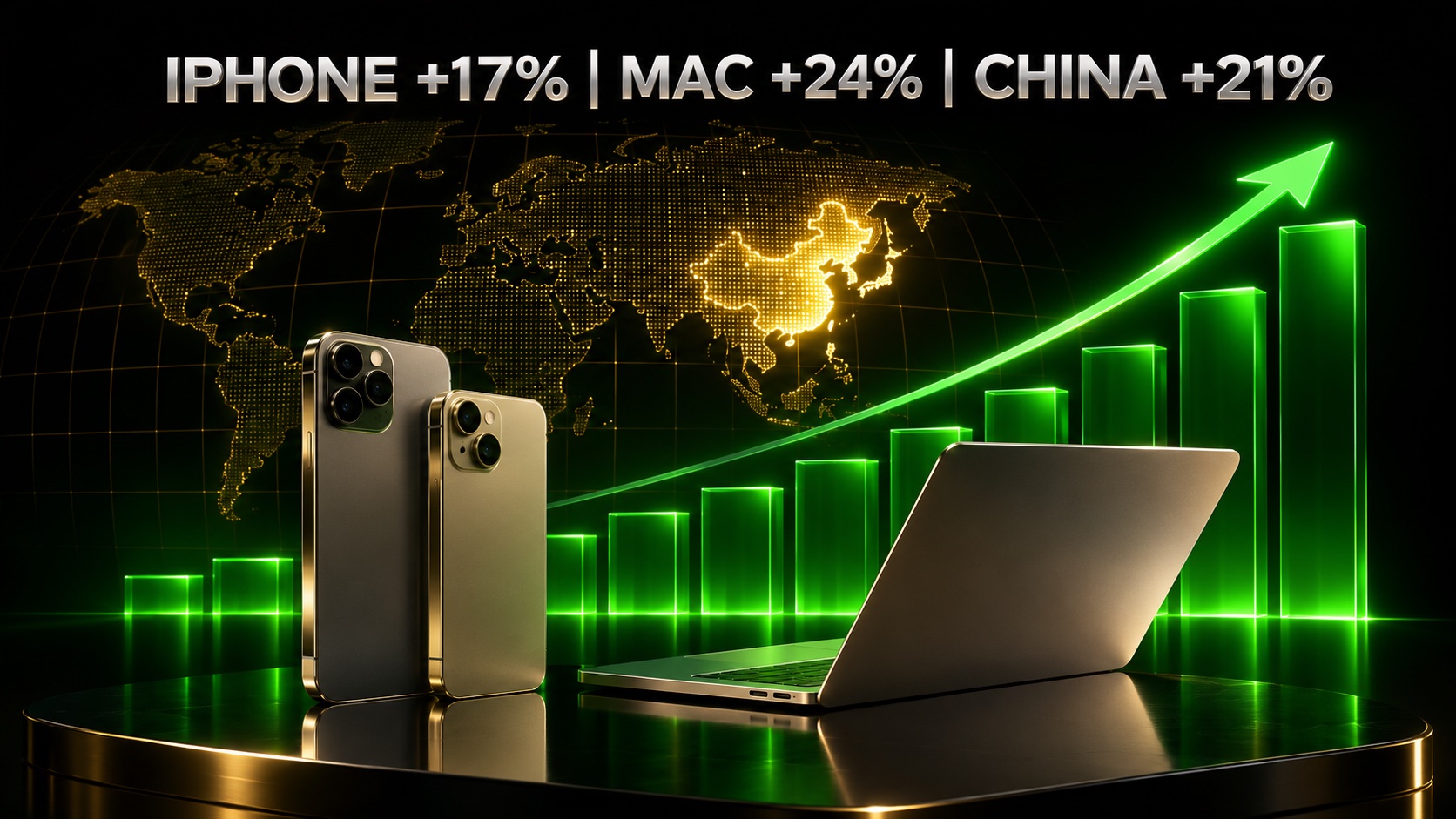
Greater China revenue rose 21% to $17.54 billion, which Ternus called a quarterly record, and grew 28% for the full year to $82.4 billion. It was Apple’s fastest-growing region this quarter.
- Americas: $48.68B, +10%
- Europe: $32.01B, +12%
- Greater China: $17.54B, +21%
- Japan: $6.54B, down 1%
- Rest of Asia Pacific: $9.71B, +15%
3. Margins, Profitability and Cash Flow
Gross margin was 47.9%, up from 47.2% a year earlier but down from about 50.1% in the June quarter. Calculated from the release, products gross margin was about 37.2% (36.2% a year ago) and Services gross margin about 75.9%. Parekh rounded Services to “76%, up 40 basis points sequentially.”
Operating expenses grew faster than revenue. Research and development rose 32% to $11.73 billion from $8.87 billion. Operating margin slipped to 31.1% from 31.6%. Much of Apple’s AI investment shows up here in opex, not in capex.

The balance sheet is absorbing the memory shock
- Inventories rose to $14.5 billion from $5.7 billion a year earlier.
- Ternus said “our manufacturing purchase obligations have increased by $33 billion from June to the September quarter.”
- Cash and marketable securities were $136.9 billion against total debt of $80.1 billion, roughly $57 billion of net cash.
That inventory build is Apple buying memory ahead of further price rises. It cushions the December quarter, but Ternus warned “we will see a decreasing benefit from the carry-in inventory on memory over time.”
Cash flow and capital return
- Quarterly operating cash flow: about $28.1 billion; capex: about $2.24 billion (calculated from the release).
- Full-year free cash flow: about $136.1 billion ($145.1 billion operating cash flow less $9.0 billion of capex).
- Returned $28 billion in the quarter: $24 billion of buybacks and $3.9 billion of dividends.
- Dividend held at $0.27 per share, payable 16 November 2026 to holders of record on 12 November 2026.
Apple’s quarterly capex of about $2.2 billion is a striking contrast with Alphabet’s $51.4 billion quarter. Apple is not building AI data centres at hyperscaler scale, which keeps its free cash flow intact.
4. Guidance and Outlook: Record Revenue, Lower Margin
Apple’s December quarter guidance, stated by Parekh on the call:
- Revenue: growth of 7% to 10% year over year, which Parekh said would be “the best quarter for revenue in the history of the company”
- Services: growth of 8% to 9%
- Gross margin: 45% to 46%
- Operating expenses: $20.4 billion to $20.8 billion
- Tax rate: around 17%; OI&E around $300 million
Against the analyst average cited by CNBC, revenue guidance was above (6.1%) and gross margin guidance was below (46.3%). That combination is the whole story of the after-hours move.
The cause is memory. “What we’re seeing with memory pricing right now is unprecedented,” Ternus said, and “looking beyond the December quarter, we see the pricing for memory purchases continuing to increase.” Khan said Mac and iPad will stay supply constrained in the December quarter, “primarily driven by memory.” AI data centres are absorbing DRAM and HBM capacity, as our Micron HBM analysis explained, and device makers are paying the bill.
Apple’s offsets are price increases and cheaper non-memory components. Parekh said “we did reluctantly make the decision to change pricing on a number of our products.” Parekh also cited “some costs related to the ramp of Siri AI” as a second drag on the margin guide.
5. What Management Said on the Call
Five quotes from the call transcript carry most of the signal:
- On memory (Ternus): “What we’re seeing with memory pricing right now is unprecedented.”
- On Siri AI limits (Parekh): “There are going to be some usage limits on features that rely on server-side models, which include Siri AI,” and “anyone who needs greater capacity will be able to purchase expanded access in the future.”
- On AI costs (Parekh): it is “still very early days” for the on-device versus cloud mix, and “on the server side, we would have some inference costs.”
- On privacy (Ternus): “Siri AI is built with essential privacy protections, so no one can access users’ data.”
- On capital return (Parekh): “we were no longer using net cash neutral as a target,” because “we think it makes sense to evaluate our cash and debt position independently.”

Two of those are new. Usage limits with paid expanded access are Apple’s first outline of a paid AI tier, though no pricing or tier details were given. Dropping net cash neutral ends a framework that guided buybacks for years. Management did not say whether that means slower buybacks, a larger cash buffer, or room for acquisitions, so investors should not assume any one of them.
Services itself grew about 10% to $31.57 billion, an all-time record but, as CNBC noted, the slowest growth since 2022. The App Store had “a record number of nearly a billion average weekly visitors,” yet the December guide of 8% to 9% points to further deceleration.
6. What Changed in the Investment Thesis
Confirmed:
- Hardware demand is strong. iPhone up 17%, record Mac year, Greater China back to growth.
- Pricing power exists. Apple raised prices and still guided to a record quarter.
- Apple stays capital light on AI, with capex near $2 billion a quarter.
Weakened:
- Margin trajectory. FY2026 may prove to be a near-term gross margin peak if memory keeps rising, and this quarter was flattered by about one point of tariff refunds.
- Services growth. Below 10% now, guided to 8% to 9% next.
Still unproven:
- Whether paid Siri AI capacity becomes a meaningful Services driver before inference costs erode margin.
- How buybacks change after net cash neutral.
- When iPhone Duo supply catches up with demand.
Our view: the after-hours reaction looks like the market repricing next year’s margins, not this quarter’s results. A roughly 3% move on a $4.9 trillion company is a recalibration, not a verdict. The Meta Muse analysis lays out the competing argument that AI may favour new form factors over the smartphone.
7. Valuation After the Print
- Trailing P/E at the $338.32 close: about 37.7x fiscal 2026 EPS of $8.98.
- Trailing P/E at the $328.85 after-hours price: about 36.6x.
- Market value: roughly $4.9 trillion at the close, using the quarter’s diluted share count of 14.63 billion.
- Diluted shares fell 1.6% year over year, so buybacks still add to per-share growth.
That multiple prices Apple as a durable compounder. It leaves little room if margins compress for several quarters while Services slows. Analyst reaction after the print was not yet available at the time of writing. Before the report, Bank of America’s Wamsi Mohan rated the stock Buy with a $370 price target, while Barclays was Underweight, citing “iPhone uncertainties this cycle” (CNBC).
8. Bull Case and Bear Case After the Results
🐂 Bull Case
- iPhone grew 17% while still supply constrained, and December is guided to a record revenue quarter.
- Greater China grew 21% in the quarter and 28% for the year, Apple’s fastest-growing region.
- Price increases are holding, showing pricing power in a tough hardware market.
- About $136 billion of annual free cash flow with minimal capex funds buybacks and a cushion against component costs.
- A paid Siri AI capacity tier on a 2.5 billion device installed base is a new Services lever.
🐻 Bear Case
- Gross margin is guided down to 45% to 46%, and Apple expects memory prices to keep rising beyond December.
- About one point of Q4 gross margin came from one-off tariff refunds.
- Services growth slowed below 10% and is guided to 8% to 9%.
- Siri AI inference costs arrive before any AI revenue has been priced.
- At roughly 37x trailing earnings, the valuation assumes execution under a new CEO with little margin for error.
9. Final Thoughts
Apple’s Q4 2026 earnings show a business with strong demand and a cost problem it does not control. The biggest positive is the hardware cycle: iPhone, Mac and China all accelerated, and Apple guided to its best quarter ever. The biggest concern is that memory inflation and AI compute costs are pushing gross margin lower just as Services, the profit engine, slows.
The next checkpoint is the fiscal Q1 2027 report, covering the December quarter. Watch gross margin against the 45% to 46% guide, any pricing for Siri AI expanded access, and Services growth against 8% to 9%. For PC and chip supply context, see our Intel Q3 2026 results, and subscribe to OneMoreStock on YouTube (www.youtube.com/@onemorestock) for the video breakdown.
FAQ
Did Apple beat earnings expectations in Q4 2026?
Yes. Apple reported revenue of $114.48 billion against a $113.39 billion consensus and diluted EPS of $2.10 against $1.99 (LSEG, via CNBC). The EPS figure includes a $0.05 benefit from tariff refunds, but it would still have beaten without it.
Why did Apple stock fall after earnings?
AAPL slipped about 3% after hours on 2 November 2026 because Apple guided December quarter gross margin to 45% to 46%, below the 47.9% it just reported and below the 46.3% analyst average. Management blamed memory prices it called “unprecedented” plus Siri AI ramp costs.
What is Apple’s guidance for the December quarter?
Apple guided revenue growth of 7% to 10% year over year, Services growth of 8% to 9%, gross margin of 45% to 46%, operating expenses of $20.4 billion to $20.8 billion and a tax rate of around 17%. Management expects it to be the best revenue quarter in Apple’s history.
How much revenue did Apple make in Q4 2026?
Apple made $114.48 billion in the quarter ended 26 September 2026, up 12% year over year. iPhone contributed $57.58 billion and Services $31.57 billion. Full fiscal year 2026 revenue was a record $478.8 billion.
What does Apple dropping net cash neutral mean?
Apple said it is no longer using net cash neutral as a target and will evaluate its cash and debt position independently. It ended the quarter with about $57 billion of net cash. Management did not say how buybacks will change, so it is too early to read it as a slowdown or an acceleration.
Is AAPL a buy after Q4 2026 earnings?
That depends on your time horizon and on whether you believe price increases and AI-driven upgrades can outrun memory costs. The business is generating record revenue and about $136 billion of annual free cash flow, but it trades near 37x trailing earnings with margins guided lower. Long-term investors should judge the next few quarters of gross margin rather than one after-hours move.
Financial Disclaimer:
This article is for educational and informational purposes only and should not be considered financial or investment advice. Investing involves risk, including the possible loss of capital. Always conduct your own research and consult a qualified financial adviser before making investment decisions.