
Nvidia Without Jensen Huang: What Happens to NVDA Stock?
Nvidia Without Jensen Huang: What Happens to NVDA Stock?
1. Introduction: The Week Nvidia Lost Its Founder
For 33 years, Nvidia and Jensen Huang were the same story. He co-founded the company in 1993, ran it through the gaming era, bet it on CUDA when few understood why, and turned it into the engine of the AI boom. On Thursday, 12 November 2026, he resigned as president, chief executive and board member, effective immediately, while an independent board investigation into his conduct was under way.
The timing could hardly be worse. Nvidia reports its third quarter of fiscal 2027 on Tuesday, 17 November, and the entire AI trade treats that report as a bellwether. The stock fell 12.75% in the week of the resignation, closed below a $4 trillion market value for the first time since July 2025, and absorbed a wave of analyst downgrades. Meanwhile a “Stand With Jensen” petition went viral and Elon Musk posted that he was signing a petition to bring Huang back.
The investment question is simple to state and hard to answer. If the machine Huang built can run without him, this selloff is a discount on a business whose next several quarters are already largely booked. If Huang himself was a large part of the moat, then this is not a dip but a re-rating.
This article provides a complete, investor-grade deep dive into Nvidia without Jensen Huang: how the saga unfolded, who runs the company now, what the petition can and cannot do, the Washington and China problem, how Wall Street reacted, what to expect from the 17 November report, and our view of what happens next.
2. At a Glance
| Item | Detail |
|---|---|
| Former CEO | Jensen Huang, co-founder, CEO for 33 years |
| Resignation | 12 Nov 2026, as president, CEO and director, effective immediately |
| Interim CEO | Colette Kress, who also remains EVP and CFO |
| Board chair | Harvey C. Jones, Nvidia’s first-ever Chair of the Board |
| CEO search | Under way, internal and external candidates |
| Board investigation | Opened 8 Nov 2026 by independent directors with outside counsel |
| Petition | “Stand With Jensen”, self-reported counts from about 21,000 to over 43,000 |
| Board response to petition | None on the record as of 14 Nov 2026 |
| NVDA close, 13 Nov 2026 | $162.85 |
| Weekly move, 9 to 13 Nov | Down 12.75%, sixth straight weekly decline |
| Approx. market value | About $3.9 trillion (24.1B shares x $162.85) |
| Next catalyst | Q3 FY2027 results, Tue 17 Nov after the US close |
Data as of 14 November 2026. Market value uses the 24.1 billion shares outstanding on the cover of Nvidia’s latest 10-Q (21 August 2026). Verify before acting on any figure.
3. How It Unfolded: A Day-by-Day Timeline
The story did not begin with the resignation. It built over roughly two weeks, through a sequence of press reports, a board investigation and growing pressure from Washington. The order matters, because it explains why a board that initially backed its founder ended up accepting his resignation in under a week.
On 29 October, The New York Times reported a close relationship between Huang and a former executive of Megaspeed, a Singapore-based buyer of Nvidia hardware that US and Singaporean authorities had already been examining over possible chip diversion to China. At the time, an Nvidia spokesperson said Huang’s interactions with her were “not unusual or unexpected.”
The pressure then escalated quickly:
- 5 Nov: The chairs of three House committees asked Huang for a closed-door briefing.
- 8 Nov (Sunday): Huang wrote to employees, “I was unfaithful to my wife.” The board’s independent directors opened an investigation with outside counsel and said it had “no reason to believe” national security or Nvidia secrets had been compromised. Huang said he supported the investigation.
- 9 Nov: NVDA closed down 4.27%.
- 10 Nov: The stock fell another 5.47%. Senator Michael Bennet wrote to Commerce Secretary Howard Lutnick and the Attorney General asking for an update on the Megaspeed investigation.
- 11 Nov: The New York Times reported a second relationship, with a senior Nvidia executive. The Wall Street Journal then reported that the board was preparing to oust Huang, and the stock fell about 8% in after-hours trading. Senators Elizabeth Warren and Chris Coons asked the administration to preserve its Nvidia export records.
- 12 Nov: Nvidia announced Huang’s resignation. Kress became interim CEO and Harvey C. Jones became chair. The stock closed down 4.34%.
- 13 Nov: HSBC cut the stock to Hold, Musk posted his support for a reinstatement petition, and NVDA closed at $162.85, down 2.01% on the day.
The admission of an extramarital affair was the trigger for the board’s action. It is mentioned here only for that reason. What turned a personal matter into a corporate crisis was the alleged intelligence angle around the Megaspeed connection, which the board itself is investigating and which remains unproven.
4. Who Runs Nvidia Now
Nvidia’s 8-K filing is precise about the new structure. Colette Kress “has agreed to serve as Interim Chief Executive Officer” and “will continue to serve as Executive Vice President and Chief Financial Officer” until a permanent successor is named. No separate interim CFO was appointed, so one executive now holds both the top operating job and the finance job five days before an earnings report.
Colette Kress
Kress joined Nvidia as CFO in September 2013. Before that she was senior vice president and CFO of the Business Technology and Operations Finance organisation at Cisco, spent 13 years at Microsoft, including four as CFO of its Server and Tools division, and began her career in finance roles at Texas Instruments. For Wall Street she is the most familiar voice at the company after Huang, because she has delivered the guidance on every earnings call of the AI era.
The new board structure
The board appointed Harvey C. Jones, a long-serving director, as its “first-ever Chair of the Board.” That is a meaningful governance change. Separating the chair role from management is standard practice at large companies, and it gives the board a single leader who is independent of the executive team during a search and an investigation.
What an interim CEO can and cannot do:
- Can: run operations, deliver the quarter, keep customer and supply commitments, reassure employees.
- Unlikely to: launch a major new strategic direction, a large acquisition, or a bold new platform bet before a permanent CEO is in place.
- The search: the board says it will consider internal and external candidates. Long-tenured technical leaders such as chief scientist Bill Dally give the bench depth, but no candidate has been named.
5. The “Stand With Jensen” Petition and Elon Musk
Within a day of the resignation, an online open letter called “Stand With Jensen” appeared at standwithjensen.com. It asks the board to reinstate Huang, to ensure an independent investigation and a fair hearing, and to give a timely public explanation of its decision. The organisers say the campaign is not affiliated with Nvidia and that neither the company nor Huang endorsed it.
The numbers, with caveats
- Reported signature counts range from about 21,000 to more than 43,000, depending on the source and the time of the count.
- Signers self-report their affiliation, and the site does not verify identities.
- The organisers say they have been removing fake signatures and warning about impersonator accounts.
- Separately, Wired reported that a genuine internal employee discussion drew more than 1,600 comments. That is a discussion thread, not 1,600 petition signatures.
Musk’s post
On 13 November Elon Musk wrote on X: “A petition is underway to reinstate Jensen and I’m signing it too.” The context matters. Musk’s companies, including xAI, are among the largest buyers of Nvidia’s AI systems, so his support carries commercial weight, but it does not give him any formal say over the board’s decision.
Not a unified employee position
The campaign has also exposed division. A separate letter circulated listing senior Nvidia figures as signatories. Bryan Catanzaro, Nvidia’s vice president of applied deep learning research, wrote on X that “The letter is clearly fake, and even if it were real, I would not sign it,” and said he supports the board’s decision and interim CEO Kress.

Can a petition bring a CEO back?
History offers three useful comparisons:
- OpenAI, November 2023: Sam Altman was fired, the large majority of employees threatened to leave, and he was reinstated within days with a new board. Pressure worked because the board’s case was thin and no outside investigators were involved.
- Uber, 2017: Travis Kalanick resigned under investor pressure and never returned, despite internal support.
- Apple, 1997: Steve Jobs returned, but more than a decade after leaving, under very different circumstances.
Nvidia’s situation differs from the OpenAI case in the way that matters most. There is an open board investigation with outside counsel, a federal investigation into a key reseller, and several committees of Congress asking questions. Directors who reverse course before those questions are answered take on real fiduciary and legal exposure. That makes a quick, Altman-style reversal much harder.
6. The Washington and China Problem
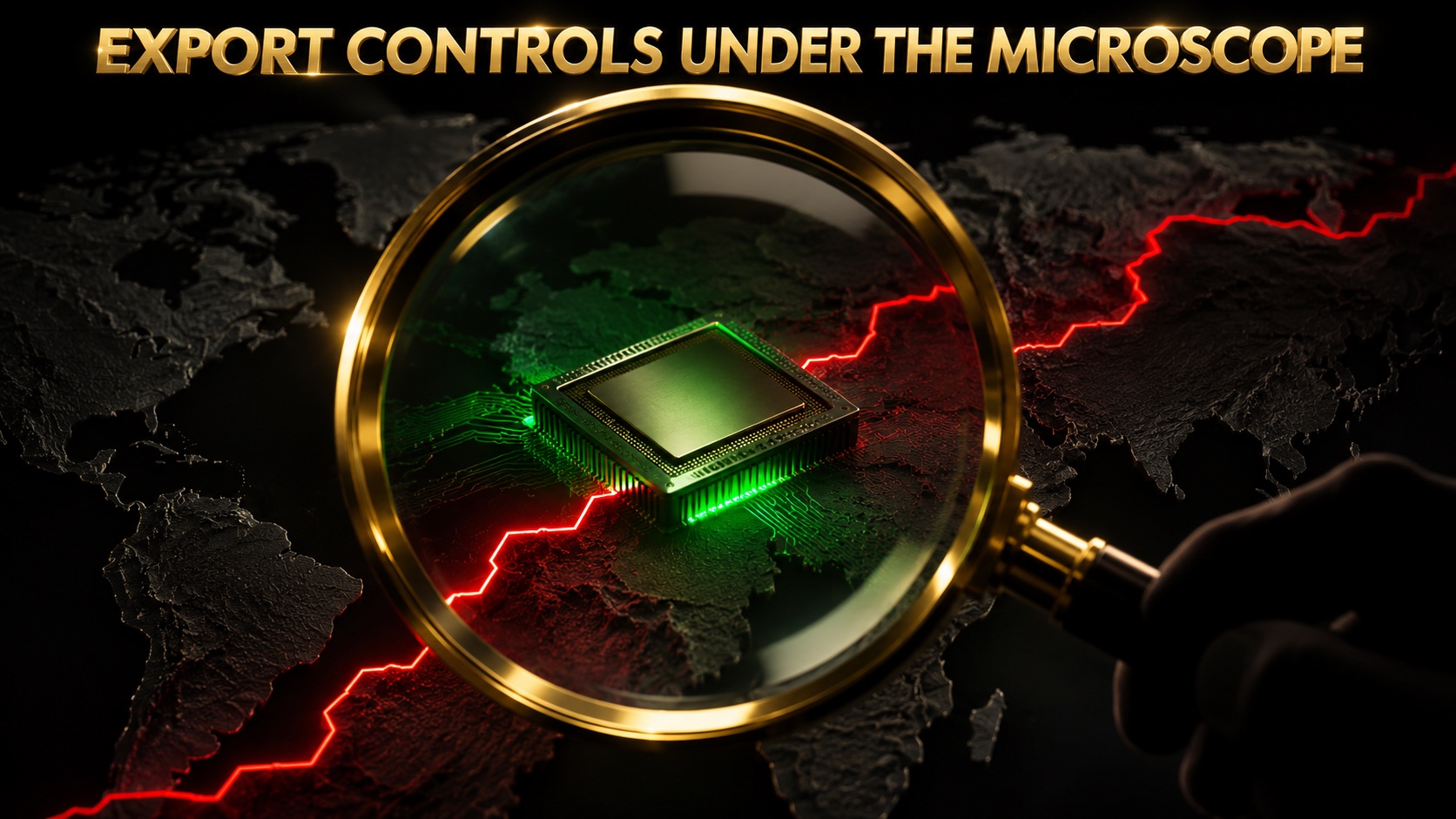
The governance story is only half of the risk. The other half sits in Washington, and it touches Nvidia’s business directly through export controls.
Megaspeed is at the centre of it. According to the senators’ letters and press reports, the Commerce Department’s Bureau of Industry and Security (BIS) began investigating the company in 2024 over the possible diversion of restricted Nvidia chips to China, and the investigation was later handed to the Justice Department. NBC News, citing two law enforcement sources, reported that the Justice Department’s National Security Division is investigating Megaspeed. Megaspeed has said it will cooperate with the US investigation.
The political fallout has widened fast:
- Senate Banking: Chairman Tim Scott summoned Huang and Lutnick to testify in December. A Commerce spokesperson said Lutnick agreed to appear voluntarily.
- House: Foreign Affairs chair Brian Mast said Huang agreed to testify under oath, with a subpoena threatened if he does not appear.
- Records: Senators Warren and Coons asked Commerce, State and the White House to preserve all records on Nvidia’s China exports, with written confirmation requested by 17 November.
- Inside the administration: Treasury Secretary Scott Bessent blamed Lutnick’s Commerce Department for not moving faster to restrict exports to Megaspeed.
- Next year: CNBC notes that Democrats take control of both chambers of Congress in January, which makes continued oversight likely.
Why this matters to investors
- China revenue is already guided at zero for data-centre compute. Nvidia’s Q3 outlook assumes no data-centre compute revenue from China, so the near-term revenue hit from tighter curbs is limited.
- The bigger risk is the option value. Any future reopening of China sales now looks politically harder.
- Compliance risk: if diversion through a partner were proven, Nvidia could face legal and reputational costs and tighter scrutiny of its reseller channel.
- Lost diplomacy: Huang was Nvidia’s most effective voice in Washington, Beijing and Taipei. An interim CEO with a CFO’s background does not replace that overnight.
7. How the Market and Wall Street Reacted
The price path tells the story of a market repricing key-man and governance risk in real time. NVDA fell 4.27% on 9 November and 5.47% on 10 November, dropped about 8% after hours on the 11 November report of a possible ouster, fell 4.34% on the day of the resignation, and lost another 2.01% on 13 November to close at $162.85.
The market-value math
- Weekly decline of 12.75% implies a 6 November close of roughly $186.65.
- At 24.1 billion shares, that is about $4.50 trillion before the week and about $3.92 trillion after.
- That is a loss of roughly $580 billion in market value in five trading days.
- CNBC noted the stock was already down more than 20% over the prior month before the resignation, and this was its sixth straight weekly decline, the longest such streak since 2012.
The downgrade wave
| Firm | New rating | Price target |
|---|---|---|
| Evercore ISI | Outperform to In Line | $465 to $186 |
| Bernstein | Outperform to Market Perform | $400 to $200 |
| Baird | Buy to Hold | $500 to $200 |
| HSBC | Buy to Hold | Cut to $170 |
| KeyBanc | Overweight to Sector Weight | Not disclosed |
| Melius Research | Buy to Hold | Not disclosed |
| Oppenheimer | To Perform | Target withdrawn |
Not every downgrade was purely about Huang. Baird’s note also cited weaker visibility into 2027 data-centre demand. Several firms cut targets but kept positive ratings: Citi to $225 (Buy), RBC to $230 (Outperform) and Stifel to $205 (Buy), with Stifel now treating a leadership transition as its base case. RBC said demand still outpaces supply by about 50%.
The bullish camp has not disappeared. Raymond James reiterated Strong Buy with a $515 target, arguing Huang’s personal issues would not significantly hurt the fundamentals. Wedbush’s Dan Ives put a $225 value on Nvidia without Huang, against $300 with him, which is a useful way to see how one prominent bull prices the key-man discount. These are the Street’s numbers, not ours, and we do not set a price target.
8. Earnings Preview: What to Expect on 17 November
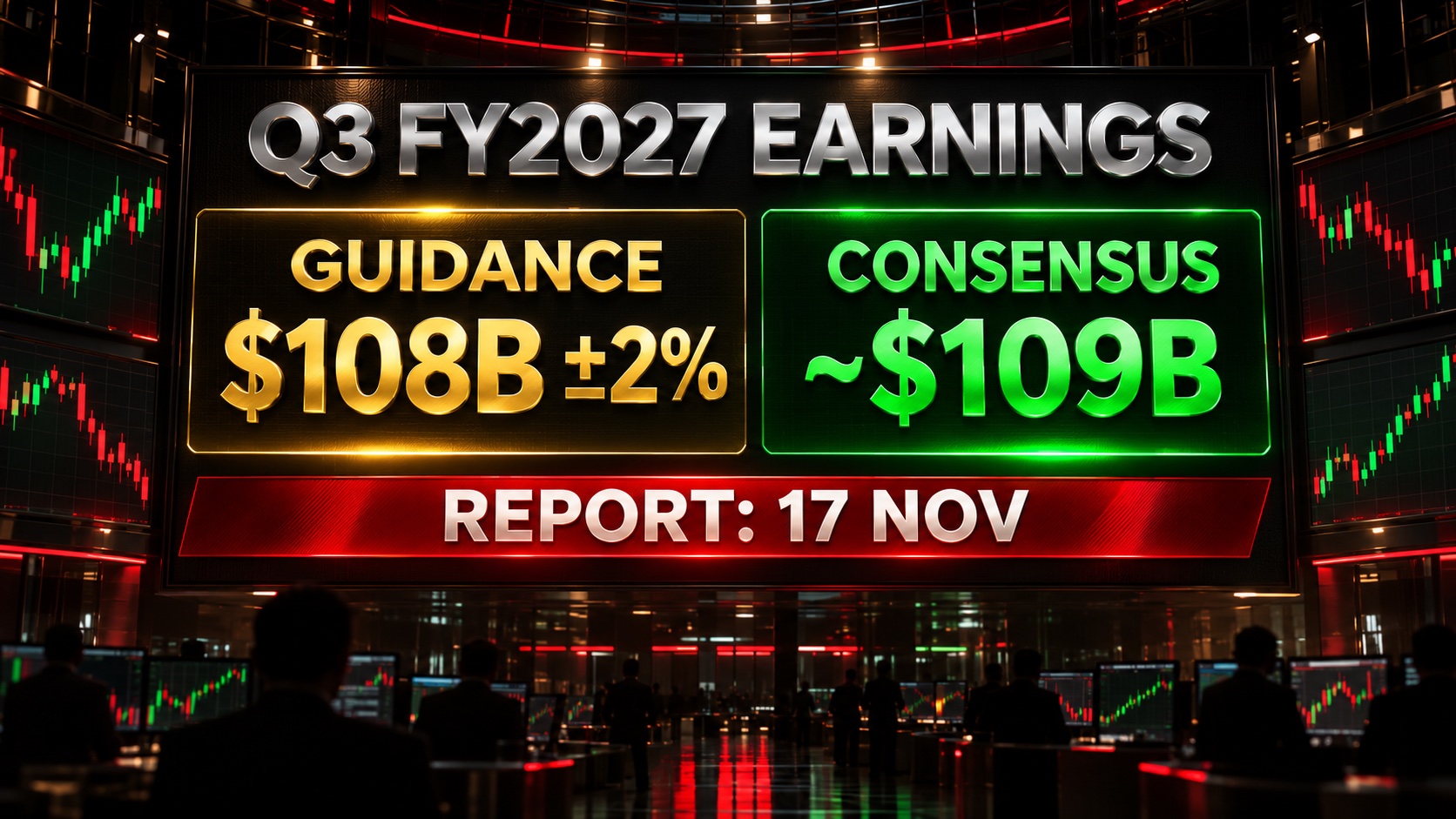
Nvidia reports Q3 FY2027 results on Tuesday, 17 November, after the US close, with the call at 2:00 p.m. Pacific time, which is 06:00 on Wednesday, 18 November, in Singapore. As of writing, the report has not been released, so every figure below is guidance or an estimate.
The setup
| Metric | Company guidance | Consensus estimate |
|---|---|---|
| Revenue | $108.0B, plus or minus 2% ($105.8B to $110.2B) | About $109.2B (LSEG) |
| Gross margin | About 74%, plus or minus 0.5 points | Near guidance |
| Adjusted EPS | Not guided | About $2.48 (LSEG); whisper $2.60 (Earnings Whispers) |
| China data-centre compute | Excluded from outlook | Not modelled |
Estimates as of 14 November 2026. Sources: Nvidia’s Q2 FY2027 release, LSEG via press reports, Earnings Whispers.
For context, Q2 FY2027 revenue was $96.2 billion, up 106% year over year, with data-centre revenue of $89.0 billion, up 117%. For our analysis of the earlier quarter, see our NVIDIA Q1 FY2027 result analysis.
Six things to watch
- The Q4 guide: the first guide without Huang as CEO. A conservative guide would be read as caution from a new leader, not necessarily weaker demand.
- Data-centre revenue and the product roadmap: any sign that the next-generation ramp is slipping would matter more than the headline beat.
- China and export commentary: any remarks on Megaspeed exposure, reseller controls, or revenue reclassification.
- Gross margin: whether rising component costs are squeezing the 74% guide.
- Leadership answers: the CEO search, the investigation, and retention of senior engineers and executives.
- Customer demand: hyperscaler and neocloud spending is the cross-check. Our CoreWeave Q3 2026 earnings review shows how hard the largest AI cloud buyers are still spending.
The numbers will very likely be strong, because they reflect orders placed months ago. The market will trade the guide, the tone of the call, and the leadership answers far more than the beat itself.
9. Our View: What Happens to Nvidia Without Jensen Huang?
This is analysis, not advice. Our position is that a short-term discount is justified, but the business is more institutional than the stock price currently implies. The real long-term risk is not next quarter. It is the next big bet.
Short term (weeks to two quarters): a discount is justified
Key-man risk, an open investigation that could surface more, congressional hearings, possible new export curbs and the risk of rivals recruiting Nvidia talent all deserve a lower multiple until a permanent CEO is named and the investigation concludes. A strong Q3 print will help, but it will not remove this overhang.
Medium term (one to two years): the machine keeps running
- Revenue for the next several quarters rests on hyperscaler orders already placed.
- The product roadmap was set years in advance and is executed by large engineering teams, not one person.
- CUDA’s software ecosystem and Nvidia’s networking lock-in do not depend on who holds the CEO title.
- Supply relationships, especially for advanced packaging at TSMC, are institutional.
- Kress is the executive investors already know best, which limits the communication shock.
What is genuinely lost
Huang was Nvidia’s chief strategist, its keynote evangelist, its relationship-holder with the largest customers, and its de facto diplomat. He made the call to bet the company on CUDA long before AI made it obvious. The real risk is whether Nvidia can make the next platform-sized bet without him, while competitors push into a perceived vacuum. AMD, Broadcom’s custom-chip business and in-house silicon such as Google’s TPU (see our Google TPU vs NVIDIA analysis) all benefit from any loss of momentum, as do infrastructure suppliers such as Marvell that help hyperscalers build custom silicon.
Will Huang come back?
Our read: unlikely while the investigation is open. The petition and Musk’s public support raise the pressure, and the board will eventually have to explain itself. But reinstatement depends on the investigation clearing him on the national-security questions. If it does, a return in some form, perhaps as chair or in a strategy role, becomes plausible. If it does not, the petition fades.
Scenarios
| Scenario | What happens | What it means for NVDA |
|---|---|---|
| Bull | Investigation clears Huang on national security, strong Q3 and Q4 guide | Fast re-rating; a return in some role becomes possible |
| Base | Kress steadies operations, a permanent CEO is named within six to nine months | Stock trades at a discount to its old multiple until the search ends |
| Bear | Adverse findings, new China curbs, senior talent leaves | Multiple compression and faster share loss to custom silicon |
🐂 Bull Case
- Q3 FY2027 revenue guidance of $108 billion reflects demand already on the books.
- RBC says demand still outpaces supply by about 50%.
- China data-centre compute is already excluded from the outlook, limiting the hit from new curbs.
- A clean investigation outcome would remove the largest overhang quickly.
🐻 Bear Case
- No permanent CEO and an open investigation create months of uncertainty.
- Congressional hearings and a federal reseller probe could produce damaging findings.
- A combined CEO and CFO role stretches the leadership team at a critical moment.
- Rivals and custom silicon gain ground if Nvidia’s strategic momentum slows.
10. Key Risks and What to Watch
Key risks
- Findings from the board investigation that go beyond what is public today.
- New export restrictions or legal action tied to reseller diversion.
- Departures of senior engineers or executives during the CEO search.
- A conservative Q4 guide that the market reads as slowing demand.
- A long or contested CEO search, or a public fight over reinstatement.
- Customer hesitation if large buyers see governance instability.
What to watch
- The Q3 report and Q4 guide on 17 November.
- Any on-the-record board response to the petition.
- The investigation’s findings and timing.
- A CEO search shortlist or appointment.
- Congressional hearings with Huang and Lutnick, and any Justice Department action on Megaspeed.
- New export rules for AI chips.
- Insider selling and executive departures in filings.
FAQ
Why did Jensen Huang resign as Nvidia CEO?
Huang resigned on 12 November 2026 after admitting an extramarital affair and amid a board investigation into reports that he was the target of a foreign intelligence effort linked to a former executive of Megaspeed, a Singapore-based Nvidia customer. The board said it had no reason to believe national security or Nvidia secrets were compromised. The investigation’s findings have not been published.
Who is Nvidia’s CEO now?
Colette Kress, Nvidia’s CFO since 2013, is interim CEO and continues to serve as CFO. Harvey C. Jones became Nvidia’s first-ever Chair of the Board. The board is searching for a permanent CEO and will consider internal and external candidates.
What is the “Stand With Jensen” petition, and did Elon Musk sign it?
It is an online open letter asking Nvidia’s board to reinstate Huang, ensure a fair independent investigation and explain its decision publicly. Signature counts are self-reported and unverified. Musk posted on X that “A petition is underway to reinstate Jensen and I’m signing it too,” but it is not independently confirmed which petition he signed.
Can Jensen Huang be reinstated as Nvidia CEO?
The board has the power to reappoint him, but it has not responded publicly to the petition. With an open investigation and congressional scrutiny, a quick reversal is unlikely. A return becomes more plausible only if the investigation clears him.
When does Nvidia report earnings and what is expected?
Nvidia reports Q3 FY2027 results on Tuesday, 17 November 2026, after the US close. The company guided revenue of $108 billion plus or minus 2% and gross margin of about 74%. The LSEG consensus is about $109.2 billion in revenue and $2.48 in adjusted EPS.
Should I sell NVDA stock after Huang’s exit?
That depends on your time horizon, risk tolerance and position size, and this article is not personal advice. The useful question is whether you own Nvidia for its next few quarters, which look largely booked, or for its long-term strategic leadership, which is now uncertain. Long-term investors may want to wait for the earnings call, the investigation outcome and the CEO decision before changing a thesis.
11. Conclusion
Nvidia without Jensen Huang is still the most important supplier in AI infrastructure, with a large order book, a deep software moat and a guidance-setting CFO now in charge. That is why the business case has not changed overnight. What has changed is the certainty around who makes the next big decisions, and how Washington treats the company while it decides.
The biggest opportunity is that the market is pricing a leadership shock onto a business whose near-term demand looks intact. The biggest risk is that the investigation and the export-control fallout reveal more than is public today, and that the company loses strategic momentum while it searches for a successor. The 17 November report will not settle that, but it will show how well the institution holds up in its first week without its founder.
For more research on AI chips and the companies around them, read our related articles, and subscribe to the OneMoreStock YouTube channel for video breakdowns of stories like this one.
Financial Disclaimer:
This article is for educational and informational purposes only and should not be considered financial or investment advice. Investing involves risk, including the possible loss of capital. Always conduct your own research and consult a qualified financial adviser before making investment decisions.