
The Ultimate Copy Trading Guide: Vet Professional Traders Before You Risk Your Money
In the world of passive income investing, few concepts have attracted as much attention in recent years as copy trading. The promise is simple and incredibly appealing: instead of spending years learning technical analysis, reading earnings reports, studying macroeconomics, or monitoring cryptocurrency markets around the clock, investors can simply mirror the trades of experienced professionals.
However, copy trading is often misunderstood. Many beginners believe it is a shortcut to guaranteed profits. In reality, successful copy trading requires careful due diligence, risk management, and trader selection.
As discussed in our cornerstone article, “Hands-Free Wealth: Implementing AI Algorithmic Trading for Consistent Cash Flow,” automation is powerful, but blindly following anyone with a high return chart can quickly become an expensive lesson.
The secret is not simply copying trades.
The secret is learning how to identify traders who can survive multiple market cycles.
Why Copy Trading Has Exploded in Popularity
The financial markets have become increasingly complex. Artificial intelligence now influences trading decisions, institutions use advanced algorithms, and information moves across markets within seconds.
For the average investor, competing directly against hedge funds, quant firms, and professional traders can feel overwhelming.
Copy trading emerged as a practical solution. Instead of becoming an expert trader yourself, you leverage the expertise of traders who have already demonstrated success.
Modern platforms allow investors to allocate capital to selected traders while maintaining full ownership of their funds. When the professional trader opens or closes positions, the same trades are automatically executed within the follower’s account according to predefined risk parameters.
This creates a semi-passive investment experience that appeals to busy professionals, passive income seekers, and investors who prefer delegation over active management.
The rapid growth of platforms such as eToro, Bybit, Binance, and MEXC demonstrates the increasing demand for social investing solutions.
The Biggest Mistake New Copy Traders Make
The majority of beginners make the same critical mistake.
They choose traders based solely on recent returns.
A trader showing 300% returns over the last six months naturally attracts attention. Unfortunately, high returns often tell only a small part of the story.
Many of these traders achieved impressive gains by taking excessive risk. Some use extreme leverage, concentrate capital into a handful of positions, or rely on strategies that perform well only under specific market conditions.
A trader can produce extraordinary gains for several months before suffering a catastrophic loss that wipes out years of profits.
The most important metric is not how much money a trader made.
It is how they made it.
Understanding Risk-Adjusted Performance
Professional investors focus heavily on risk-adjusted returns.
A trader generating 20% annually with controlled drawdowns may be significantly superior to someone producing 100% annual returns while risking complete account destruction.
When evaluating copy traders, investors should focus on consistency.
Long-term profitability usually indicates a repeatable process. Traders who survive multiple market environments often possess robust risk management systems that allow them to adapt when conditions change.
A trader with three years of stable performance is generally more attractive than a trader with six months of spectacular gains.
The goal of passive income investing is not maximizing returns at all costs.
The goal is maximizing sustainable returns while minimizing catastrophic risk.
How to Vet Professional Traders Properly
Before allocating capital to any trader, investors should conduct a thorough evaluation process.
The first factor is trading history. Ideally, a trader should have at least twelve to twenty-four months of verified performance data. Longer track records provide better insight into how the strategy performs across different market conditions.
The second factor is maximum drawdown. Drawdown measures the largest percentage decline from peak portfolio value. This metric often reveals far more about a trader’s skill than total returns.
A trader producing 50% annual returns with a 10% drawdown is often more attractive than a trader producing 100% returns with a 60% drawdown.
Third, investors should examine trade frequency and consistency. Professional traders typically follow repeatable systems rather than relying on random market timing.
Consistency suggests discipline.
Discipline is often the foundation of long-term profitability.
Finally, investors should understand the underlying strategy. Whether the trader focuses on trend following, swing trading, forex, crypto momentum, AI-assisted trading, or algorithmic systems, followers should understand how profits are generated.
If the strategy cannot be explained clearly, caution is warranted.
The Rise of AI-Powered Copy Trading
Artificial intelligence is becoming increasingly integrated into copy trading ecosystems.
AI systems now analyze thousands of traders simultaneously, identifying patterns that human investors might miss.
Modern AI tools can evaluate:
- Risk-adjusted returns
- Drawdown characteristics
- Market adaptability
- Position sizing behavior
- Strategy consistency
- Historical correlation patterns
These capabilities allow investors to identify potentially superior traders more efficiently.
Some platforms are even introducing AI-generated portfolio recommendations that automatically allocate capital among multiple traders based on risk preferences.
This trend aligns closely with the broader automation movement transforming finance.
Rather than selecting a single trader, investors increasingly rely on AI-assisted diversification strategies.
Why Diversification Matters in Copy Trading
One of the biggest advantages of modern copy trading platforms is the ability to follow multiple traders simultaneously.
Many beginners allocate all capital to a single trader.
This creates unnecessary concentration risk.
A more effective approach involves building a diversified portfolio of traders using different strategies and market exposures.
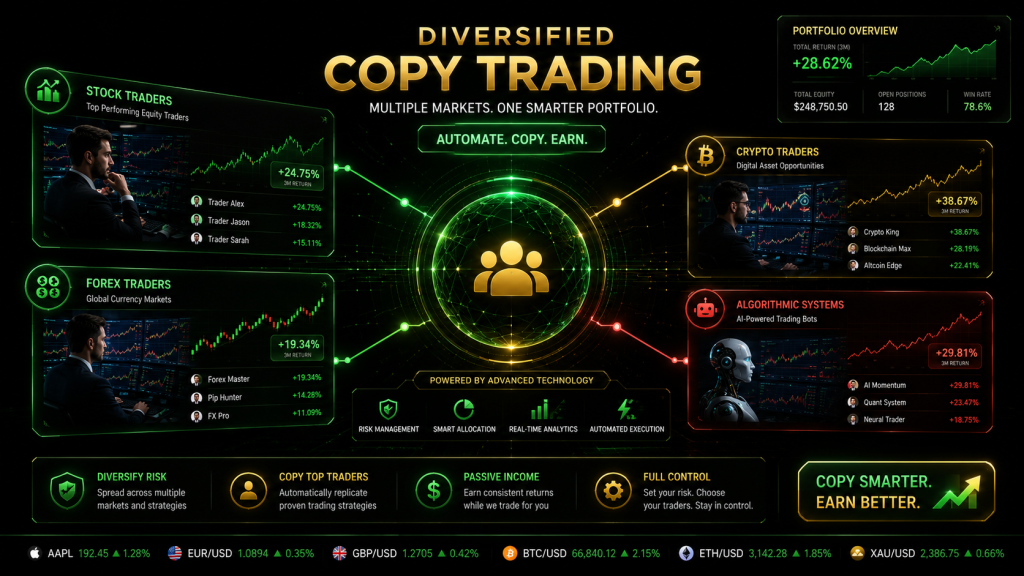
For example, an investor may allocate capital across:
- A stock market swing trader
- A forex trend-following specialist
- A cryptocurrency momentum trader
- An AI-driven algorithmic trader
When combined together, these strategies may reduce overall portfolio volatility while improving long-term consistency.
Diversification remains one of the most powerful risk management tools available to investors.
The Connection Between Copy Trading and Passive Income
Many people misunderstand passive income.
Passive income does not mean income without risk or oversight.
Instead, passive income involves creating systems that generate returns without requiring constant active labor.
Copy trading fits naturally into this framework.
Unlike day trading, which demands continuous attention, copy trading allows investors to leverage professional expertise while spending relatively little time managing positions.
This makes it particularly attractive for individuals focused on building multiple income streams.
Investors can simultaneously:
- Build AI-powered content businesses
- Operate affiliate marketing systems
- Invest in dividend stocks
- Generate crypto staking income
- Utilize copy trading platforms
The combination creates diversified income sources that reduce dependence on traditional employment.
Common Red Flags to Avoid
Many copy trading disasters can be traced back to easily identifiable warning signs.
Investors should be extremely cautious when traders display unusually high returns combined with extreme leverage.
Similarly, traders who hide losing positions, constantly average down, or refuse to disclose strategy details should raise immediate concerns.
Another major warning sign is rapid account growth over a very short period.
In many cases, extraordinary short-term returns are simply the result of excessive risk taking rather than exceptional skill.
Long-term survival remains one of the strongest indicators of trading competence.
Building a Copy Trading Portfolio for 2026
The most successful copy traders in 2026 will likely combine human expertise with AI-assisted analysis.
Rather than chasing the hottest trader of the month, sophisticated investors are increasingly building diversified portfolios focused on consistency, risk management, and long-term wealth accumulation.
This approach aligns closely with the OneMoreMoney philosophy.
The objective is not gambling.
The objective is constructing scalable financial systems that can generate sustainable returns over time.
Copy trading can become a valuable component of a broader passive income strategy when combined with prudent risk management and realistic expectations.
Final Thoughts
Copy trading has evolved from a niche concept into a mainstream investment tool. Advances in AI, social investing platforms, and automated portfolio management are making professional trading expertise more accessible than ever before.
However, successful copy trading requires discipline.
Investors who focus solely on returns often end up following traders who eventually implode. Those who prioritize consistency, risk management, diversification, and long-term track records tend to achieve far better outcomes.
For passive income seekers, copy trading offers an attractive opportunity to automate part of their investment process while retaining control of their capital.
The future of investing is increasingly automated.
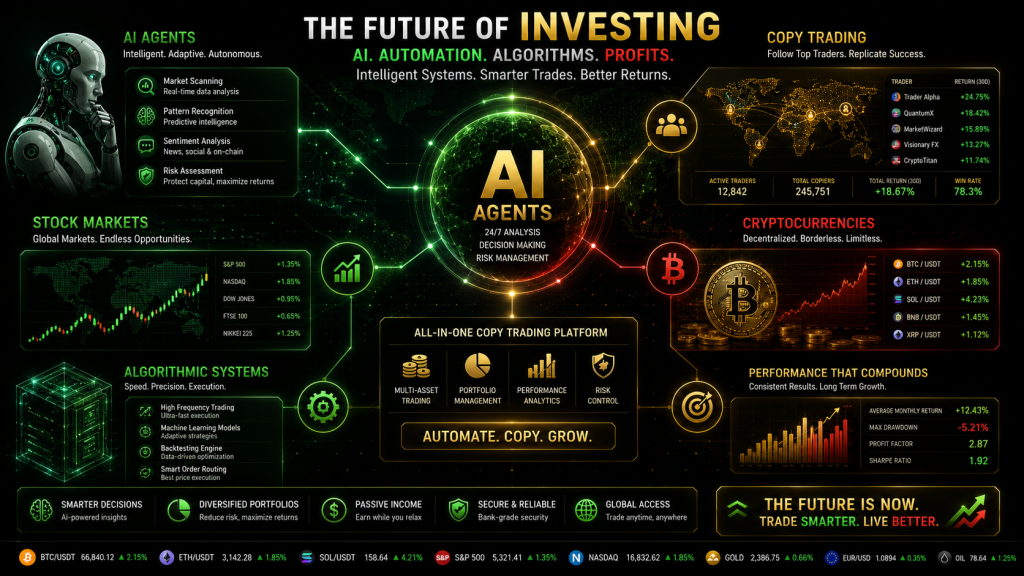
The investors who learn how to combine human expertise, AI-driven analysis, and disciplined portfolio construction will be best positioned to thrive in the years ahead.
FAQ Section
Q1: Is copy trading suitable for beginners?
Yes. Copy trading allows beginners to leverage the expertise of experienced traders while learning how financial markets operate.
Q2: Can I lose money with copy trading?
Yes. Copy trading carries market risk. Following an unsuccessful trader can result in losses, which is why due diligence is essential.
Q3: What is the most important metric when choosing a trader?
Maximum drawdown and risk-adjusted returns are generally more important than absolute returns.
Q4: Should I copy only one trader?
No. Diversifying across multiple traders and strategies can significantly reduce risk.
Q5: Can AI improve copy trading performance?
AI can help analyze trader performance, identify risk patterns, and support better portfolio allocation decisions.