

Introduction: The Rise of Autonomous Wealth Systems
The financial markets are undergoing a structural transformation. What was once dominated by institutional players armed with proprietary algorithms is now increasingly accessible to retail investors through artificial intelligence and algorithmic trading systems (AI Algo Trading). The convergence of cloud computing, machine learning, and real-time data analytics has put automated trading within reach of individual investors. However, despite the marketing narratives surrounding “set-and-forget” passive income, the reality is more nuanced. True long-term success in AI-driven trading lies not in blind automation, but in strategic oversight, what we define within the OneMoreMoney ecosystem as “monitor and adjust.”
This cornerstone article serves as a comprehensive, experience-driven blueprint for implementing AI algorithmic trading (AI Algo Trading) systems that align with the OneMoreStock and OneMoreForex philosophies, focused on compounding capital intelligently while managing downside risk with precision.
The Philosophy: Why “Set and Forget” is a Myth, but “Monitor and Adjust” Is What Works
The idea of passive income through trading bots often attracts beginners with the promise of effortless wealth. In reality, markets are adaptive, non-linear, and influenced by macroeconomic shifts, liquidity cycles, and behavioral dynamics. Any strategy that performs well in one regime can quickly deteriorate in another. This is why the concept of “set and forget” is fundamentally flawed.
The OneMoreMoney philosophy rejects static systems. Instead, it embraces a dynamic framework where automation handles execution, while human intelligence governs strategy evolution. Think of AI trading systems not as autonomous profit machines, but as force multipliers, tools that amplify well-designed strategies while requiring periodic recalibration.
From a practical standpoint, this means establishing a structured review cadence. Weekly performance audits, monthly parameter adjustments, and quarterly strategy reviews form the backbone of a resilient AI trading operation. Metrics such as Sharpe ratio, maximum drawdown, win rate consistency, and risk-adjusted return must be continuously evaluated. This approach transforms trading from a speculative activity into a systematic capital allocation process.

Stock Market Automation: Integrating AI Signals into Traditional Brokerage Accounts
Equity markets remain one of the most stable environments for algorithmic trading, particularly when combined with AI-driven signal generation. Unlike highly volatile markets, stocks benefit from structural growth trends, institutional participation, and relatively predictable liquidity patterns.
The modern approach to stock market automation involves integrating AI-generated signals into brokerage accounts through APIs or semi-automated execution systems. Platforms like Interactive Brokers and TradeStation allow traders to connect algorithmic models directly to their accounts, enabling real-time trade execution based on predefined conditions.
Within the OneMoreStock framework, AI is primarily used for signal generation rather than full autonomy. Machine learning models analyze historical price action, volume patterns, earnings data, and macro indicators to identify high-probability trade setups. These signals are then filtered through risk management rules before execution.
A key advantage of this hybrid model is control. By maintaining a human-in-the-loop approach, traders can override signals during periods of abnormal market behavior, such as earnings shocks, geopolitical events, or liquidity crises. This significantly reduces tail risk compared to fully autonomous systems.
Another important consideration is portfolio construction. Rather than relying on a single strategy, the OneMoreStock approach emphasizes diversification across multiple AI models: trend-following, mean-reversion, and momentum-based systems. This multi-strategy architecture can smooth returns over time, although it does not remove the risk of loss.
Forex vs. Crypto Bots: Which Market Suits Automated Trading Better?
One of the most critical decisions in algorithmic trading is market selection. While both Forex and cryptocurrency markets offer automation opportunities, they differ significantly in terms of volatility, liquidity, and structural characteristics.
Forex markets are the largest and most liquid financial markets in the world, with average daily turnover of about $9.6 trillion in April 2025, according to the BIS Triennial Survey. This liquidity ensures tight spreads and relatively stable price movements, making Forex well suited to systematic strategies such as scalping and mean reversion. The OneMoreForex philosophy uses these characteristics to build systematic strategies with controlled volatility. Keep in mind that retail forex is usually traded with leverage, which magnifies losses as well as gains: European regulator ESMA found that 74–89% of retail CFD accounts typically lose money.
Crypto markets, on the other hand, are characterized by extreme volatility and 24/7 trading cycles. While this creates opportunities for high returns, it also introduces significant risk. AI bots in crypto markets often rely on momentum and arbitrage strategies, which can generate outsized gains during bullish cycles but suffer during prolonged downturns.

Forex prices generally move less than crypto prices, but leverage can make forex trading just as risky, so neither market is “safe” for automation. However, crypto can play a complementary role within a diversified portfolio, acting as a high-risk, high-reward component.
To illustrate the idea of a stable core with higher-risk satellites, a split might look like the one below. It is an example, not a recommendation; the right mix depends on your goals, experience and risk tolerance:
- 60–70% in Forex bots as the core, for lower price volatility
- 20–30% in stock automation for long-term growth
- 10–20% in crypto bots for asymmetric upside potential
The principle is to aim for steadier overall returns while keeping a limited exposure to high-growth, high-risk opportunities.
Risk Management: The OneMoreMoney Approach to Drawdown and Position Sizing
Risk management is the cornerstone of any successful trading system. Without it, even the most sophisticated AI models will eventually fail. The OneMoreMoney approach prioritizes capital preservation above all else, recognizing that surviving market downturns is essential for long-term compounding.
At the heart of this framework is drawdown control. Maximum drawdown represents the largest peak-to-trough decline in portfolio value, and it must be strictly managed to avoid catastrophic losses. A general rule within the OneMoreMoney system is to limit drawdown to 10–20% per strategy.
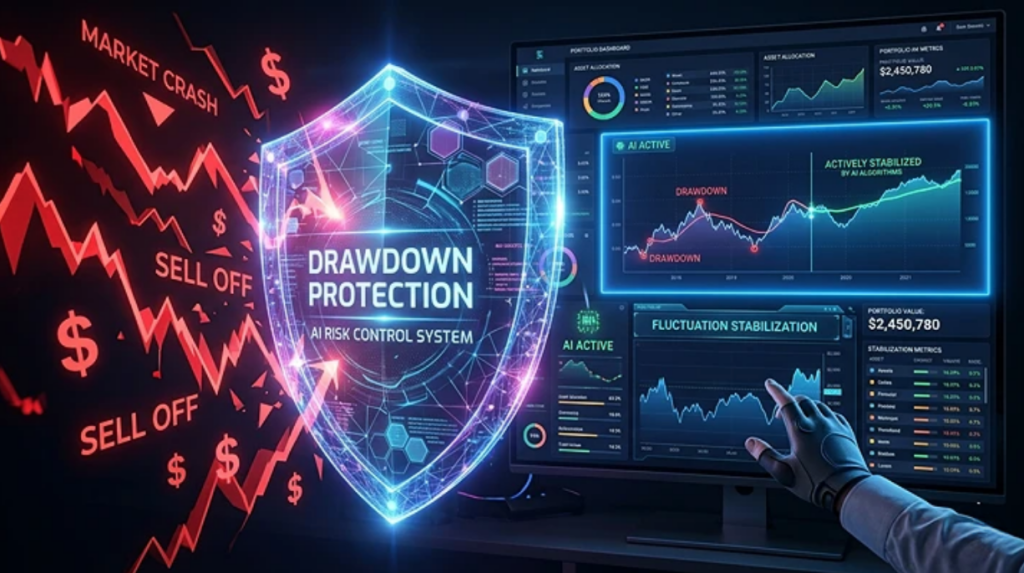
Position sizing plays a critical role in achieving this objective. Rather than allocating fixed trade sizes, the system uses volatility-adjusted position sizing, where trade exposure is scaled based on market conditions. During periods of high volatility, position sizes are reduced to minimize risk. Conversely, during stable periods, exposure can be increased to maximize returns.
Another key component is strategy correlation. Running multiple highly correlated strategies increases risk, as losses can compound simultaneously. The solution is to diversify across uncorrelated systems, ensuring that underperformance in one strategy is offset by gains in another.
Stop-loss mechanisms and circuit breakers further enhance risk control. These safeguards automatically halt trading when predefined thresholds are breached, preventing runaway losses during extreme market events.
Tool Selection: Hardware vs. Cloud-Based Trading Servers
The infrastructure supporting an AI trading system is often overlooked, yet it plays a critical role in execution reliability and latency. Traders must choose between local hardware setups and cloud-based trading environments, each with its own advantages and trade-offs.
Local hardware offers full control and eliminates recurring cloud costs. However, it comes with significant drawbacks, including power dependency, maintenance requirements, and potential downtime. For serious algorithmic traders, these risks can outweigh the cost savings.
Cloud-based solutions, such as AWS and Google Cloud, provide high uptime, scalability, and global accessibility. Virtual private servers (VPS) are particularly popular for hosting trading bots, ensuring continuous operation even when the trader’s personal device is offline.
Within the OneMoreMoney ecosystem, cloud infrastructure is generally preferred for its reliability and flexibility. A typical setup includes:
- VPS hosting for trading bots
- API integrations with brokers and exchanges
- Automated monitoring dashboards
- Backup systems for redundancy
This architecture enables traders to manage their portfolios from anywhere in the world while ensuring uninterrupted execution.
Building a Sustainable AI Trading Ecosystem
The ultimate goal of algorithmic trading is not short-term profit, but sustainable wealth creation. This requires a holistic approach that integrates strategy development, risk management, and infrastructure into a cohesive system.
The OneMoreMoney philosophy emphasizes continuous improvement. Markets evolve, and so must trading strategies. By combining AI-driven insights with disciplined oversight, traders can build systems that adapt to changing conditions while maintaining consistent performance.
Importantly, expectations must be realistic. AI trading is not a shortcut to instant riches, but a scalable framework for long-term capital growth. With proper implementation, it can transform trading from a time-intensive activity into a semi-passive income stream.
Key Takeaways from AI Algo Trading
- AI trading is powerful, but requires active oversight
- Diversification across stocks, Forex, and crypto improves stability
- Risk management is more important than strategy accuracy
- Cloud infrastructure enhances reliability and scalability
- Long-term success depends on continuous optimization

FAQ
1. Is AI algorithmic trading truly passive income?
AI trading is not fully passive. It requires monitoring and periodic adjustments to remain effective in changing market conditions.
2. How much capital is needed to start AI trading?
You can start with as little as $1,000, but $5,000 to $10,000 is recommended for better diversification and risk management.
3. Which is safer: Forex bots or crypto bots?
Forex bots are generally more stable due to higher liquidity and lower volatility, while crypto bots offer higher potential returns with greater risk.
4. Do AI trading bots work in bear markets?
Yes, but performance depends on the strategy. Some bots are designed for bearish conditions, such as short-selling or mean reversion.
5. What is the biggest risk in algorithmic trading?
The biggest risk is poor risk management, including excessive leverage and lack of drawdown control.
6. Can beginners use AI trading systems effectively?
Yes, but beginners should start with simple strategies, use proper risk controls, and continuously learn before scaling up. Always start with a demo trading account before putting your hard-earned money in it.
Sources
- Bank for International Settlements, Triennial Central Bank Survey of foreign exchange markets, 2025
- ESMA, ESMA agrees to prohibit binary options and restrict CFDs to protect retail investors: retail CFD loss rates
- U.S. CFTC, Foreign Currency (Forex) Fraud
- U.S. SEC Investor.gov, Artificial Intelligence (AI) and Investment Fraud: Investor Alert: how to spot AI trading-bot scams
- Interactive Brokers, TWS API documentation: connecting your own models to a brokerage account
Disclaimer: This article is for educational purposes only and does not constitute investment advice. Trading with leverage carries a high risk of loss. Investors should conduct their own due diligence before making any financial decisions. We are not responsible for any investment losses incurred based on the information provided in this article.