
Python Forex Trading Automation: The Passive Income Audit
Somewhere between “I know a bit of Python” and “I have an income stream” sits a very popular idea: write a script, point it at a broker API, let it trade the currency markets while you sleep. The appeal is obvious, and the code is genuinely not that hard.
The problem is the word passive. Python forex trading automation is a real skill with real value, and it is one of the few routes on this site where what you build is worth something even if the strategy never makes a cent. But the honest version is semi-passive at best, with an ongoing time cost, a running monthly bill and a failure mode that ends at zero.
This is the audit: what it costs, what it takes, what the regulators’ own numbers say about the odds, and who it genuinely suits.
1. The Numbers Up Front
| Line item | Realistic figure |
|---|---|
| Broker account minimum | $100 to $1,000 for micro-lot trading |
| VPS or cloud hosting | $8 to $60 per month, most traders $12 to $20 |
| Market data | $0 on open-source feeds, $29 per month and up for a real FX tier |
| EUR/USD dealing cost | Roughly 0.8 to 1.2 pips all-in on a mainstream account |
| Initial build time | 50 to 100 hours to code, backtest and deploy |
| Ongoing time | 2 to 5 hours per week, indefinitely |
| Share of US retail forex accounts unprofitable | 65.96% at OANDA, 67.44% at FOREX.com, Q2 2026 |
Data as of 16 September 2026. Verify before acting on any of it.
That last row is the one to sit with. It is not a scare statistic from a critic. US regulation requires every retail forex dealer to calculate and publish, every quarter, the percentage of non-discretionary customer accounts that were profitable and unprofitable. The brokers report it themselves. In Q2 2026 those disclosures showed 64.00% of Schwab accounts unprofitable, 54.47% at Interactive Brokers, 65.96% at OANDA, 65.50% at tastyfx and 67.44% at FOREX.com. Australia’s regulator, ASIC, reported in January 2026 that 68% of retail CFD investors lost money over the 2024 financial year.
Automation does not exempt you from that distribution. It just makes you lose faster or win faster, with fewer emotional interruptions.
2. What a Python Forex Bot Actually Does
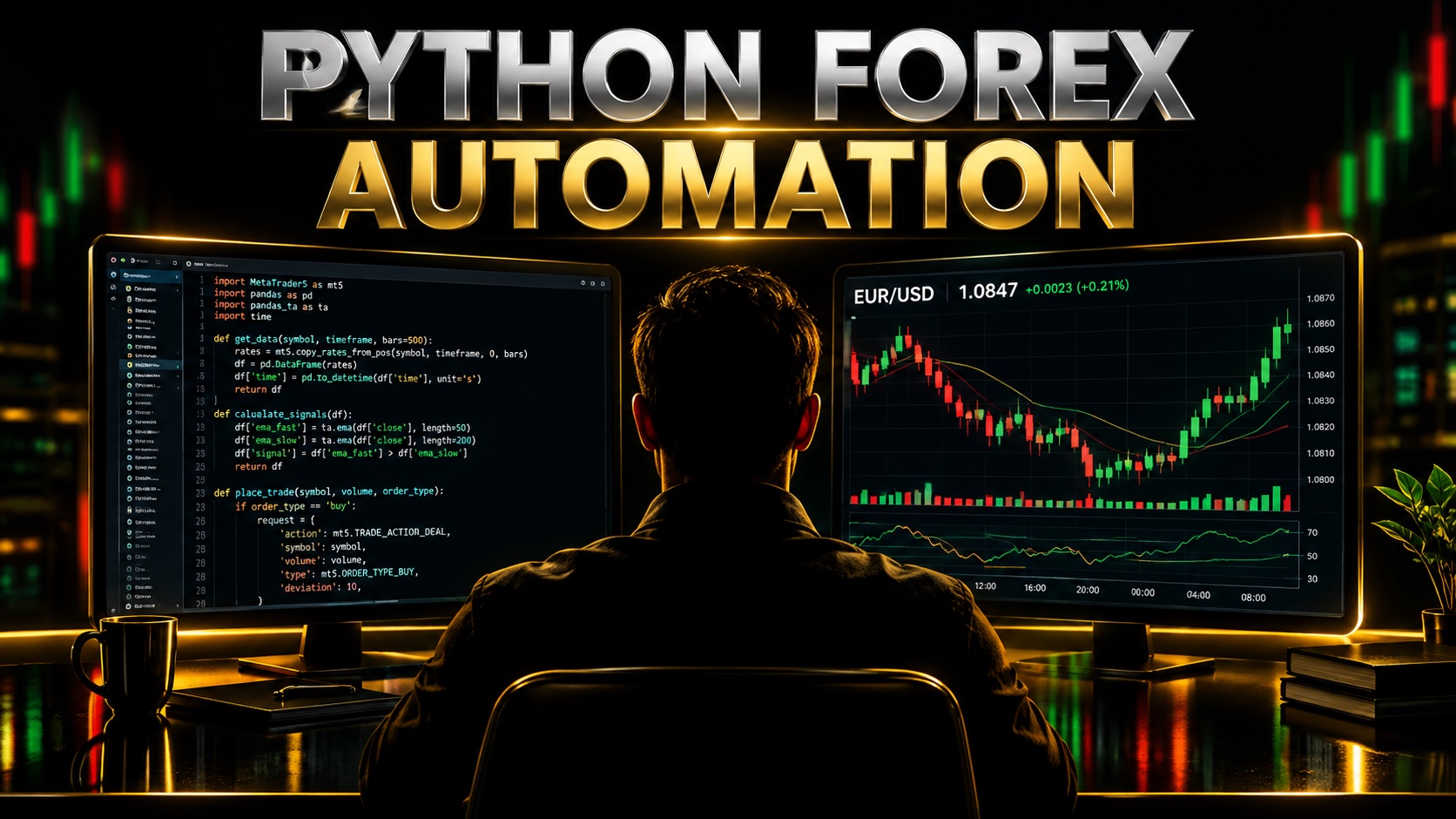
Strip away the marketing and a retail forex bot is four things in a loop.
- Fetch: pull candle or tick data from a data feed or the broker’s own API
- Decide: compute indicators such as moving averages or RSI, and test entry and exit conditions against them
- Execute: issue a REST or WebSocket order to the broker
- Protect: enforce a stop loss and a position size before the order ever goes out
That is it. The decision layer, the part everyone obsesses over, is often twenty lines. The protection layer determines whether you still have an account in six months, and it is the part tutorials skip.
What Python removes is not effort. It is discretion. A script does not widen a stop because it feels confident, does not revenge-trade after a loss, and does not skip a valid signal because the news looked scary. That is a real edge over manual trading. It is also the only edge automation gives you for free.
3. The Library Stack, and What Is Actually Maintained
This is where the standard tutorial goes stale, and where an afternoon of verification saves you a month. Package versions and release dates below were checked directly against PyPI on 16 September 2026.
| Library | Purpose | Latest release | Status |
|---|---|---|---|
| pandas / numpy | Data handling and vector maths | Current | Actively maintained |
| yfinance 1.7.0 | Free historical data | Aug 2026 | Maintained, but weak for FX |
| pandas-ta 0.4.71b0 | Technical indicators | Sep 2025 | Maintained, still beta |
| MetaTrader5 5.0.6180 | MT5 broker integration | Sep 2026 | Actively maintained |
| alpaca-py 0.44.0 | Alpaca broker API | Aug 2026 | Actively maintained |
| ib_async 2.1.0 | Interactive Brokers API | Dec 2025 | Maintained successor |
| ib_insync 0.9.86 | Interactive Brokers API | Jul 2023 | Unmaintained, do not start here |
| backtrader 1.9.78 | Event-driven backtesting | Apr 2023 | Effectively frozen |
| oandapyV20 0.7.2 | OANDA REST API | Aug 2021 | Five years stale |

Three things fall out of that table.
ibinsync is the big one. It is still the library named in most Interactive Brokers tutorials, and it is no longer maintained. Its author, Ewald de Wit, died unexpectedly in early 2024, and because the community could not get access to the original repositories, the project was reconstituted as ibasync under a new organisation. If you are starting today, start on ib_async. Copying a 2023 tutorial will put you on a dead dependency on day one.
Backtrader is frozen, not broken. Its last release was April 2023. It is still mature, well documented and widely used, and for a first moving-average backtest it is perfectly adequate. Just know you are building on something that will not get fixes. Backtesting.py, VectorBT and NautilusTrader are the live alternatives, with the caveat that VectorBT’s open-source edition is in maintenance mode while development happens in the paid PRO version.
Free data is the quiet trap. yfinance is excellent for equities and fine for learning. For forex it gives you coarse bars, not the bid-ask reality your strategy will actually trade against. Backtest on data that hides the spread and you will build something that looks profitable and is not. A genuine FX data tier starts around $29 per month and climbs from there. Note that Polygon.io, the feed most commonly recommended for this, rebranded to Massive.com during 2026, so older guides point at a redirect.
4. Where Simple Strategies Break
The canonical beginner strategy is a moving average crossover: go long when the 20-period crosses above the 50-period, exit when it crosses back. It works, in the narrow sense that it captures sustained trends.
Currency markets spend most of their time not trending.
In a ranging market, a crossover system generates a continuous stream of small losing trades as price oscillates across both averages. Each one costs the spread. None is individually alarming. Collectively they grind an account down, and because the losses are small and frequent rather than dramatic, the system rarely trips whatever intuition would have made you stop.
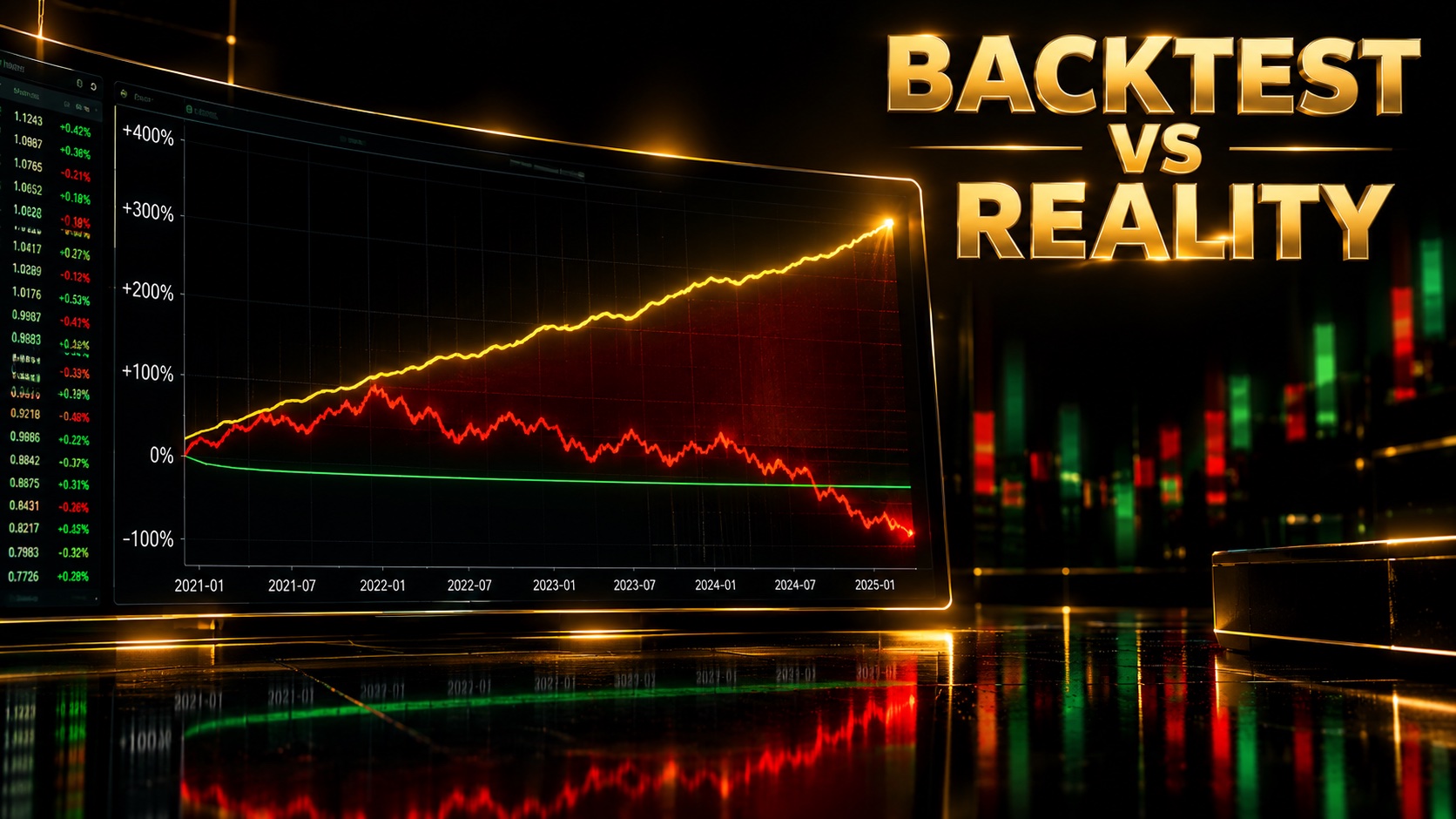
Then there is curve-fitting, which is worse because it feels like progress. You backtest, the result is mediocre, so you adjust the periods. Better. You add a filter. Better again. After a weekend you have a beautiful equity curve. What you have actually done is describe the last two years of price history in unusual detail. That is not an edge, it is a memorised past, and it is worthless on Monday.
The tells are consistent.
- Performance collapses on data the strategy was not tuned on
- Small parameter changes cause large performance swings, which means the result was never robust
- The backtest shows no slippage and no commission, which means it is fiction
- The strategy reads a value it could not have known at that moment, which is lookahead bias
5. The Costs That Decide It, and the Boring Baseline
A strategy does not need to be right to lose. It needs to be less right than its running costs, which is a much lower bar.
- Spread: roughly 0.8 to 1.2 pips all-in on EUR/USD at a mainstream broker, paid on every trade, in both directions
- Swap: an overnight financing charge or credit on any position held past the daily rollover
- Slippage: the gap between the price your script decided on and the price it got, which widens exactly when it matters most, during news
- Hosting: $8 to $60 per month whether the strategy trades or not
- Data: $0 to $300 per month depending on how honest you want your backtest to be
Run a high-frequency crossover system and the spread alone can consume the entire theoretical edge before a single market risk materialises.
Now the comparison this site always insists on. A broad index fund costs a fraction of a percent per year, takes about an hour to set up, and asks for roughly zero hours per week thereafter. A fixed deposit pays a known rate for a known term. Neither is exciting. Both are the baseline any forex automation project has to beat, after costs, after 50 to 100 hours of build time, and after the 2 to 5 hours a week it will keep asking for.
If you would not take this on as an unpaid part-time job in quantitative development, the numbers do not support it as an income plan.
🐂 Bull Case
- The skills transfer. Data pipelines, backtesting discipline and risk modelling are employable in their own right, whatever the strategy does
- Automated execution genuinely removes emotional error, which is a documented and expensive category of manual trading loss
- The entry cost is small and bounded: a few hundred dollars of account and roughly $15 a month of hosting
- Backtesting forces the discipline of stating a rule precisely and testing it, which most discretionary traders never do
- Failure is educational and cheap if you size positions properly, unlike most routes where failure is just failure
🐻 Bear Case
- Regulator-mandated disclosures show roughly two thirds of US retail forex accounts unprofitable in Q2 2026, and automation does not move you out of that group by itself
- Spread, swap and slippage are charged on every trade regardless of whether the strategy has an edge
- Curve-fitting is the default outcome of iterating on a backtest, and it is invisible until live money is on the line
- Leverage means the realistic downside is total loss of the account, not a bad year
- The ongoing time cost of 2 to 5 hours per week never ends, which disqualifies the word passive on its own
6. Infrastructure Is Half the Build
A script that works on your laptop is not a trading system. A trading system runs when your laptop is shut.

That means a VPS or cloud instance, which is where the $8 to $60 per month goes. It also means handling the failure cases that only appear in production.
- Disconnects: what happens to an open position when the connection drops mid-session
- Restart state: after a crash, does the script know it already has a position open, or does it open a second one
- API key security: credentials in environment variables, never in the repository
- Rate limits: a retry loop that hammers a throttled endpoint gets you blocked at the worst moment
- A kill switch: one manual control that flattens everything and stops trading
The main risks in live operation are not clever ones. They are extreme drawdown, a logic error in your own code, server downtime, slippage, broker disconnects and unscheduled geopolitical news. Only the first is about the market.
7. Where AI Genuinely Helps, and Where It Does Not
Large language models have made the boilerplate portion of this work dramatically faster. Connecting to an API, reshaping a dataframe, debugging a stack trace: all of that is now minutes rather than evenings. Machine learning libraries such as scikit-learn and PyTorch are used seriously to classify market regimes rather than to predict prices outright, which is the more defensible use of them.
The limitation is specific. Generated quantitative code frequently contains subtle errors that run perfectly and produce wrong answers: an off-by-one in a rolling window, a vectorised calculation that silently misaligns, or lookahead bias where the backtest reads a bar that had not closed yet. None of these throw an exception. All of them inflate your results.
AI raises your build speed. It does not raise your floor of understanding, and an unaudited generated backtest is worse than no backtest, because it is confidently wrong.
8. So Who Is This Actually For?
If you want income, this is the wrong door. The time cost is real, permanent and unpaid until the strategy works, and the regulators’ own figures say it probably will not. A broad index fund beats it on every axis that matters to someone who wants money rather than a project.
If you want the skill, this is an excellent door. Building a data pipeline, a backtester and a risk layer teaches quantitative finance faster than any course, and the artefact is employable. Treat it as education with a small tuition fee, size positions so a total loss is survivable, and the trade is a good one.
If you want both, be specific about the order. Skill first, for a long time, on a demo account, with a strategy you did not tune into beauty. Capital only after a system has survived a market regime it was not designed in.
Whichever applies, the depth lives on the specialist properties. OneMoreForex covers the currency mechanics, the spread and swap arithmetic and the broker landscape in detail. OneMoreStock covers the boring baseline this route has to beat.
FAQ
Is automated forex trading passive income?
No. It is semi-passive at best. The execution is automated, but the strategy needs monitoring, recalibration and code maintenance, which realistically runs 2 to 5 hours per week indefinitely, on top of 50 to 100 hours to build. The trading happens without you. The work does not.
How much money do I need to start?
A broker account for micro-lot trading typically opens at $100 to $1,000, plus $8 to $60 per month for a VPS and anywhere from nothing to $300 a month for data. The real cost is time, not capital: budget 50 to 100 hours before a single live trade.
Can I just use ChatGPT or Claude to write the bot?
For boilerplate, yes, and it will save you a lot of hours. For the strategy and backtest logic, only with careful human review. Generated quantitative code commonly contains lookahead bias and vector misalignment errors that run cleanly and produce results that are wrong in your favour.
Why do most automated forex strategies fail?
Two reasons dominate. Costs, because spread and swap are charged on every trade whether or not the strategy has an edge. And curve-fitting, because iterating on a backtest until it looks good produces a description of the past rather than an edge in the future.
Which Python libraries should I actually use in 2026?
pandas and numpy for data, pandas-ta for indicators, and a broker library that is still maintained. Use ibasync rather than ibinsync for Interactive Brokers, and check the last release date of anything a tutorial recommends before you build on it.
Is a moving average crossover strategy worth trying?
As a learning exercise, yes. As a live strategy, it performs well in sustained trends and erodes capital steadily in ranging markets, which is where currencies spend most of their time. Treat it as the thing you test your infrastructure with, not the thing you fund.
Sources
- OANDA, v20 REST API documentation
- MQL5, MetaTrader 5 Python integration
- Backtrader, Backtrader documentation
- pandas, pandas documentation
- Bank for International Settlements, Triennial Central Bank Survey of foreign exchange markets, 2025
- ESMA, ESMA agrees to prohibit binary options and restrict CFDs to protect retail investors
⚠️ Disclaimer: The content on OneMoreMoney.com is for informational and educational purposes only and does not constitute financial, investment, or trading advice. Always conduct your own research and consult a licensed financial advisor before making any investment decisions. Past performance is not indicative of future results.