DeepSeek Harness Explained: Modes, Plugins and Real Cost
DeepSeek Harness Explained: Modes, Plugins and Real Cost
1. Introduction: A Free Harness Bolted to a Dearer Model
DeepSeek released DeepSeek Harness, or dsh, on 13 August 2026 under an MIT licence. It is an open-source agent framework, and the coverage since has focused almost entirely on the fact that it is a free alternative to Claude Code and OpenAI Codex.
That framing is half the story. On the same day, DeepSeek also took its V4-Pro model to general availability and raised API prices sharply. The tool is free. The thing that makes the tool useful is now several times more expensive than it was last week.
Both facts are true at once, and only reading them together tells you what dsh will cost you. This piece covers what the harness actually is, what its four execution modes do, exactly what the new token prices are, a worked monthly estimate, and the ways to run it without paying DeepSeek anything at all.
Release at a Glance
| Item | Detail |
|---|---|
| Name | DeepSeek Harness (dsh) |
| Released | 13 August 2026 |
| Licence | MIT |
| Status | Developer preview, v0.1 |
| Repository | github.com/deepseek-ai/deepseek-harness |
| Package | @deepseek-ai/dsh on npm |
| Runtime | Node.js, local first |
| Web UI | http://127.0.0.1:3080 by default |
| Execution modes | Standard, Code, Minimal, Creator |
| Architecture | Cordis plugin kernel |
Data as of 15 August 2026. Verify before relying on it, since the project is in active preview.
2. What DeepSeek Harness Actually Is
The clearest way to understand dsh is by what it is not. Claude Code and Codex are finished coding agents: you install them and they work. DeepSeek Harness is closer to a kit for building one.
Its design philosophy is a single sentence, and DeepSeek repeats it everywhere: Everything is a Plugin. Models, tools, skills, sessions, sandboxes, storage, execution loops, scheduling and even the user interface are all swappable through configuration rather than by editing source code.
Underneath sits Cordis, a plugin kernel that handles mounting, unmounting and dependency resolution between plugins. Cordis is not new code written for this launch. Its design is set out in a paper called A Programming Paradigm for Spatiotemporal Composability, a collaboration between DeepSeek and Peking University, and the same architecture has run the Koishi chatbot framework for about four years across more than 4,000 community plugins.
That lineage matters more than the launch-day benchmarks. A plugin system that has survived four years of third-party abuse is a different proposition from one designed last quarter.
One genuinely useful feature for anyone reviewing agent work: dsh keeps an append-only session log recording prompts, reasoning, tool calls, results and context injections. Its Trajectory view lets you inspect, search, fork and replay any step. If you have ever tried to work out why an agent deleted the wrong file, that is the feature you wanted.
3. The Four Execution Modes
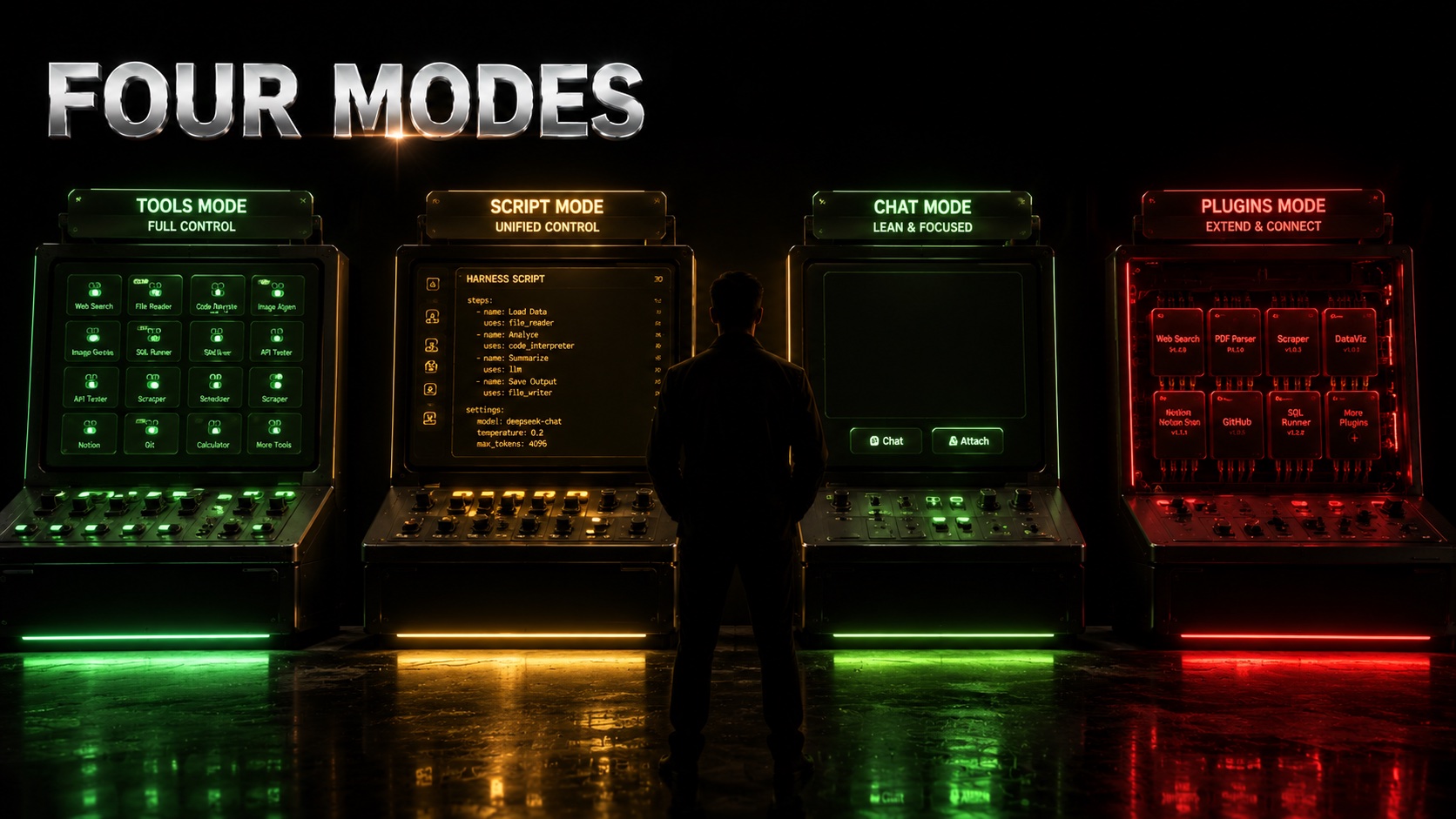
A mode is essentially a tool budget. More tools means more capability and more tokens spent describing them.
| Mode | What it gives the model | Use it for |
|---|---|---|
| Standard | Full agent: file editing, shell, file and web search, skills, planning, goals, subagents, workflows | Everyday repository work |
| Code | Same tools, exposed through a Code Mode SDK so the model writes one TypeScript program instead of many separate calls | Multi-step operations that should happen atomically |
| Minimal | Two tools only: a persistent bash shell and strreplaceeditor | Benchmarking a model with minimal scaffolding |
| Creator | Runtime inspection, in-memory Cordis plugin testing, preset authoring | Building your own modes |
Most people will live in Standard. Code mode is the interesting one commercially, because collapsing six tool calls into one script means fewer round trips, and every round trip resends your context.
Minimal mode explains something about why this project exists at all. It is a clean-room harness for benchmarking models without scaffolding advantages, which is exactly what a lab needs when it wants to publish comparable numbers.
4. What It Costs to Run
Here is the part the launch coverage buried. DeepSeek is raising V4-Pro API prices with effect from 16 August 2026 at 16:00 UTC, which is 17 August at midnight Singapore time. It is also splitting billing into peak and off-peak windows for the first time. Peak hours are 01:00 to 04:00 and 06:00 to 10:00 UTC, which in Singapore is 09:00 to 12:00 and 14:00 to 18:00, in other words most of the local working day.
The rate card
All figures are US dollars per one million tokens.
| V4-Pro rate | Until 16 Aug 2026 | New off-peak | New peak |
|---|---|---|---|
| Input, cache hit | $0.003625 | $0.022 | $0.044 |
| Input, cache miss | $0.435 | $0.66 | $1.32 |
| Output | $0.87 | $1.98 | $3.96 |
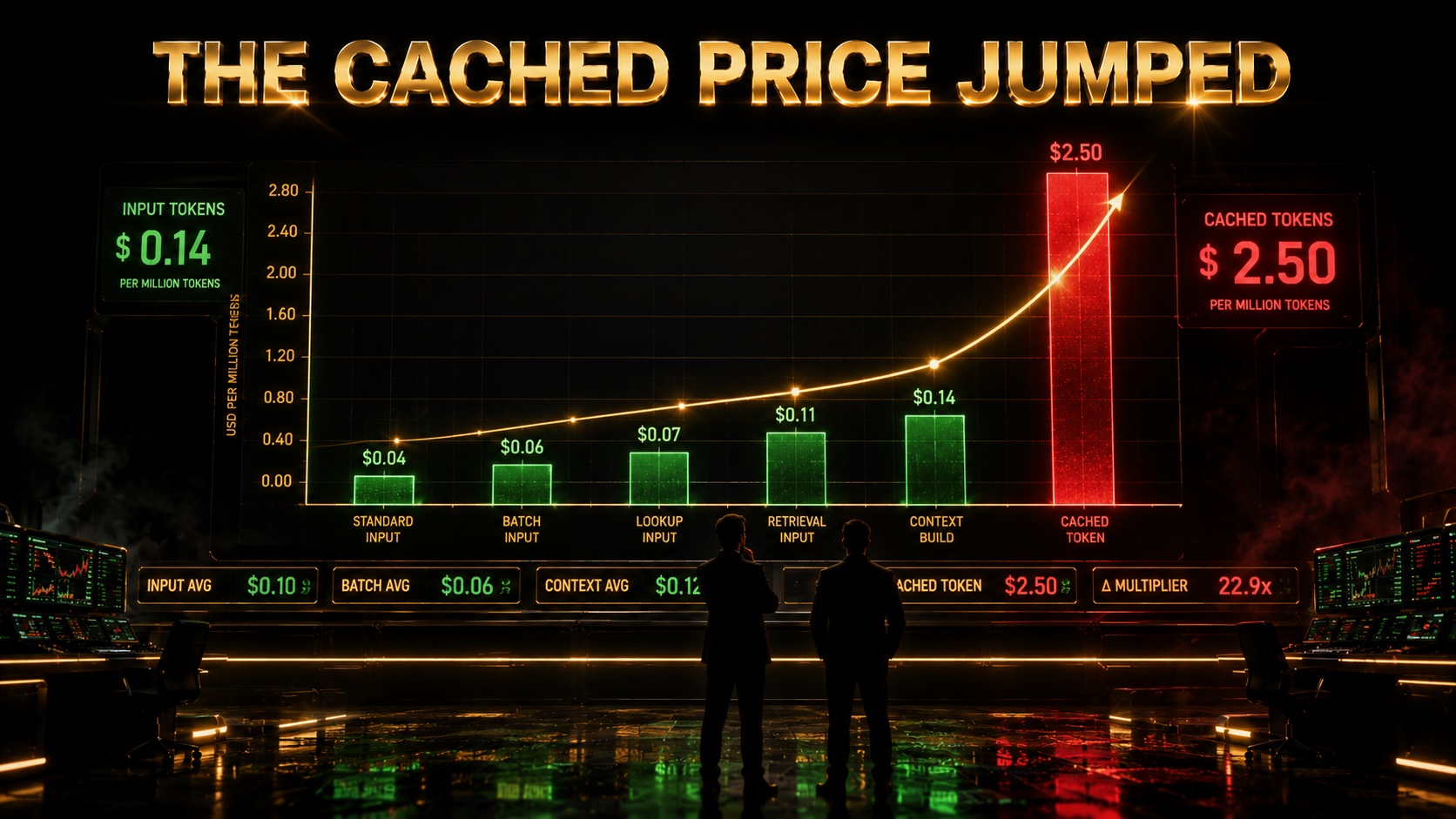
Look at the top row. Cached input rises about 6 times off-peak and about 12 times at peak. That is the increase behind the reported headline of rates rising by as much as 1,100 percent, and it lands precisely where a coding agent lives.
Agents are cache-heavy by design. Every turn resends a large, stable prefix: your system prompt, the file tree, the open files, the conversation so far. That prefix was billed at the cheap cache-hit rate, which is exactly why agent workloads looked so inexpensive on DeepSeek. The cheap path is the one getting dearer.
A worked example
Assume a moderately busy day: 100 agent turns, each resending a 50,000 token cached prefix, adding 2,000 new input tokens, and generating 1,000 output tokens. That is 5 million cached tokens, 0.2 million uncached, and 0.1 million output per day.
| Scenario | Per day | Per month, 22 working days |
|---|---|---|
| Old rate | $0.19 | $4.23 |
| New off-peak | $0.44 | $9.68 |
| New peak | $0.88 | $19.36 |
So roughly 2.3 times the old bill off-peak, and 4.6 times at peak. These are illustrative figures built on stated assumptions, not projections, and your own usage will differ. Change the turn count or the prefix size and everything scales with it.
The honest read: this is still cheap in absolute terms. Under $20 a month for heavy daily use is not what breaks anyone. But if you built a business case on the old DeepSeek rates, or you are running many agents in parallel, recheck the arithmetic rather than assuming the old numbers hold.
5. The Escape Hatch: You Do Not Have to Pay DeepSeek
Because models are plugins, dsh is not tied to DeepSeek’s own API. This is the single most underrated fact about the release.
You can point it at any OpenAI-compatible endpoint by setting a base URL, which covers Ollama, vLLM and LM Studio. Ollama publishes its own integration guide for DeepSeek Harness, and exposes an OpenAI-compatible endpoint locally. The web UI also offers an “Add a custom provider” path where you supply a provider ID, base URL, protocol, credential and at least one model.
Run a local model and your marginal token cost is zero. The trade is real, though: local models are meaningfully weaker at long agent loops, you need the hardware, and electricity is not free. Treat local hosting as a way to cap costs on routine work rather than a free replacement for a frontier model.
6. Can You Actually Earn Anything With This?
For most readers of this site, honestly: not directly. dsh is a developer tool, and the people who profit from it are people already being paid to write or maintain software.
Where it does convert into money:
- Billable time recovered. A freelance developer who saves 3 hours a week at a $40 hourly rate recovers about $480 a month against a token bill in the tens of dollars. That maths works, but only if you were already selling those hours.
- Internal automation. Small teams using Code mode for repetitive migrations and refactors, where atomic multi-step scripts beat manual work.
- Building and selling plugins. The plugin architecture invites an ecosystem. Whether it becomes a paying one is unproven and worth no assumptions today.
Where it does not: there is no route here for a non-developer to earn from dsh on its own. It assumes you can read code, run a terminal, and judge whether the agent’s output is correct. Without that last skill in particular, an agent framework produces work you cannot evaluate, which is a liability rather than an asset.
Realistic ramp: a working developer should expect a few days to get productive and a few weeks to build reliable presets. Someone learning to code should not start here.
7. Limitations and Failure Modes
The project says so itself, in capitals in its own README: there will be compatibility-breaking changes. Some specifics worth weighing:
- Preview status. APIs and configuration schemas will change between releases. Anything you build on it now may need rework.
- Assembly required. “Everything is a plugin” is another way of saying fewer decisions are made for you. Compared with a finished agent, expect setup time.
- Thin documentation. The README is high level, and provider configuration lives across separate guides and community write-ups rather than in one authoritative page.
- Cost drift. Peak and off-peak billing is new for DeepSeek. A job scheduled without regard to the clock can silently cost double.
- The usual agent risk. Standard mode has shell access. An agent with a shell can do real damage to a real repository, which is why the sandbox plugin and the Trajectory replay view matter rather than being nice extras.
8. What to Do This Week
If you write code and are curious, the first concrete step costs nothing:
“ npx @deepseek-ai/dsh web “
That starts the web UI at http://127.0.0.1:3080 without installing anything permanently. Point it at a local Ollama model first, so you can learn the interface at zero token cost, and try Minimal mode before Standard to see the machinery without the noise.
Then, before you connect a paid API key, set a spending cap and check the clock. If your work can shift outside 09:00 to 12:00 and 14:00 to 18:00 Singapore time, you are paying half. That single scheduling decision is worth more than any prompt trick.
The realistic result of taking that step: an evening of setup, a working local agent, and enough understanding to decide whether the paid model is worth it for you. Not a transformed workflow by Friday.
FAQ
Is DeepSeek Harness free?
Yes. The harness itself is open source under the MIT licence and costs nothing to download or run. What costs money is the model you connect to it, so if you point dsh at a local model through Ollama your only expense is your own hardware and electricity.
How is DeepSeek Harness different from Claude Code?
Claude Code and OpenAI Codex are finished coding agents that work out of the box. DeepSeek Harness is a framework for assembling your own agent, where models, tools, sandboxes and even the interface are plugins you choose. That means more flexibility and more setup work.
Did DeepSeek raise its API prices?
Yes. New V4-Pro rates take effect on 16 August 2026 at 16:00 UTC, along with a new peak and off-peak split. Cached input tokens saw the steepest rise, going from $0.003625 to $0.022 off-peak and $0.044 at peak per million tokens.
Can I use DeepSeek Harness without a DeepSeek API key?
Yes. Models are plugins, so you can point dsh at any OpenAI-compatible endpoint, including Ollama, vLLM and LM Studio running on your own machine. Ollama publishes a dedicated integration guide for it.
What are the four execution modes for?
Standard is the full coding agent, Code exposes tools through a TypeScript SDK so the model can chain steps in one program, Minimal strips things back to a shell and a file editor for benchmarking, and Creator lets you inspect the runtime and build your own presets.
Is it safe to use on a real project?
Treat it carefully. It is a developer preview with breaking changes expected, and Standard mode gives the model shell access. Use its sandbox plugin, work on a branch you can discard, and rely on the Trajectory replay view to audit what the agent actually did.
⚠️ Disclaimer: The content on OneMoreMoney.com is for informational and educational purposes only and does not constitute financial, investment, or trading advice. Always conduct your own research and consult a licensed financial advisor before making any investment decisions. Past performance is not indicative of future results.